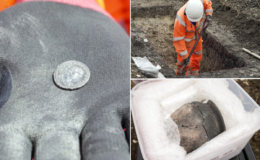
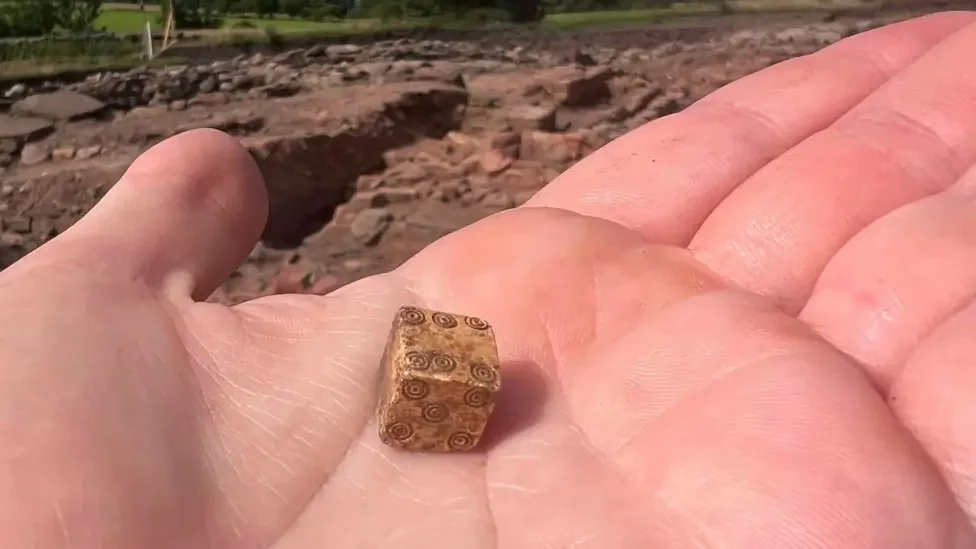

Archaeologists have unearthed a remarkably well-preserved die while digging at an ancient Roman site in a first-of-its-kind discovery.
The small object, crafted from bone, was found at Magna Roman Fort in Northumberland.
Read Also: Archaeologists discover 3,000-year-old tomb next to Ancient Egyptian necropolis
It was uncovered next to the furnaces of the praetorium bathhouse during what are known as Period 8 excavations at the fort.
Dating back nearly two millennia, the die provides a tangible link to the leisure pursuits of those stationed along Hadrian’s Wall.
Sonya Galloway of The Vindolanda Trust, which manages the site, said: “Holding something so familiar, yet so ancient, really brings that human story of Magna to life.”
The discovery has been hailed as offering a remarkably personal glimpse into Roman daily life at the frontier garrison.
Sue Mingay, the excavator who made the discovery, described herself as “over the moon” upon realising what she had found.
She said: “When I saw it, and the shape of it, I hoped it would be a die.

Ms Mingay added: “When I looked more closely, I was over the moon to see how delicate the markings were.”
The dig at Magna forms part of a broader five-year programme of excavations supported by the National Lottery Heritage Fund.
Previous work at the site has already yielded significant finds.
These include fourth-century paving stones, a copper alloy Roman belt buckle, a spearhead, and the remains of a Hadrianic hypocaust system, an underfloor heating mechanism once used in the commander’s private bathhouse.
LATEST DEVELOPMENTS:
- Lost 17th century garden revealed after Britain’s record-breaking heatwave
- Archaeology breakthrough as back-to-back heatwaves expose breathtaking lost sites across Wales
- Archaeologists uncover stunning Pompeii fresco in ancient banquet hall depicting famous Greek myth

Ms Galloway, who serves as communications manager for The Vindolanda Trust, noted that the find had generated considerable excitement online.
She said: “It’s easy to see why this little bone die has captured so many people’s imaginations.
“It is a wonderfully relatable object, almost everyone will have rolled a die while playing a game, so there’s an immediate connection to the people who lived at Magna nearly 2,000 years ago.”
The universal familiarity of dice games, she suggested, is precisely what makes the artefact resonate so strongly with the public.

Ms Galloway added: “Now we need to find the game board!”
Games involving dice were incredibly popular and widely used during Roman times.
They were a fundamental part of daily leisure, socialising, and gambling across all social classes, from ordinary citizens and soldiers to elite emperors.
They have been discovered at taverns, military forts, and public bathhouses.
Our Standards: The GB News Editorial Charter