
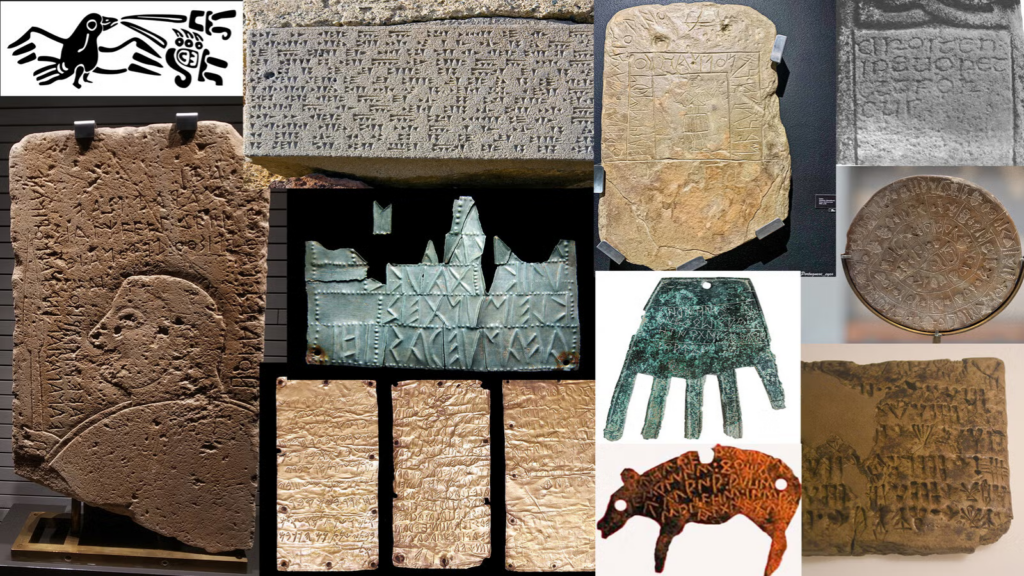

The world experienced a linguistic “golden age” several millennia ago when tens of thousands of languages were in use across the globe, before an age of empire wiped out communities and traditions.
New research published in the journal Science saw an international team of linguists, demographers, and evolutionary biologists trace the trajectory of global language diversity over the past 12,000 years.
Read Also: Archaeologists discover 3,000-year-old tomb next to Ancient Egyptian necropolis
The study revealed the dramatic decline in the number of languages spoken began not with European colonialism around 500 years ago as widely assumed, but rather centuries earlier.
The study found the emergence of large states and multinational empires, including the Roman Empire, triggered a steep drop in linguistic diversity – with colonial expansion only later accelerating the process.
Since no written records of languages exist from before the invention of writing some 6,000 years ago, the researchers turned to a combination of ethnographic evidence, prehistoric population estimates, and statistical and social modelling.
Their aim was to reconstruct linguistic diversity throughout the Holocene, the geological period spanning the last 12,000 years.
To estimate how populations were distributed and sized before farming began, the team drew on ethnographic data from 171 hunter-gatherer and fisher societies that had not been altered by contact with agricultural communities.
They cross-referenced this with independent analyses placing the global population 12,000 years ago at between roughly 4.4 and seven million people.

Based on these figures, their models suggested between 4,500 and 6,200 languages were spoken at the start of the Holocene.
The researchers modelled thousands of potential pathways linking early Holocene language estimates to the present day.
They accounted for population growth driven by agriculture and technological advances, as well as contractions caused by conflict, disease, and environmental pressures.
These models consistently pointed to a peak in linguistic diversity between one and three millennia ago.
LATEST DEVELOPMENTS
- Museum jobsworths threaten Italian takeaway for using Michelangelo’s David to sell ice cream
- Archaeologists find ‘amazing’ Roman coin revealing Britain’s breakaway emperor
- Historic 200-year-old bridge set to reopen after £12m restoration for first time in seven years
Lead author Damián Blasi, a research professor at Pompeu Fabra University in Barcelona, said: “The world immediately before agriculture was probably not exceptionally rich in languages.
“There were most likely fewer languages than there are today. Linguistic diversity then grew alongside the human population for thousands of years.”
As states and empires rose to dominance, they imposed their own languages and cultures on previously independent populations, bringing the golden age to an end.
The near 7,600 languages currently spoken or signed around the world amount to a narrow and historically skewed fraction of those that once existed, the researchers concluded.

The study exposed significant consequences for how scholars understand global linguistic and cultural patterns.
Co-author Russell Gray, who heads the Department of Linguistic and Cultural Evolution at the Max Planck Institute for Evolutionary Anthropology in Leipzig, said: “The languages we see today are the survivors of a massive and highly selective historical bottleneck.
“A linguistic feature may be common not because it is inherently efficient or better for communication, but because it happened to be carried by populations that expanded.”
Yale linguist Claire Bowern, another co-author, added: “Political currents don’t have to move in one direction. It’s not inevitable that endangered languages become extinct.”
Our Standards:
The GB News Editorial Charter