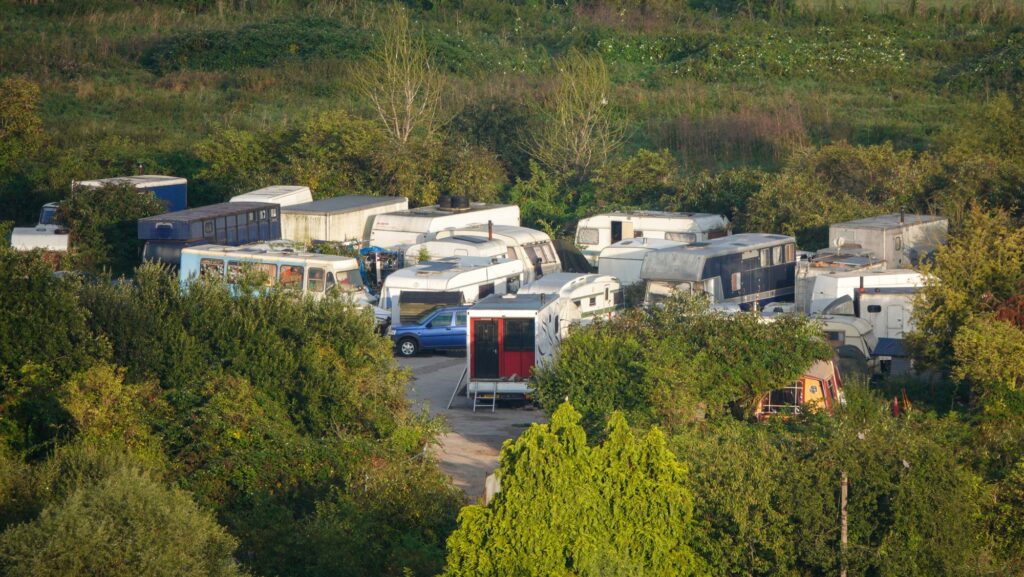

Unauthorised traveller sites are on the rise across the UK leaving local residents in dismay over the “military-like operations”.
Unauthorised traveller caravans across England have surged by 73 per cent since January 2020, reaching 4,950 as of this January, up from 2,860 six years earlier.
Read Also: Travellers win long-running planning row after pitching up on picturesque rural site
Summer figures paint a similar picture, with a 44 per cent jump recorded between July 2019 and July 2025, climbing from 3,113 to 4,471.
Much of the development takes place over Bank Holiday weekends, when council offices are shut and enforcement action cannot be swiftly mounted.
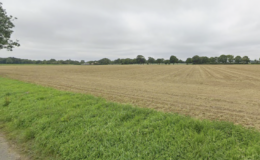
Since April, land in Hertfordshire, Essex, Cambridgeshire, Bedfordshire and other parts of England has been rapidly converted into sites, sparking legal disputes and anger among neighbouring residents.
Locals near one newly established site described its swift construction as resembling a “military operation.”
A senior councillor in one of the affected areas has warned of a “loss of control” within the planning system, as authorities struggle to keep pace with the scale of unlawful development.
Cliff Codona, founder and chair of the National Travellers’ Action Group, argues the planning regime acts as a “big dagger in their back” for travellers, forcing them to “break the law” simply to secure somewhere to live.

Mr Codona himself arrived at his family’s current site near Wisbech, Cambridgeshire, in 2020 without permission.
“We pulled down on a Friday evening when we knew the council was all closed up and we just took it for granted that this is how things get done,” he told the BBC.
He contends that planning applications are “stopped dead in its tracks” the moment an applicant is identified as a traveller.
His family subsequently submitted a “part-retrospective” application, which a planning committee granted despite objections from the parish council that the location was unsustainable.
Mr Codona, who says he has been evicted 50 times during his life, describes the experience as “horrific” and like enduring “hell and back”.
LATEST DEVELOPMENTS:
- Travellers flee leafy English village after police called over ‘tense stand-off’ with locals
- Travellers concrete over ENTIRE field in illegal land grab as ‘locals outnumbered’ by caravan invaders
- Travellers pitch up on land next to working men’s club in family neighbourhood
The broader traveller caravan count across England rose 21 per cent over the same period, from 23,636 in July 2019 to 28,659 by July 2025, but the proportion lacking planning consent grew at a far steeper rate.
Mr Codona, who has Gypsy and travelling showman heritage, attributes the increase partly to a growing population — he himself has 14 grandchildren and a great-grandchild.
He also describes how travellers have historically resorted to “covert” methods to purchase land, disguising their identity at auctions.
“We would have to put a raincoat on, sunglasses or whatever, slide ourselves into an auction [and] wait for the property to come up for sale,” he says.
The shift to digital property sales has made the process easier. Mr Codona calls online auctions “even better… fantastic” for travellers seeking to acquire plots without facing the discrimination he says they encounter in person.

Basildon in Essex recorded more unauthorised caravans than any other local authority area in England during last summer’s count, with numbers soaring 164 per cent between July 2019 and July 2025.
Although the borough’s winter tally dipped year-on-year between 2025 and 2026, it remained 14 per cent above the January 2020 baseline.
Conservative cabinet member George Jeffery believes insufficient enforcement has left the council looking like a “soft touch”.
The area is no stranger to confrontation over illegal sites. Around 15 years ago, 80 families were forcibly removed from the Dale Farm encampment in an operation that drew national attention.
Mr Jeffery has not ruled out once again drawing on “police resources to keep the peace” if necessary.
“Basildon should be robust and tackle it head on and not be afraid to use the full extent of the powers available to it,” he says, pointing to a long-standing breach at a site on Newlands Road, Wickford.
The Government has described unauthorised development as “totally unacceptable,” insisting that local authorities possess “strong powers” to address it.
Yet the gap between official rhetoric and reality on the ground appears to be widening, with the senior councillor’s warning of a “loss of control” reflecting growing frustration among local officials who feel outpaced by the speed at which sites are established.
Mr Jeffery stresses he is opposed to all unauthorised building and does not wish to single out any particular community.
For Mr Codona, however, the issue remains deeply personal. “We’ve broke the law — I’ll admit to you here today — I’ve done everything… to live on land and get permission to be there,” he says.
Our Standards: The GB News Editorial Charter