
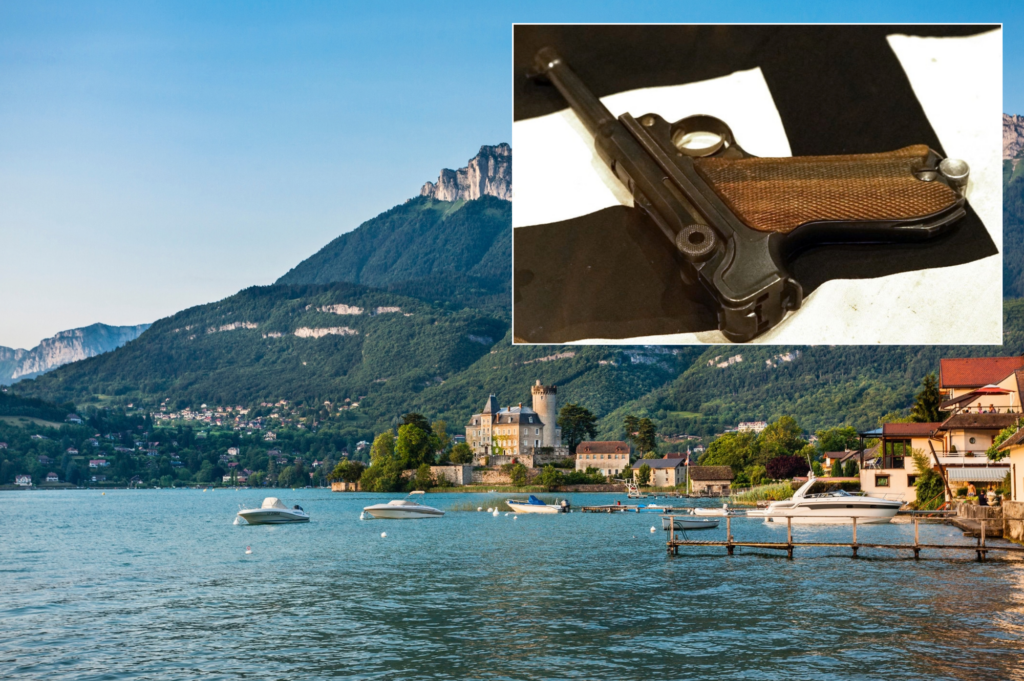

A British father of two has potentially uncovered a crucial piece of evidence in one of Europe’s most perplexing unsolved murders after pulling a heavily corroded Luger pistol from the bottom of Lake Annecy in the French Alps.
Kyle, 41, a construction worker from Wiltshire who has asked not to be fully identified, spotted the weapon’s handle protruding from the sandy lakebed while snorkelling more than 50 yards offshore during a family camping trip last month.
Read Also: Israeli minister sparks fresh Falklands row over Andy Burnham sanctions – 'It's time!'
Forensic scientists are now working to establish whether the antique handgun is the same weapon used in the Chevaline massacre of September 2012, when three members of a British-Iraqi family and a French cyclist were gunned down on a remote mountain road near the lake.
The victims of that brutal attack were Saad al-Hilli, 50, his 47-year-old wife Iqbal, and her mother Suhaila al-Allaf, 74, all discovered alongside French cyclist Sylvain Mollier, 45, beside a bullet-riddled BMW in a wooded lay-by close to the village of Chevaline.
Read Also: Tiger Woods makes first public appearance since ban from driving
Read Also: Ex-Wimbledon champion leaves US Open court in floods of tears after suffering major upset
The al-Hilli family had travelled from their home in Claygate, Surrey, and had been staying at the Le Solitaire du Lac campsite in St Jorioz before the shootings.
Their two young daughters survived the atrocity.
Zeena, who was four at the time, concealed herself in the car’s footwell next to the bodies of her mother and grandmother, while seven-year-old Zainab was shot and beaten but pulled through.
On August 20, Kyle was accompanying his two sons, aged ten and five, on a lake outing when he and a fellow British holidaymaker, a semi-retired teacher in his sixties, decided to go snorkelling.

After about 10 minutes in chin-deep water, he noticed what appeared to be a pistol grip beneath the sand.
He told the Mail: “I dived down again, grabbed the grip and as soon as I started lifting it I could tell it was a metal object, it was extremely heavy. I thought: ‘that’s a bloody Luger.'”
Initially unaware of the Chevaline killings, Kyle wrapped the weapon in a magazine and spent the night researching the case online.
The following day, he and his companion cycled to the local Gendarmerie in St Jorioz, only to find it shut for lunch.
LATEST DEVELOPMENTS

After eventually flagging down a patrol car, a forensic team arrived at the campsite that afternoon, sealing the gun in evidence bags.
French prosecutors have previously said that the Chevaline killer used a 7.65mm Luger P06, a model issued to Swiss military and police forces during the 1920s and 1930s.
Marie-Céline Lawrysz, the deputy prosecutor overseeing the investigation, has confirmed the recovered weapon “appears to be a P06”.
However, a former Metropolitan Police ballistics expert with over two decades’ experience has disputed this assessment, arguing the gun looks more like a larger-calibre 9mm Luger P08.
He noted the absence of a grip safety lever characteristic of the P06 model.
A source close to the inquiry has cautioned that analysing the weapon is “extremely complex” given its prolonged submersion.
Kyle, who returned to Wiltshire on August 29, expressed hope the discovery might bring resolution for the surviving al-Hilli sisters.
He said: “Hopefully it helps close a horrific chapter of their lives.”
Our Standards: The GB News Editorial Charter