
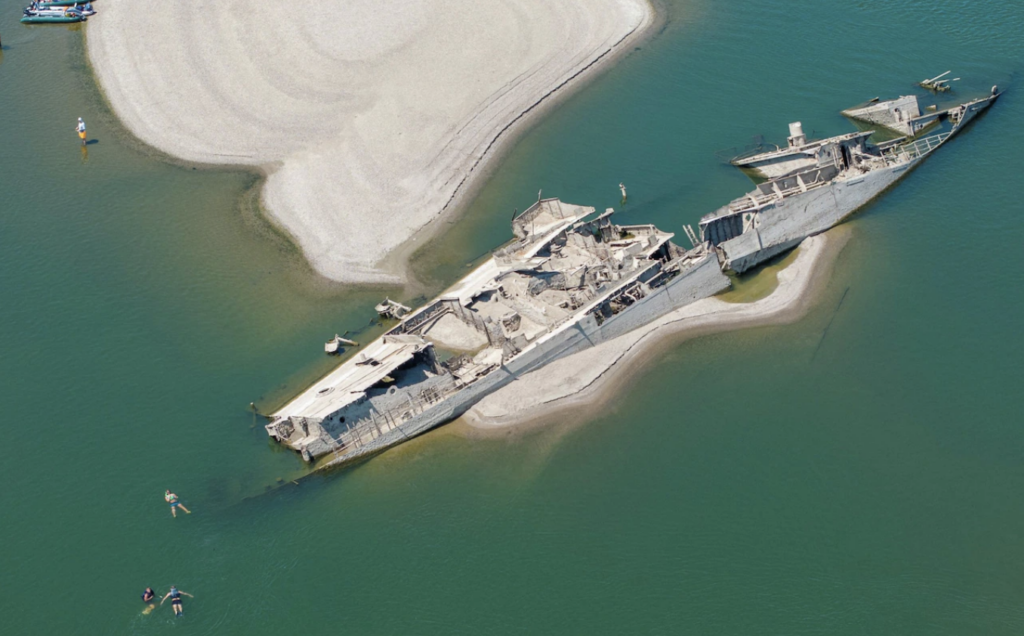

A sunken Nazi warship has resurfaced as hot weather continues to cause a huge dip in water levels across the world.
The Second World War vessel became visible along the Danube on the riverbed near Prahovo in eastern Serbia as a severe heatwave gripped much of Europe, causing the continent’s second-largest river to drop dramatically.
The ship is thought to have been deliberately sunk by retreating German forces during the closing stages of the war as they attempted to escape the advancing Soviet Red Army.
It is one of numerous Kriegsmarine wrecks that have become exposed across stretches of the Danube in recent years as water levels have continued to fall.
Read Also: Urgent probe launched after Southport attack victims' files accessed in major data breach
Read Also: Briton saves five bears from cages in South Korean camp in extraordinary rescue mission
According to the European Investment Bank, approximately 200 vessels remain scattered along the bottom of the waterway, ranging from wrecked cargo ships to tugs and barges.
Many of the sunken craft still feature gun turrets, command bridges, snapped masts and mangled hulls, although some are largely buried beneath sandbanks.

The wreckage and efforts to clear it have been costing Serbia an estimated €5million (£4.3million) each year in delays to commercial shipping traffic.
To address the problem, the European Investment Bank has pledged €16million (£15million) towards clearing the obstructions, forming part of a broader investment programme targeting the western Balkans.
LATEST DEVELOPMENTS
- Italy suspends Schengen free-travel deal with Spain after ‘migrant invasion’ in Ceuta
- US map of Africa mislabels every country ‘due to artificial intelligence’ in hilarious blunder
- British tourists told to prepare ‘evacuation grab bags’ amid wildfires raging through Europe

Separately, the dropping water levels yielded a remarkable prehistoric find further upstream in Bulgaria.
Near the northeastern city of Ruse, researchers uncovered the remains of a woolly mammoth in the Danube riverbed.
Among the bones recovered were a jawbone, tusks, a shoulder blade and a femur still bearing its rounded head.
Scientists believe the creature was relatively young at the time of its death.
The notably dark colouration of the skeletal remains has led researchers to suggest the animal may have inhabited a marshy habitat for a prolonged period during its lifetime.
Our Standards: The GB News Editorial Charter