
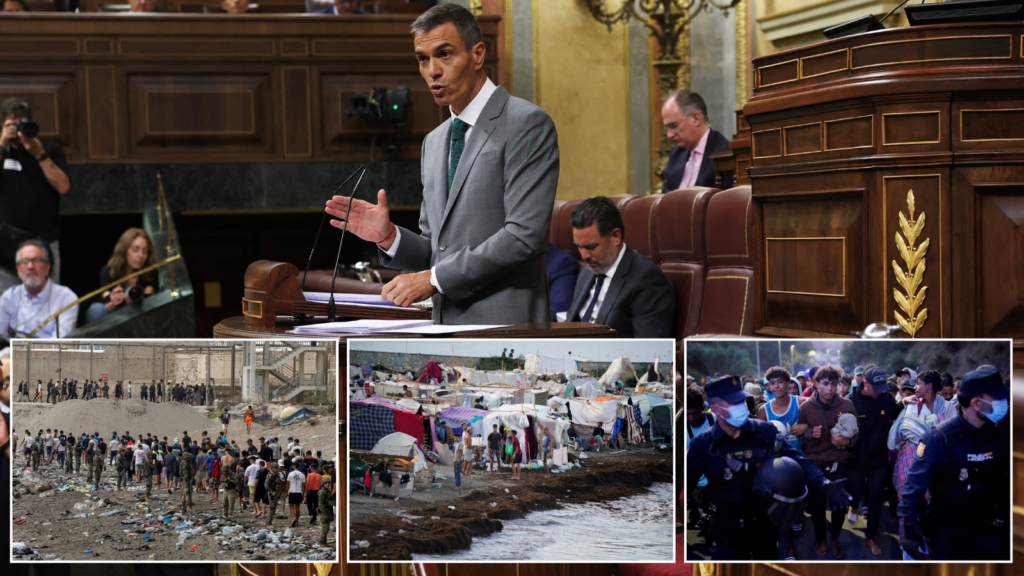

Spain is preparing to house up to 10,000 migrants in Ceuta after admitting the crisis may last for months.
Pedro Sánchez, the Spanish Prime Minister, has begun preparations to house 10,000 people as he denied his Government’s botched response to the migrant influx in July.
“I would not say it was mishandled,” he said in an interview with the left-leaning TV show El Intermedio, referring to how 80,000 migrants entered the Spanish enclave from Morocco on July 30 and 31.
He continued: “What happened is that we could not cope with the influx.
Read Also: Earl Charles Spencer's new book on Princess Diana stolen in Dutch lorry raid
“What we did was absorb those people and then return them to Morocco. The proof is that nine out of ten went back.”
Mr Sánchez said 6,000 people would be provided with accommodation by the end of this week, eventually reaching 10,000.
“We hope to have stabilised the situation by the end of the year,” he said as he asked Ceutans for patience.
Ceuta has a population of roughly 84,000.

Shortly after the crisis, Spain’s Prime Minister spent 25 days on holiday in August but said he continued to work while he was away.
His chief of staff also went on holiday in Japan that month, ABC News reported, which has not been denied by Mr Sánchez’s office.
The Spanish Government initially stated it had no warning of the migrant crisis in Ceuta, with the local delegation in the enclave echoing this on August 25.
However, this position changed on September 9, when the Spanish Government released a previously classified National Intelligence Centre (CNI) communications warning on July 29 of organised attempts to enter Ceuta by land and sea.
LATEST DEVELOPMENTS
- Spain to hand hundreds of thousands of Africans citizenship in ‘historic reparation’
- Spain’s Socialist PM branded ‘traitor’ over Ceuta migrant crisis in fiery parliamentary stunt
- Spanish intelligence warned of Ceuta invasion despite PM’s claim migrant flood was ‘unexpected’

One of the 40 communications detailed a call on social media for an assault the following evening.
The Moroccan intelligence agencies were also warned by the CNI.
On the communications, Mr Sánchez said the WhatsApp messages were “not proof” there was an alert.
However, Spain’s Prime Minister insisted intelligence is packaged as a report by analysts and shared with senior officials.
He said the Spanish and Moroccan authorities were monitoring the situation, but not on the scale or with the mobilisation seen on July 30 and 31.
The Spanish Prime Minister defended Morocco’s response, despite 141 migrants dying during the crisis.
He said: “For ten hours, what we saw from the Moroccan authorities was not so much a passive attitude — they also alerted us to the arrival of those migrants — as a decision to try to manage the influx intelligently, in other words, to cause the migrants as little harm as possible.”
Emphasising continued cooperation between the two countries, he said there was no evidence that Rabat was behind the mass crossings.
Mr Sánchez’s interview aired at the same time as Juan Jesús Vivas, Ceuta’s president, spoke to El Hormiguero, a rival TV programme to El Intermedio.
Mr Vivas said he made a string of appeals to the Spanish Government in the days before the influx of migrants, which wreaked havoc in the small north African enclave.
He said these appeals, if heard, could have prevented the mass incursion with greater preparation.
Mr Vivas said Spain’s Government failed to act despite warnings from the CNI, saying there were around 13,000 migrants still in the city.
The Spanish Prime Minister had not been in touch since July 31, Mr Vivas also said, when he visited Ceuta.
Our Standards:
The GB News Editorial Charter