
The Spanish Government has finally apologised to Ceuta for last month’s migrant invasion.
Spain now plans to reform migration and asylum laws as a senior minister issued the apology to a parliamentary committee.
Read Also: Travellers win long-running planning row after pitching up on picturesque rural site
Defence Minister Margarita Robles said: “I want to apologise to all those who may have felt, or who even still feel, abandoned or not sufficiently cared for.
“I have witnessed first-hand your feelings of anxiety, of abandonment, of lack of safety.”
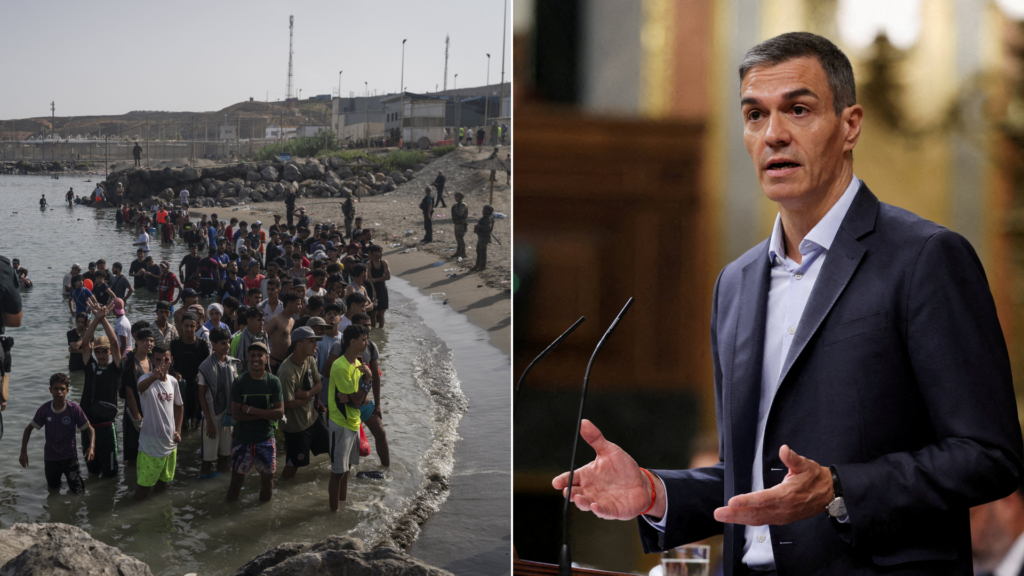
More than 70,000 illegal migrants flooded into Ceuta from Morocco at the end of July and in early August.
Most of the migrants entered the Spanish exclave in north Africa by swimming after a judge changed rules around deportation in Ceuta.
The exclave’s mayor Juan Jesus Vivas said at least 100 people had died during the mass crossing.
While the Spanish military was deployed to return most of the illegal migrants back to Morocco, thousands are still in Ceuta, sleeping rough on the streets or beaches.
Sex crimes, including assault and harassment, have spiked since the illegal crossings – eight times higher than expected in the exclave.

The Spanish Government has now declared a situation of interest for national security in the city, taking central control of the crisis.
Coinciding with the Defence Minister’s parliamentary appearance was a slate of migration reforms to ensure Spain was in alignment with the EU.
Interior Minister Fernando Grande-Marlaska said the changes would include limiting the amount of time it takes an illegal migrant to undergo medical, biometric and legal evaluations to just three days after their arrival.
The reforms will also create a system for processing urgent asylum requests, in theory accelerating cases which are “urgent”.
Prime Minister Pedro Sanchez has blamed traffickers for the invasion, claiming they used a “self-serving interpretation” of the judge’s ruling which “spread like wildfire” on social media.
LATEST ON THE SPANISH MIGRATION CRISIS:
- Spanish holiday hotspots rocked by earthquake leaving dozens injured
- EU civil war explodes as Italian foreign minister blasts ‘disproportionate’ response to crisis
- Gibraltar now ‘at risk of African invasion’ as second migrant flood threatens Spain

And Mr Grande-Marlaska said there was “no report” that indicated “what eventually happened was going to happen”.
But those claims were challenged by Esther Munoz of the leading opposition party People’s Party (PP) in Spain’s parliament.
She said: “The crisis in Ceuta didn’t begin on July 30. It’s been brewing for years and you know it, because you know that [the Moroccan authorities] have spent years testing us, testing our ability to respond and our willingness to do so.”
And she warned of a possible “pull factor” if Spanish authorities dish out care for Moroccan minors.
Mr Sanchez, has, however, previously shot down the idea of “pull-factors”, claiming that migration accounts for 80 per cent of the country’s growth.

He has also granted amnesty to millions of illegal migrants, allowing them to be given permanent residency – and has spent years claiming the country needs migration.
“Those who propose a Spain closed in on itself are offering a Spain that will not be prosperous, that will be poor and that, without a doubt, will not have sufficient resources to sustain its welfare state,” he said in January.
Defending his amnesty policy, he claimed that “without immigration, Spain would lose 19 per cent of its GDP by 2050”.
“The fact that more than a million people applied shows just how necessary this measure was,” he added.
Mr Sanchez also said that when it comes to migrants, was “the only decent thing to do is extend a hand, not turn our backs on immigration”.
Our Standards:
The GB News Editorial Charter