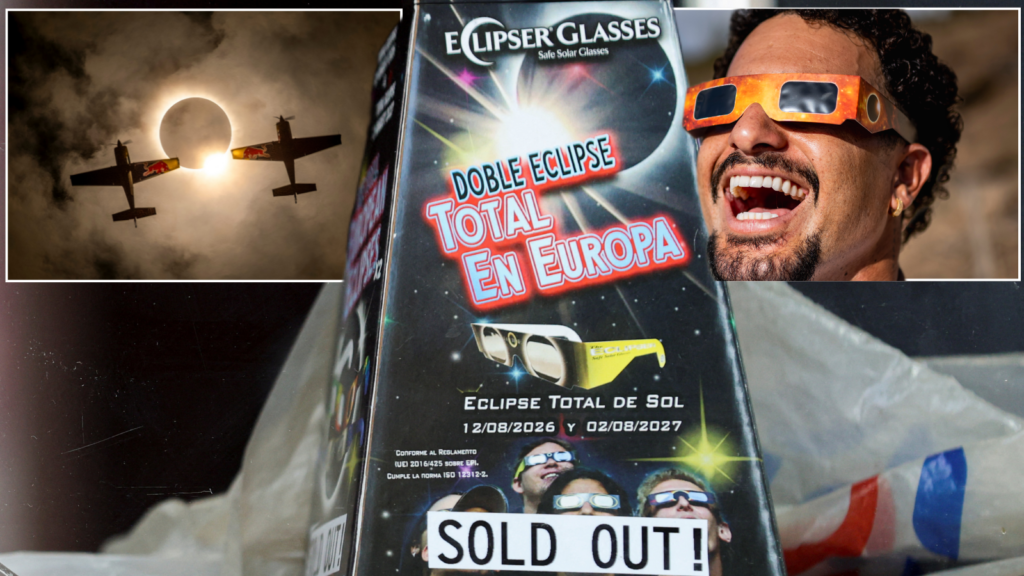

Solar eclipse glasses have sold out a day before the biggest celestial spectacle in 27 years.
Specialist eclipse eyewear has virtually disappeared from online retailers and high street shops.
Read Also: Travellers win long-running planning row after pitching up on picturesque rural site
This has triggered a frantic last-minute hunt and urgent warnings from eye health professionals not to resort to uncertified knock-offs or standard sunglasses, which offer nowhere near sufficient protection against harmful solar radiation.
Britain is set to witness its most dramatic solar eclipse in more than a quarter of a century on Wednesday evening.
The moon will block upwards of 90 per cent of the sun across much of the country.
The event will be the deepest partial eclipse visible from these shores since the famous total eclipse of August 1999, when the path of totality swept across Cornwall.
Yet as clear skies are forecast for the spectacle, thousands of would-be watchers face a rather more earthbound problem: finding a safe pair of glasses to view it through.
On Amazon, a five-pack of Lunt Solar Systems glasses, the platform’s recommended listing, was available on Monday for £26.26, but the soonest delivery slot was Friday, two days after the eclipse.

Harrison Maddox, a 27-year-old architectural assistant and keen amateur astronomer from West Kensington, spent hours trawling central London on Monday after striking out online, the Times reports.
He visited more than 15 locations, among them the Science Museum and numerous opticians, before eventually tracking down a £6 pair at the Fresh Bakes bakery on Bond Street.
He said: “I was following leads on a WhatsApp group, but everywhere I tried had sold out and told me I was about the tenth person today to ask.”
The shortage extends well beyond Britain.
LATEST DEVELOPMENTS:
- Britain set for stunning night with meteor shower to coincide with biggest solar eclipse since 1999
- When and where to watch spectacular solar eclipse across Britain this week
- Dramatic aftermath of 5,400mph SpaceX Moon crash revealed for very first time

French pharmacies, opticians and supermarkets have reported similar stock problems, with the optical chain Optic 2000 alone shifting more than 160,000 pairs by the weekend, Le Monde reports.
The eclipse is due to get underway at roughly 6pm, reaching its maximum at approximately 7.10pm, though exact timings will shift depending on location.
Cornwall will see the greatest obscuration, with between 95 and 96 per cent of the sun’s disc hidden.
Cardiff and Belfast can expect around 93 per cent coverage, London roughly 90 per cent, and Shetland about 88 per cent.
Full darkness will not descend with the thin remaining crescent will still cast considerable daylight.
Instead, observers should notice a strange, muted quality to the light, with shadows appearing unusually crisp.
Temperatures may also dip noticeably at the peak.
As the event falls in the evening, the sun will sit low on the horizon, less than 15 degrees up, so anyone hoping to watch will need a vantage point with a clear, unobstructed view to the west.
Eye specialists have urged the public to ensure any glasses they use meet the ISO 12312-2 safety standard and to avoid uncertified alternatives entirely.
Mohamed Elalfy, consultant ophthalmologist and president of the Royal College of Ophthalmologists, said: “The safest way to enjoy the eclipse is to observe it indirectly, such as by watching a live broadcast.”
“Looking directly at the sun during a solar eclipse can cause damage to the retina, potentially damaging the cells responsible for sharp central vision. Crucially, the retina has no pain receptors, so people will not feel the damage as it happens,” he added.
Blurred or distorted vision, a central dark spot and diminished colour perception can develop hours afterwards.
While some patients recover over weeks or months, others sustain lasting harm.
Following the 1999 total eclipse, 70 cases of vision problems were recorded.
Our Standards:
The GB News Editorial Charter