
Slavery reparations campaigners are pushing the British Museum to hand back Caribbean artefacts as Jamaica steps up its demands for redress from Britain.
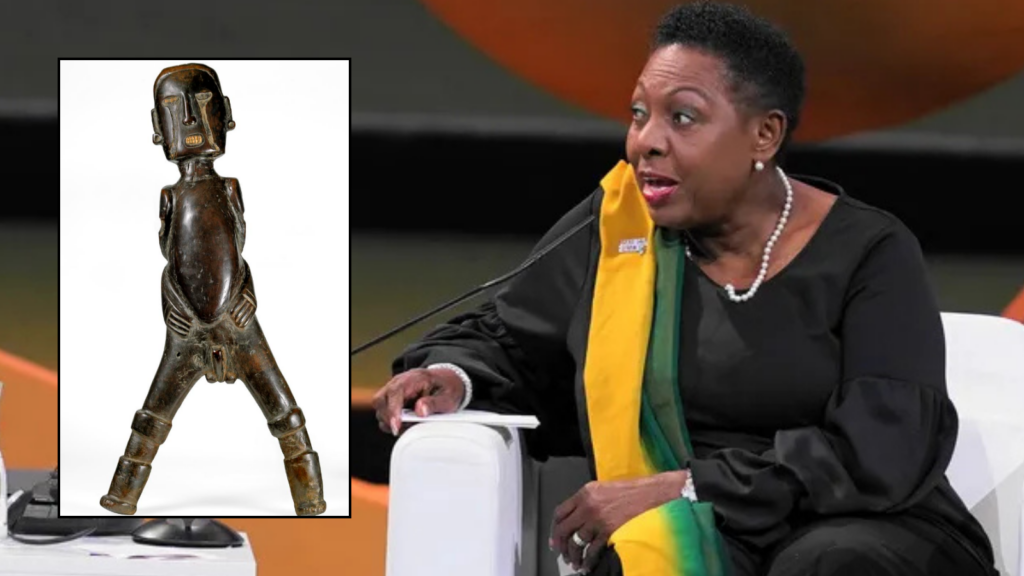
Jamaica’s Culture Minister Olivia Grange is in London this week and is due to hold talks with museum officials over the repatriation of objects taken from the island during British colonial rule.
The Jamaican Government has made the return of cultural artefacts part of its wider campaign for reparatory justice.
However, three sacred sculptures expected to be at the centre of discussions were not stolen or seized by British forces.
The wooden “zemi” objects were created by the Taino people, the indigenous inhabitants of Jamaica and other parts of the Caribbean, around the 15th century.
The three pieces were discovered in a Jamaican cave in 1792, when the island was under British rule.
They later entered the collection of William Ockleford Oldman before being donated to the British Museum in the early 20th century.
Jamaica gained independence from Britain in 1962.
Despite the circumstances in which the objects left the island, the Jamaican Government argues they form an invaluable part of the country’s cultural heritage and should be brought home.

Ms Grange said: “They are priceless they are significant to the story of Jamaica and they belong to the people of Jamaica.”
She has revealed that Jamaica previously sought the objects for an exhibition but was unable to secure them and received replicas instead.
Ms Grange said discussions with the museum had since progressed, with three Jamaican curators invited to examine artefacts in its collection.
“We would wish to have repatriation of those artefacts,” she said.
“For years, we have tried, I think we’re making some inroads now in terms of the dialogue, and we have been invited to send three curators for them to go through to see what artefacts are in the possession of the museum, and for us to engage in discussions.”
WOKE MADNESS – READ THE LATEST:
- Scottish civil servant ‘dressed as cat’ for training as SNP issues reminder on ‘appropriate dress’
- MI5 accused of ‘flagrant racism’ as white candidates told not to bother applying for internship
- Kids’ Halloween costume pulled from supermarket shelves after woke outrage erupts in America

The British Museum faces strict legal restrictions on permanently removing objects from its collection, an issue which has also complicated Greece’s long-running campaign for the return of the Parthenon Sculptures.
The museum has instead increasingly used loans and partnerships to allow historic objects to be displayed in their countries of origin.
The talks come as Jamaica launches a separate legal offensive over Britain’s historic involvement in slavery.
A delegation is lodging a petition asking the King, who remains Jamaica’s head of state, to refer three questions concerning transatlantic chattel slavery to the Judicial Committee of the Privy Council.
The questions concern whether the enslavement of Africans in Jamaica was lawful under English law, whether it violated international law and whether Britain now has a legal duty to provide redress.

The Jamaican Government has stressed that the petition itself is not a demand for a payment.
Ms Grange said: “Up to 2015, Britain was paying the slave masters, because we were being considered property.”
She added: “The question really should be: if in modern times we’re still paying back the slave masters for the property that was our people, our ancestors, for property that was because of the abolition of slavery, then why shouldn’t we be pursuing some remedy at this time?”
Buckingham Palace said: “We understand the Jamaican government is seeking a petition to be heard before the judicial committee of the Privy Council.
“The process for seeking a petition is to lodge it with the judicial committee so that referral under section four of the 1833 Act can be considered.
“We also understand the Jamaican representatives will be received by the Foreign, Commonwealth and Development Office for bilateral discussions.”
Our Standards: The GB News Editorial Charter