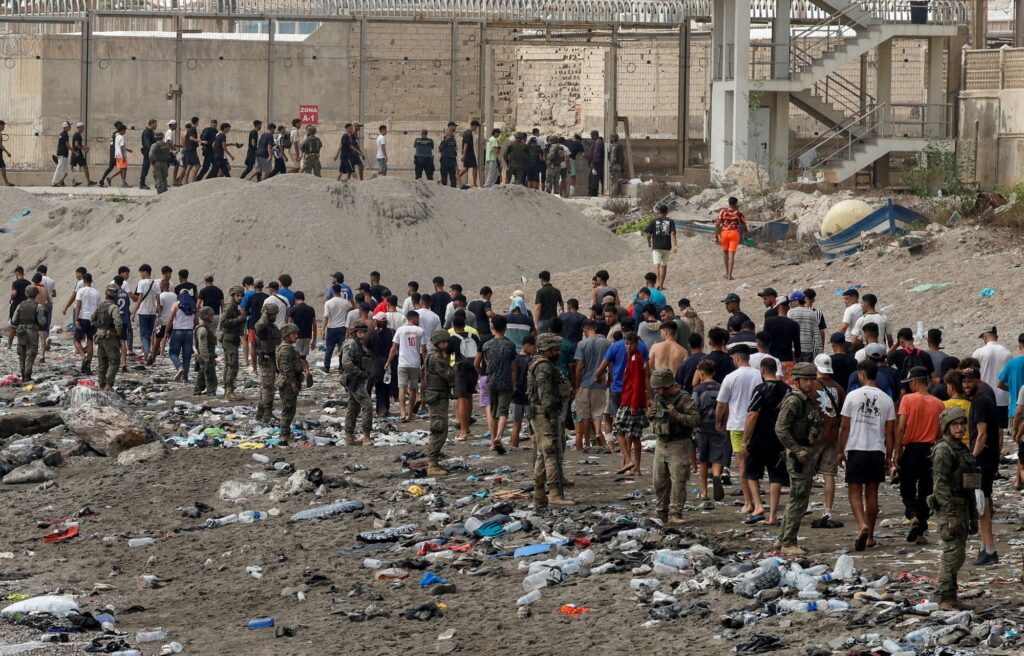

Sexual assaults have been occurring daily in Ceuta following the migrant invasion at the end of July.
Spanish prosecutors have recorded 23 sexual assaults in the enclave since the end of July, including nine involving children.
Read Also: Travellers win long-running planning row after pitching up on picturesque rural site
Ceuta’s chief prosecutor, Silvia Rojas, told El País the figure amounted to almost one case a day.
He added migrant girls were “particularly vulnerable because of their irregular status in the territory”.
More than 72,000 migrants crossed from Morocco into Ceuta on July 30 and 31.
While most have since returned, an estimated 5,000 remain, fuelling unrest in the North African city and creating a political crisis for Spanish Prime Minister Pedro Sánchez.
Mr Rojas said between 1,400 and 1,600 of those still in Ceuta are children.
Suspects in the assaults include four Moroccan nationals, three Spaniards and one Belgian national, according to news agency Efe.

Tensions between migrants and local residents have escalated into violence in recent days, prompting Mr Sánchez to convene a second meeting of his national security council within a week.
Mr Rojas said the surge in arrivals had led to a sharp rise in sexual assaults, with many victims reluctant to report attacks due to fear or their precarious status in the city.
The Spanish Society of Epidemiology said the crisis had exposed the difficulty of identifying and addressing violence against migrant women and girls.
One 24-year-old Moroccan woman told the BBC she had “put her life in danger” travelling to Ceuta, describing being sexually assaulted while sleeping among a mixed group of migrants.
LATEST DEVELOPMENTS
- Spain’s socialist leader absolves Morocco of involvement in 80,000 migrants invading Ceuta
- Furious Spanish locals torch Ceuta migrant camp as tensions boil over following ‘invasion’
- Spain finally apologises to people of Ceuta for migrant invasion… while welcoming in millions more

She said: “I was shocked… If I had known this, I wouldn’t have come.”
Emergency doctor Susana Ascaso said her department at Ceuta University Hospital had treated multiple assault victims last month, including a 10-year-old child.
Economy Minister Carlos Cuerpo confirmed the Spanish Cabinet had approved a multi-million euro aid package to fund essential services and support unaccompanied minors.
Ceuta’s mayor, Juan Jesús Vivas, has called for demonstrations across mainland Spain tomorrow in solidarity with the city, coinciding with its annual holiday.
Mr Sánchez’s Government has faced fierce criticism over its handling of the crisis.
The right-wing Vox party claimed the Prime Minister had not “lost control of Ceuta” but had instead “handed it over”.
Arantxa Campos, President of the Ceuta Employers’ Confederation, told the BBC: “We can’t do anything unless these people leave.
“We don’t have a plan from the Government. We don’t have anything. We don’t even know when they’re going to finish screening everyone.”
Mr Sánchez said on Monday King Felipe VI would visit Ceuta “as soon as conditions allow” – a move widely seen as an attempt to reassert Spanish sovereignty over the territory.
Morocco has long disputed Spanish control of both Ceuta and Melilla (another enclave, roughly 250 miles east) and a previous royal visit in 2007 prompted Rabat to withdraw its ambassador from Madrid.
Speaking to Cadena Ser, Mr Sánchez noted that the King had not visited Ceuta in 20 years, despite Felipe having reigned for 12 years — it was his father, Juan Carlos, who last visited in 2007.
Mr Sánchez also said he was the only Spanish Prime Minister to have made an official visit to Ceuta while in office, having travelled there on 31 July as the crisis unfolded.
Some commentators suggested his comments appeared to indirectly criticise the king, whom he met later that same day.
Mr Sánchez has avoided directly blaming Morocco for the migrant surge, saying intelligence had found no evidence of Moroccan state involvement.
Instead, he pointed to disinformation campaigns online, which he linked to Russia, Israel and a broader international far-right movement he accused of exploiting migration to destabilise Spain and Europe.
He clarified this did not necessarily mean state involvement, while Government spokeswoman Elma Saiz later said evidence showed certain “digital forums amplified” the crisis in an apparent effort to “fracture and polarise Europe”.
Both Russia and Israel have denied any involvement.
Israeli Foreign Minister Gideon Sa’ar accused Mr Sánchez of “a blatant lie” while a spokesman for Russia’s foreign ministry demanded evidence to support the claims.
At least 100 people have died attempting to swim around the border fence, despite a wave of social media posts in August falsely portraying the crossing as safe, Mr Vivas said.
Messages encouraging people to attempt the crossing began circulating on Moroccan social media before the influx started on 30 July, following a Supreme Court ruling in Spain the previous month, Spanish fact-checking organisation Maldita showed.
Spain’s Supreme Court ruled last month migrants intercepted at sea while attempting to reach Ceuta, or the enclave of Melilla, could not be summarily returned under the country’s special border-rejection policy.
The opposition People’s Party has accused Sánchez of shielding Morocco from blame.
Party spokesman Borja Sémper argued such a large number of people could not have reached the border without Moroccan authorities being aware.
Morocco has denied any involvement in orchestrating the crossings.
Our Standards: The GB News Editorial Charter