
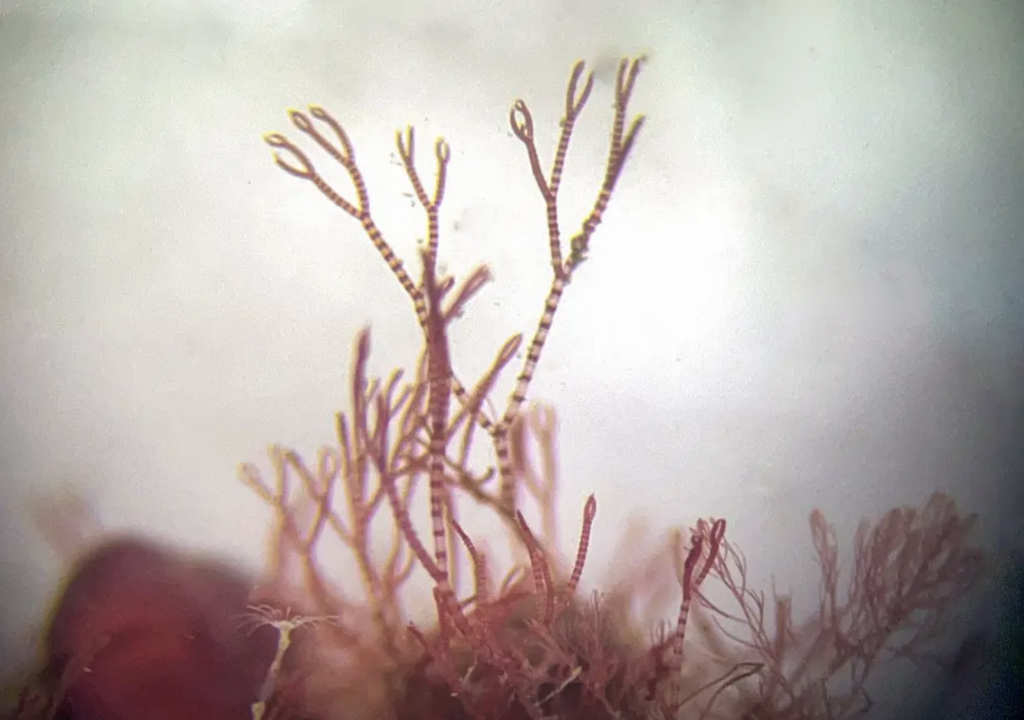

A scientist has finally revealed the mystery of the elusive “pink zebra” seaweed in British waters.
Four decades ago, Professor Christine Maggs stumbled upon a tiny fragment of pink-striped seaweed while conducting PhD research on maerl beds in British waters.
She had never encountered anything like it and extensive searches through existing scientific literature confirmed that nobody else had either.
Prof Maggs became convinced she was looking at a species entirely unknown to science, but the specimen was too small for formal identification. What followed was a career-long pursuit, with the elusive organism appearing only in tantalising glimpses, including once growing on a sea squirt, yet never in sufficient quantity to allow definitive classification.
Read Also: Urgent probe launched after Southport attack victims' files accessed in major data breach
Read Also: Briton saves five bears from cages in South Korean camp in extraordinary rescue mission
“I just kept hoping that I would find out, it’s been over four decades,” she told the BBC. The mystery seaweed became something of a lifelong obsession, shadowing her through every stage of her academic career as she waited for the breakthrough that would finally resolve the puzzle.
Maerl beds bear a striking resemblance to coral reefs but are actually composed of thousands of individual pieces of calcified seaweed, living freely and interlocking to form a dense carpet teeming with biodiversity. They rank among the most species-rich marine habitats found in British waters.
Seaweeds themselves are among the planet’s oldest life forms, having evolved more than a billion years ago. Many species serve as vital food sources for fish and provide essential shelter for egg-laying.
Their value extends to human health too, with mineral-rich and anti-inflammatory seaweed extracts finding their way into treatments ranging from acid reflux remedies to wound dressings.

“We really have to look after seaweeds, we really have to love them,” said Prof Juliet Brodie, a prominent seaweed specialist, speaking from the Natural History Museum’s vaults. “What would the world be like without seaweeds? You would be taking away your nurseries for some of your economically important fish.”
The breakthrough arrived roughly two years ago, when scientific divers conducting a Natural England survey of Cornish maerl beds brought up bags of samples containing a small red alga with distinctive pink bands and pincer-shaped tips.
Francis Bunker, a freelance marine biologist who carries a magnifying glass on dives, kept spotting the tiny organism among his collected specimens. “You’ve got to be awed by it all, which I never cease to be,” he said. Suspecting it matched Prof Maggs’ long-sought species, he gathered as much material as possible and dispatched it to her in London.
The seaweed was so minuscule that molecular analysis was essential, so Prof Maggs purchased a wine fridge — providing the ideal dark, cool conditions — to cultivate the sample to a size suitable for DNA sequencing. “That’s why this has taken me 40 years,” she explained.
LATEST DEVELOPMENTS
- Scientist reveals reason behind sudden disappearance of wasps across Britain
- Mysterious three-lobed asteroid appears to have own moon, scientists reveal
- Dinosaurs were NOT wiped out by asteroid impact say scientists in bombshell new study

Working alongside Professor Beatriz de Barros Barreto, who carried out the genetic analysis, Prof Maggs finally confirmed the seaweed was indeed a species previously unrecorded by science.
“We knew that maerl was a rich, biodiverse habitat, but we didn’t necessarily realise that we’d be still finding new species that live on that maerl,” Prof Maggs said.
The newly confirmed organism has been given the scientific name ceramium ruenessianum, chosen to honour a colleague who has devoted four decades to studying this particular genus. A specimen has been formally added to the Natural History Museum’s official collection, and Prof Maggs’ findings are due to appear in the peer-reviewed journal Phycologia.
“It’s great,” Mr Bunker said. “I think it’s what spurs you on really, finding a new species. It’s like the icing on the cake, or the cherry on top.”
As for a common name, the diving team’s leading candidate is “pink-zebra weed”, although alternatives such as “pink-banded bandit” and “ribbon claw” are also in contention. Prof Maggs has invited the public to offer their own suggestions.
Professor Craig Schneider, a biologist at Trinity College, Connecticut, who was not involved in the research, described the discovery as “significant” and said it could bolster the case for safeguarding maerl beds, which are “already of the greatest importance to all of the other plants, animals and microbes in the ecological community that they support”.
Maerl beds are scarce across Britain and are classified as a threatened and declining habitat under the OSPAR convention, the international framework for protecting the North-East Atlantic marine environment. Only four sites currently enjoy formal protection in the UK, among them the Fal and Helford Special Area of Conservation.
However, the less well-studied beds off the south Cornish coast, where the new species was also recorded, remain unprotected. Defra has indicated that designating this area as an SAC may not be necessary, stating there is no obligation “to protect all examples of a species or habitats”. The department cited the need to balance nature recovery with “wider priorities, including offshore wind development and fisheries”.
Our Standards: The GB News Editorial Charter