
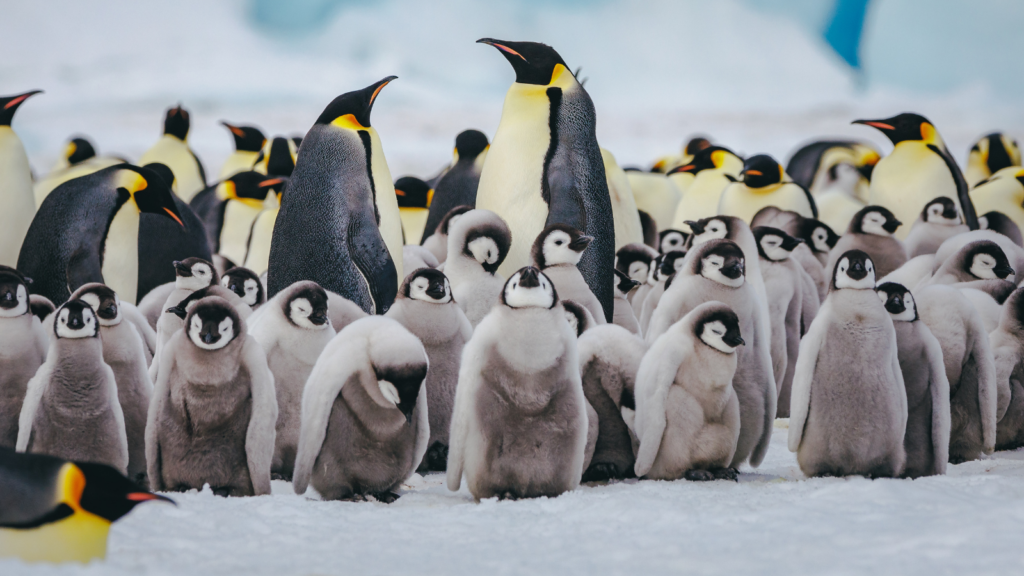

Scientists have tracked emperor penguins from space for the first time ever in a major breakthrough that could help protect the endangered species.
A team of geographers from Durham University used freely available satellite radar imagery to monitor the birds throughout the Antarctic polar winter, when almost constant darkness makes conventional observation extremely difficult.
The breakthrough has allowed researchers to build a year-round picture of the penguins’ movements during a crucial stage of their breeding cycle.
Until now, tracking emperor penguins through the winter months has proved extremely challenging because of the harsh and dark conditions across Antarctica.
Read Also: British officials hauled into US embassy for grilling over Labour's internet crackdowns
Researchers say understanding how the birds behave during this period could prove vital to protecting the species as it faces growing environmental threats.
Emperor penguins depend on stable coastal sea ice for around nine months each year to breed and rear their young.
The species was classified as Endangered on the International Union for Conservation of Nature Red List of Threatened Species earlier this year.
Scientists fear emperor penguin populations could decline sharply this century as climate change causes Antarctic sea ice to diminish.

The Durham team used the European Space Agency’s Copernicus Sentinel-1 synthetic aperture radar mission to follow penguin colonies during winters between 2017 and 2024.
Standing at around four feet tall, emperor penguins could be distinguished by radar against the relatively flat surface of the winter sea ice, allowing researchers to track them even in darkness.
Scientists monitored colonies at Atka Bay, Coulman Island and Cape Washington.
Radar data was combined with optical summer imagery from the European Space Agency’s Sentinel-2 and Nasa’s Landsat 8 satellites to build a more complete picture of their movements.
SCIENCE – READ THE LATEST:
- Archaeology row erupts over hunt for fourth musketeer’s tomb
- British scientists claim to have found the most compelling indication of dark matter
- Archaeologists uncover clue in hunt for ancient Egyptian lost city

Researchers were even able to detect trails of penguin guano using radar during late summer, with the findings subsequently confirmed using optical satellite imagery.
Dr Grant Macdonald, the study’s lead author and a postdoctoral research associate at Durham University’s Department of Geography, said: “We’ve shown that satellite radar imaging is a very useful tool for understanding their behaviour during a key part of the breeding cycle and particularly their response to environmental change during winter.”
All three colonies moved during the winter, although the penguins were generally less mobile than during summer.
Their movements varied between different years and locations, while researchers occasionally observed distinct groups moving collectively away from the edge of the sea ice even when it appeared stable.

Dr Peter Fretwell, a co-author from the British Antarctic Survey, said: “Winter is a critical time in the emperor penguins’ breeding cycle, but the optical satellites that we usually use to track the colonies are blind at this time due to the darkness of the polar night.
“The ability of these radar-based satellites, that can take imagery regardless of illumination, gives us a vital insight into the year-round behaviour of these endangered birds.”
The study was published in Communications Earth & Environment and involved researchers from Durham University, the University of Canterbury in New Zealand and Woods Hole Oceanographic Institution in the United States.
It was funded by NERC, a Royal Society New Zealand Rutherford Discovery Fellowship and the US Department of Defence.
Our Standards: The GB News Editorial Charter