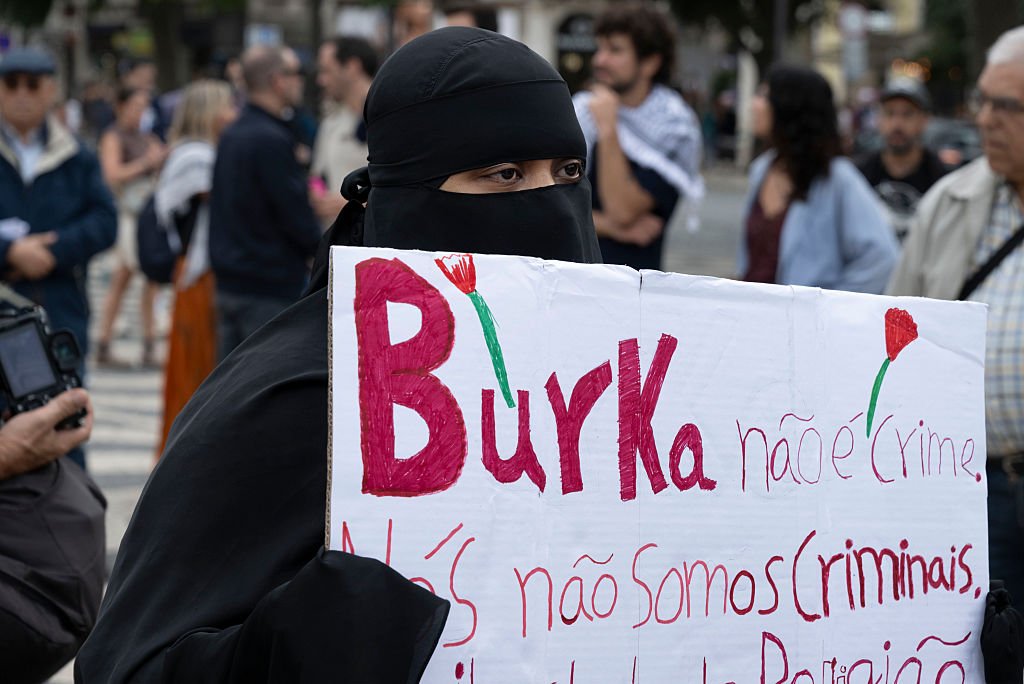

Portugal has banned face-coverings in public in a measure widely seen as a “burka law” targeting Muslim women.
President António José Seguro signed into law a bill that originated with the hard right-wing Chega party.
Read Also: Travellers win long-running planning row after pitching up on picturesque rural site
The policy was adopted by Lisbon in July with votes from the right-wing governing coalition and the hard right, while left-wing parties voted against it.
A statement issued by President Seguro’s office read: “The face must be considered a central element of human identity and communication.”
Under the law, the wearing in public spaces of clothing designed to conceal or obstruct the face is prohibited.
The legislation also bars coercing anyone into covering their face on grounds of gender, religion, age or origin.
Breaches carry fines of €150 to €750 where negligence is established and €400 to €3,000 where intent is proven.
Forcing another person to cover their face is punishable by up to three years in prison.


President Seguro acknowledged that the issue was one of “great social and cultural sensitivity”.
Exemptions are in place for health, professional, artistic, entertainment and advertising reasons.
The ban does not apply to aircraft, diplomatic and consular premises, places of worship or other holy sites.
However, human rights campaigners have pointed out bans effectively erode women’s rights by telling them what to wear.
LATEST DEVELOPMENTS:
- Burka banned in ALL schools in Denmark under crackdown on non-integrated migrants
- Kemi Badenoch considering burqa ban amid Tory review into Islamist extremism
- ‘It’s un-British!’ Nigel Farage reignites calls for cousin marriage crackdown after Sweden pushes ahead with ban

Executive Director of Amnesty International in Portugal, João Godinho Martins, said: “This new law is discriminatory and is a threat to human rights.
“Despite having removed direct references to Islam, which were a part of previous versions of the text, this new law clearly violates the human rights of Muslim women who choose to cover their faces. It is a direct threat to their freedom of expression and freedom of religion.
“No one should dictate what a woman may or may not wear, and no woman should be penalized for practising her faith, cultural identity or beliefs.
“Far from promoting women’s rights as claimed, this blanket ban is likely to have the opposite effect. Women who choose to wear full-face veils may face greater exclusion from public life, social isolation or increased difficulties in accessing education, employment and public services.”

Portugal joins France, Belgium, Austria, Denmark and the Netherlands among European countries that already have full or partial bans on face coverings in public.
The Balearic Islands, Majorca, Menorca, Ibiza, and Formentera, are also looking into proposals to outlaw the traditional Islamic dress and issue fines of up to £25,000 to those caught wearing them repeatedly.
The plans, drawn up by Spain’s hard right-wing Vox and the People’s Party of the Balearic Islands (PP), are currently being considered by the Balearic Parliament.
However, the Bill has faced opposition from PSIB, MES per Mallorca, MES per Menorca, and Unidas Podemos in the legislature.
Vox has also tabled a motion to punish those who force or coerce women to wear niqabs and burkas with up to four years in prison.
Manuela Canadas, one of the party’s MPs, insisted that the normalisation of the strict Islamic coverings “means accepting a medieval regression in the 21st century”.
She added that protecting Spanish culture from practices that “denigrate women” should be treated as a “priority”.
Ms Canadas said: “The veil is a tool for erasing personality, designed to obliterate a woman’s civil existence”.
Our Standards:
The GB News Editorial Charter