
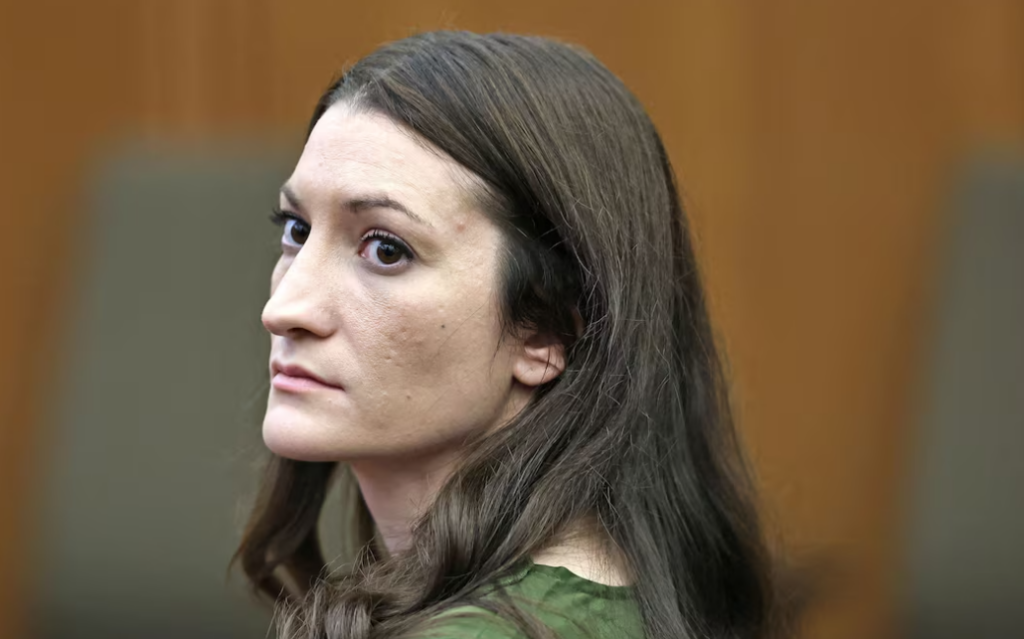

The panel of jurors deciding the fate of Lindsay Clancy has declared itself unable to reach agreement following three days of deliberations. Judge William Sullivan has directed the 12-member jury, comprising nine women and three men, to persist in their efforts to arrive at a unanimous decision.
The declaration of deadlock prompted audible gasps in the Massachusetts courtroom on Tuesday. The jury had spent more than 17 hours reviewing evidence before informing Judge Sullivan they could not agree on a verdict.
Read Also: Travellers win long-running planning row after pitching up on picturesque rural site
Clancy remained composed in her wheelchair beside her legal representative as the judge read out the jury’s note. She was left paralysed after jumping from a second-floor window shortly after the killings.
The panel had heard weeks of testimony from dozens of witnesses before beginning their deliberations last week.
The 36-year-old former nurse faces three counts of first-degree murder over the deaths of her children in January 2023. Prosecutors contend she killed Cora, five, Dawson, three, and eight-month-old Callan through strangulation using fitness bands at the family’s Massachusetts residence.
Her legal team does not contest that she ended the children’s lives. However, they maintain she was experiencing postpartum psychosis at the time and lacked the capacity to differentiate between right and wrong.
The prosecution asserts her actions represented a calculated and intentional choice to kill her offspring. The central question before the jury concerns whether Clancy should face criminal punishment or be committed to a mental health facility.
She has entered a not-guilty plea to all murder charges.

A conviction on the most serious charge would result in a mandatory sentence of life imprisonment with no possibility of release. First-degree murder involves the intentional and premeditated killing of another person.
The jury is also weighing lesser charges that carry prison time but different standards. Second-degree murder would apply if the killings were committed with malice or extreme recklessness but without advance planning, whilst manslaughter would involve unintentionally causing death through wanton and reckless conduct.
Should the panel find Clancy not guilty by reason of insanity, she would not walk free. Instead, she would be transferred to a psychiatric hospital where her condition would undergo periodic review.
Under this outcome, she could remain institutionalised for the remainder of her life.
LATEST DEVELOPMENTS
- US issues urgent warning in three Middle East nations as airspace could close imminently
- US Army Secretary resigns after months of strife with Pete Hegseth
- Venus Williams makes furious complaint after crashing out of US Open at 2am
Should the impasse continue, Judge Sullivan may resort to what is termed a “dynamite charge”, known formally in Massachusetts as Tuey-Rodriguez instructions. This measure would ask jurors to weigh the reasonableness of their own views and those of their fellow panel members whilst continuing to work towards agreement.
Heather Cucolo, a New York Law School professor and expert in mental health law, told the BBC such instructions represent “typically a last-ditch effort” from a judge. She noted jury deadlocks occur in “complex and emotionally charged trials”.
If unanimity proves impossible, a mistrial declaration would follow. Prosecutors would then face a choice: mount a second trial, abandon the case entirely, or attempt to reach a negotiated plea arrangement with Clancy.
It remains unclear whether the jury is divided on all charges or only certain counts.
Our Standards: The GB News Editorial Charter