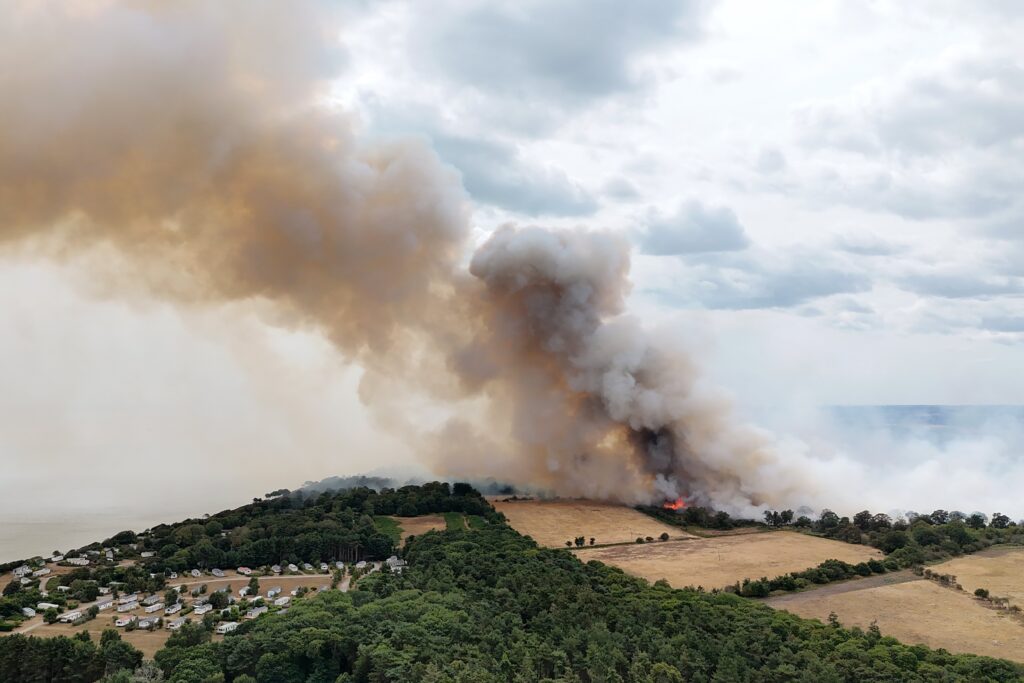

The Government has been urged to reverse eco-policies that campaigners say make wildfires worse.
With this summer set to be the hottest on record, more than 1,000 fires have already hit England and Wales, matching last year’s total.
Read Also: Travellers win long-running planning row after pitching up on picturesque rural site
The fires have been blamed on climate change, with temperatures soaring and nearly three quarters of England and Wales in drought.
But countryside campaigners say that Government policies are playing a part by creating the perfect conditions for fires to take hold.
Many upland UK landscapes include large areas of peatland.
Previously, land managers such as farmers or gamekeepers would carry out controlled burning during the winter months. This involves setting fire to a small area to remove the older, woodier vegetation that can fuel wildfires.
But Government department, Defra, has said burning on deep peatland should be used as a “last resort” and permitted only “in exceptional circumstances”.
It says burning peat is harmful to habitats and damages air quality. It also damages the country’s path to Net Zero, it states.

Last September, Defra extended the licencing regime for controlled burning, with the new rules covering three times the previously licenced area.
The ban is seen as part of a wider ‘rewilding’ drive, which sees human interference on swathes of land minimised.
The Country Land and Business Association (CLA), which lobbies for farmers, landowners and rural businesses, says the policies amount to “a de facto ban on the most effective wildfire prevention method across the highest-risk upland land”.
The CLA outlined its concerns in May. It told a Government consultation that “hotter, drier summers create the risk for bigger and more frequent wildfires”.
LATEST DEVELOPMENTS
- Fires rage across West Midlands as terrified Britons flee homes: ‘Like a horror movie!’
- Busy London commuter train derails in East Sussex with passengers ‘trapped’ after horror crash
- Water bills set to rise for MILLIONS despite hosepipe bans amid mass drought

But it went on: “Recent Defra’s policy in England has de facto banned prescribed burning on any peat soils deeper than 30 cm, which we believe will worsen wildfire risk.”
The CLA’s Jonathan Roberts told the Daily Mail that recent fires proved the policy needed changing.
He said: “Last year was the worst on record for wildfires, yet ministers responded by making it harder for land managers to carry out the controlled burning necessary to stop wildfires taking hold in the warmer months.”
The Countryside Alliance echoed these concerns and said the rules made fires more likely.
It said: “Moorland communities are facing increasing challenges, the Government having recently more than trebled the area over which the controlled burning of vegetation is effectively banned in our uplands.
“The Countryside Alliance has repeatedly warned that by ignoring the latest scientific evidence, the Government is significantly increasing the risk of catastrophic wildfires.”
Former England cricket captain Lord Botham also weighed in on the issue. Made a life peer by the Tories in 2020, he has used his position in the Lords to voice rural concerns.
He wrote in the Telegraph: “The winter burns used to create firebreaks. Now we have huge expanses of continuous, ageing vegetation.
“The result is disaster after disaster.”
He went on: “For two decades we have added far too much vegetation to our landscape and are now suffering the inevitable consequences.”
Defra recommends restoring peatland and ‘rewetting’ it, making it less likely to burn.
It said its policies were an effective long-term solution and lowered the fuel loads that sustained fires.
They were also better for the planet, it said.
A spokesman said: “Peatland restoration is the most effective, sustainable, and long-term solution for reducing fuel load on degraded peatlands, as wetter, healthy-functioning peatlands hold more water in the landscape for longer and are more resilient to the impacts of wildfire.”
Prime Minister Andy Burnham chaired a meeting of the Government’s emergency Cobra committee on Wednesday in response to the prolonged spell of exceptionally hot and dry weather.
Some 1,017 wildfires have been recorded in England and Wales this year, according to data shared by the National Fire Chiefs Council (NFCC), the same as last year’s record-breaking total.
A Met Office study on the 2022 heatwave claimed climate change made wildfires six times more likely.
Our Standards:
The GB News Editorial Charter