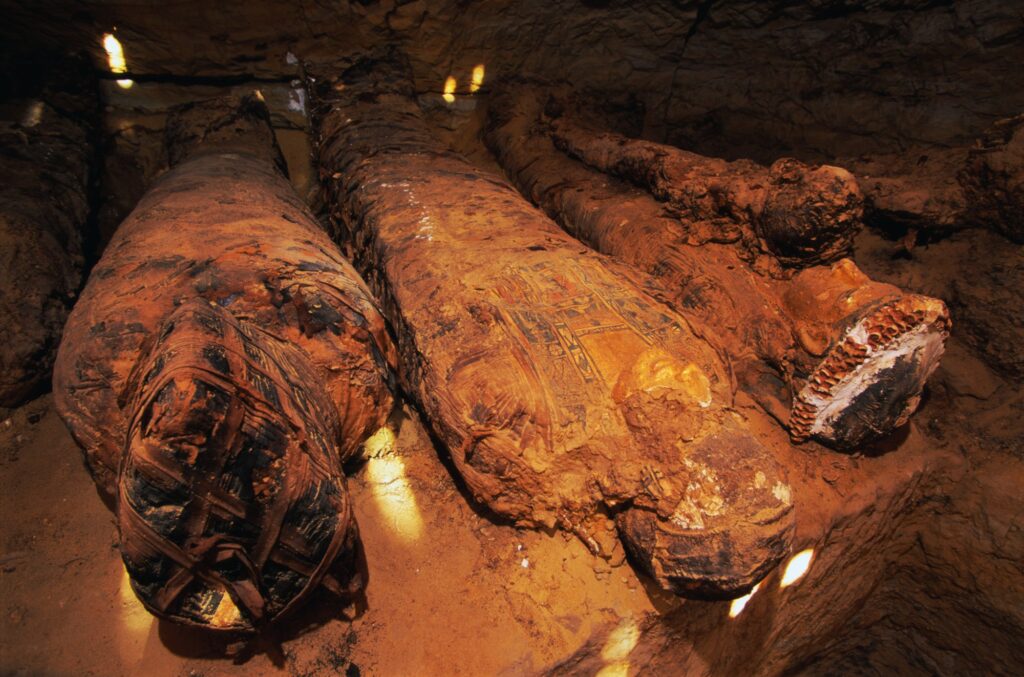

Scientists have raised the alarm over a booming international online market in mummified human remains.
They caution that the trade in centuries-old hands, feet and heads threatens to expose buyers and sellers to dangerous ancient fungal spores and poisonous chemicals.
Read Also: Travellers win long-running planning row after pitching up on picturesque rural site
Researchers publishing their findings in the International Journal of Cultural Property described the hazards as amounting to “a real mummy’s curse”.
Microorganisms that have lain dormant for hundreds of years can become airborne the moment remains are handled or transported, the experts warned, while toxic preservation substances applied to the dead long ago pose additional dangers.
The team wrote: “Where mummified remains are transported without appropriate controls or documentation, the living are exposed to various risks.”
The study examined 128 online listings across Meta platforms, e-commerce websites, web stores and auction houses, uncovering widespread sales of mummified body parts.
Detached hands and feet were the most commonly offered items, with whole mummified heads the next most prevalent category.
More than half of the sample, 51.6 per cent, comprised heads in various conditions, ranging from complete specimens to partial skulls retaining soft tissue or hair, as well as tsantsas, the shrunken heads crafted by the Shuar people of northern Peru and eastern Ecuador.

Photographs accompanying the listings showed remains displayed openly in living rooms and domestic settings without any apparent temperature regulation.
Sellers offered no health or safety advice and frequently dispatched items through ordinary postal services.
Thirteen of the listings displayed remains bearing visible signs of suspected fungal growth, pointing to poor and unstable storage environments.
Six of those cases showed extensive biological deterioration that the researchers judged a direct threat to anyone handling the items.
LATEST DEVELOPMENTS
- Scientific breakthrough finally uncovers how ‘first bird’ learnt to fly 150 million years ago
- Treasure trove of British natural history sold to Middle East in ‘loss to the nation’
- Egyptian pyramids mystery finally explained as archaeologists uncover how ancient wonders were built

The paper warns: “Most bacteria, fungi and yeasts survive, recolonise and multiply by using the body’s available organic material, especially when remains have been manipulated and subjected to suboptimal storage conditions.”
The mummification process itself introduces further hazards, as heavy metals including arsenic, mercury and lead were historically applied to delay decomposition.
Exposure to these substances can trigger severe poisoning, brain damage, cancer, liver and kidney problems, skin lesions and lung irritation.
Museums typically house mummified specimens in climate-controlled glass enclosures, safeguarding both the remains and visitors — protections that private collectors rarely replicate.

The notion of a mummy’s curse dates back to the 1922 opening of Tutankhamun’s tomb, and researchers believe a severe case of aspergillosis, triggered by inhaling Aspergillus spores, may have played a role in the death of Lord Carnarvon, the expedition’s principal financier.
A similarly deadly episode occurred in the 1970s in Poland, when Aspergillus spores were blamed for killing 10 of the 12 conservation scientists who unsealed the tomb of King Casimir IV in Kraków.
The researchers said: “In these cases, fungal spores lay dormant for hundreds of years, and once disturbed, they became airborne and dangerous to human health.”
The team urged the public to stay alert and report any sales of mummified remains to the appropriate authorities and professional bodies.
Our Standards: The GB News Editorial Charter