
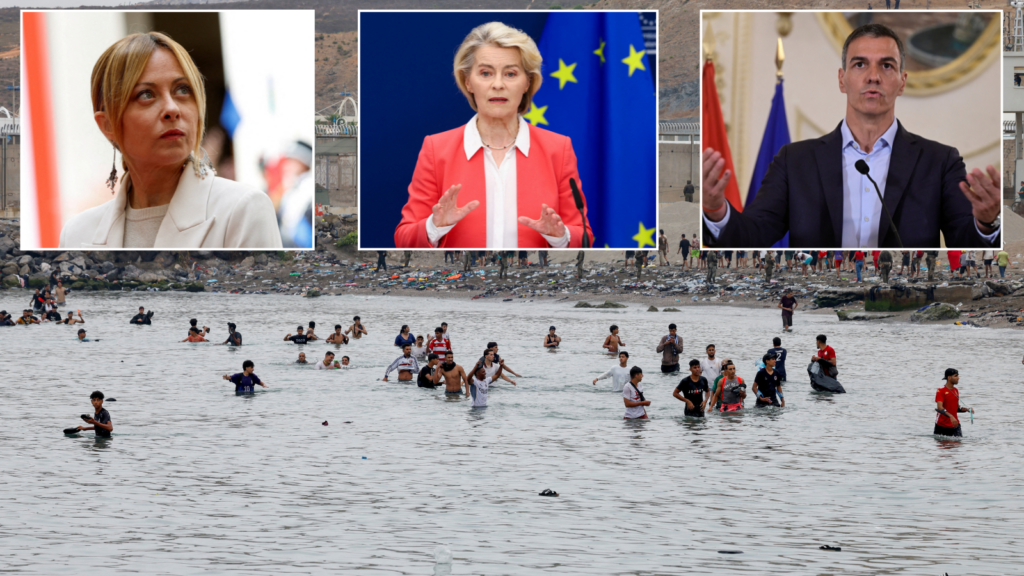

The European Union is set to host an emergency meeting next week after 60,000 migrants stormed the Spanish border and entered Ceuta illegally from Morocco.
The death toll from the chaotic crossings has climbed to at least 67, according to officials.
Spain has since lashed out at what it described as “selfish, polarising and unlawful” responses from some of its European partners.
This comes after Italy’s decision to suspend its border-free Schengen arrangement with its Mediterannean counterpart prompted particular fury in Madrid.
Read Also: Urgent probe launched after Southport attack victims' files accessed in major data breach
Read Also: Briton saves five bears from cages in South Korean camp in extraordinary rescue mission
A joint letter signed by 22 member states has called for a unified response and the reinforcement of the EU’s external borders.
Spanish Prime Minister Pedro Sánchez wrote to European Commission President Ursula von der Leyen expressing “serious concerns” about the behaviour of certain EU governments.
He insisted that Madrid had regained full control of the border and stopped any “unauthorised onward movement towards continental Europe” within just two days.
Mr Sánchez acknowledged that most member states had demonstrated “support and solidarity,” but accused others of targeting Spain, “driven by prejudice, fake news, ignorance, or political interest.”

He also stressed that Ceuta does not fall within the Schengen zone.
The Spanish leader blamed people smugglers for taking advantage of a recent supreme court ruling that limited the government’s ability to carry out immediate deportations of those arriving by sea.
Interior Minister Fernando Grande-Marlaska told reporters that normality had largely been restored.
“Almost all of [the migrants] have already left Ceuta,” he said, noting that local businesses had reopened.
LATEST DEVELOPMENTS:
- ‘I’m here for fun!’ Ceuta migrants speak to GB News after 60,000 storm Spanish city
- Spain’s socialist leader posts ‘soundtrack of my summer’ Instagram reel while migrants ‘invade’ country
- Spain’s socialist leader refuses to take responsibility for African migrant ‘invasion’ of Ceuta

Spain is also developing an inflatable barrier designed to block irregular maritime crossings.
Italy’s Prime Minister Giorgia Meloni imposed a month-long suspension of the Schengen agreement with Spain, a step that won backing from both Finland and Denmark.
Danish Prime Minister Mette Frederiksen went further, urging the bloc to “consider all options, including a suspension of Schengen co-operation.”
France and Portugal also indicated they were reviewing or weighing up the introduction of border checks with Spain.

The Schengen Area, which removes passport controls across 29 European nations and covers more than 450 million people, has become a central flashpoint in the diplomatic row.
The joint letter from 22 EU leaders — addressed to EU President Antonio Costa, Ursula von der Leyen, and Irish Taoiseach Michael Martin, whose country currently holds the Council presidency — warned of “hybrid threats” designed to foster the belief that unauthorised entry into the bloc was achievable, cautioning that such perceptions risked triggering further crossing attempts.
European Commission President von der Leyen described the scenes from Ceuta as “unacceptable,” writing on social media: “We cannot allow anyone to come to our Union without abiding by our rules.”
Germany’s Chancellor Friedrich Merz called on Morocco to “take back illegal migrants immediately,” adding diplomatic pressure on Rabat.
Prime Minister Andy Burnham confirmed that he had been in direct contact with Mr Sánchez and that Britain was “providing what help we can.”
Our Standards: The GB News Editorial Charter