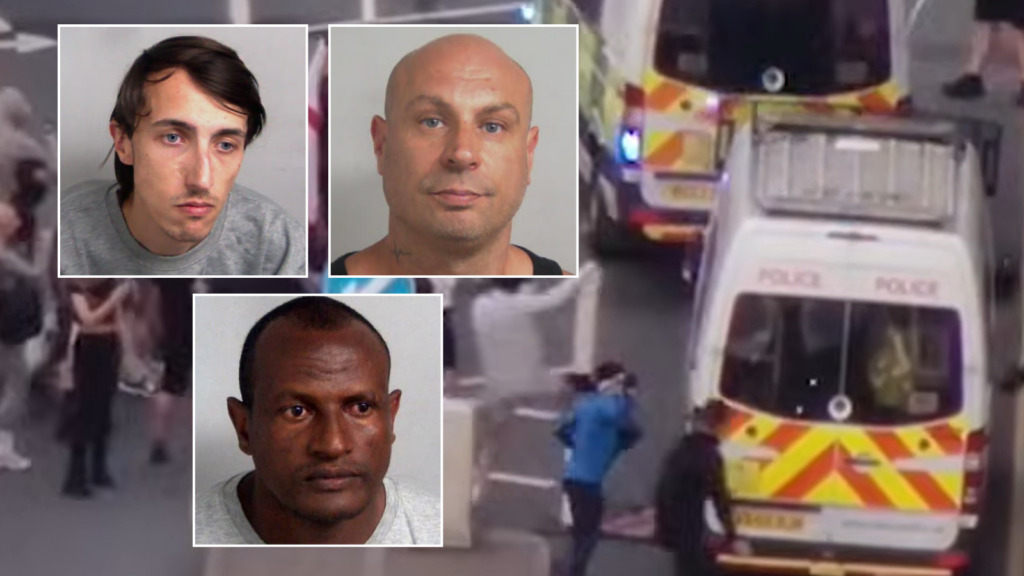

Two men have been jailed for violent disorder during protests outside an asylum hotel in Essex last summer, receiving longer sentences than the hotel occupant who assaulted a woman and girl in the town.
Charlie Land, 24, and Jonathan Glover, 48, were sentenced over their “entirely unacceptable” behaviour outside The Bell Hotel in Epping last summer.
Read Also: Travellers win long-running planning row after pitching up on picturesque rural site
Both were found guilty of violent disorder after a 10-day trial at Chelmsford Crown Court, with Glover, of Waltham Abbey, sentenced to 30 months in prison, and Land, of Hatfield – also found guilty of criminal damage – handed a 32-month prison sentence.
The sentences of both men stand longer than that of one migrant occupant of the hotel, found guilty of touching and trying to kiss a schoolgirl in Epping.
Hadush Kebatu was jailed for 12 months for sexually assaulting a 14-year-old girl and a woman on Epping High Street and was later mistakenly released from prison after an administrative blunder before eventually being deported back to Ethiopia.
Glover was depicted in footage shouting at officers during a protest outside the hotel last year and “impeding police carriers” as they arrived to address the disturbance on July 17.
Meanwhile, drone and bodycam footage showed Land repeatedly damaging police vehicles “over the course of the evening”, according to Essex Police.
The court heard Glover had “reluctantly” attended the protest with his partner, but in sentencing, Judge Mills said “far from an unwilling participant, you were wholeheartedly engaged in what was going on”.


In one altercation, Glover was pushed back by an officer with their riot shield, which saw him lose two teeth.
Glover maintained he was a journalist attending the protest on business, which Judge Mills countered as “nothing of the sort”.
“Genuine journalists record events – they do not manufacture them,” the judge said.
“You were not a reporter being picked on by the police; you were not the victim of so-called two-tier justice – you were the antagonist. Far from seeking to calm tensions, you repeatedly inflamed them.”
LATEST DEVELOPMENTS
- Record 1.3 million foreign nationals now receiving benefits
- Family who drowned off Sussex harbour revealed to be Palestinian migrants
- Portugal BANS full-face veils in public under ‘burka law’

Meanwhile, Land was found to have attacked nine police vehicles, punching windows, kicking off wing mirrors and letting air out of car tyres.
During the trial, footage showed Land climbing on top of one of the vehicles and kicking the windscreen, while adorned in a face covering banned at the time under a police dispersal order.
“You were a full and enthusiastic participant in the violent disorder,” Judge Mills told him, adding he had “no regard” for the safety of police officers and that wearing a mask “contributed to an atmosphere of intimidation”.
Keith Silk, 34, of Loughton, was also found guilty at the same trial as the pair and is due to be sentenced for violent disorder and criminal damage later this year on November 10.

Essex Police confirmed 11 men have been convicted for their behaviour during the wave of protests, which garnered national attention for their frequency and scale.
Ten of these men have since been sentenced, with combined custodial terms currently totalling more than 17 years.
Chief Inspector Terry Fisher said: “Each of these sentences is a reminder of the impact of this disorder – the community in Epping was left scared and anxious, daily life was disrupted and businesses felt the effect of closing early, with the town’s reputation affected.
“Whilst many people who wanted their voices to be heard on an important issue did that safely, a number chose to behave well beyond that and these convictions and sentences show that behaviour is and was entirely unacceptable.”
Our Standards: The GB News Editorial Charter