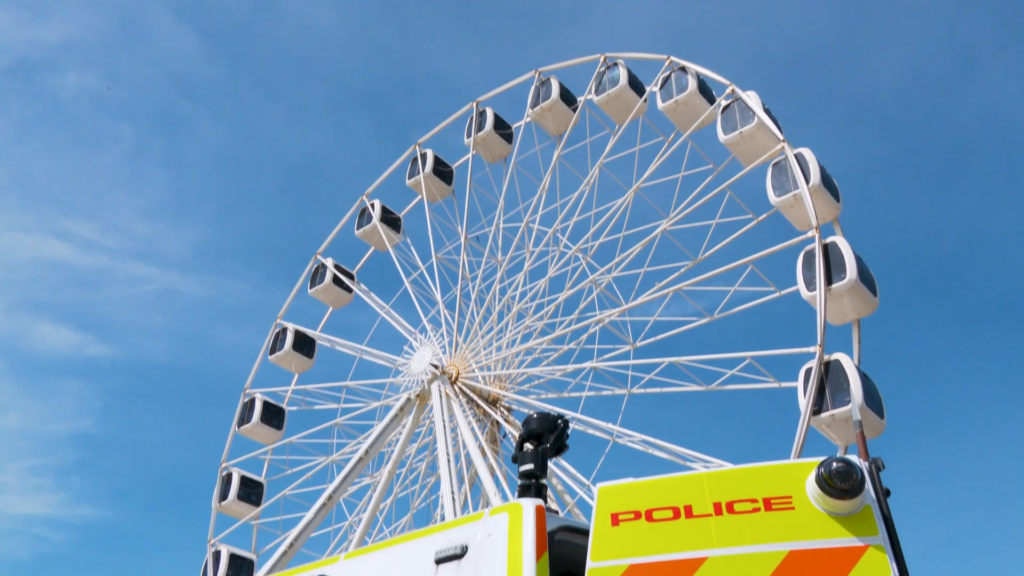

Live facial recognition technology has been rolled out by Dorset Police in Bournemouth for the first time.
The system is being used by forces across the country, as technology plays an increasing role in preventing and investigating time.
Detective Chief Inspector Jamie Harford, who is part of the team operating the technology, said: “The technology is really successful. The inaccuracy is very, very low.”
A camera scans the faces of people passing the van, searching for potential matches against a criminal watchlist.
Read Also: British officials hauled into US embassy for grilling over Labour's internet crackdowns
If a match is flagged, officers inside the van are alerted and can decide whether to intervene.
DCI Halford said the technology had already produced a positive match involving a sex offender.
He said: “We’ve exchanged with our local uniform officers. They’ve spoken to that individual, confirmed that that person wasn’t breaching their order and that person was allowed to go.”
The watchlist can contain wanted people, suspects, offenders subject to court orders and people reported missing.

Dorset Police’s watchlist currently contains around 5,000 names.
During a demonstration, my face was added to the list as I walked past the camera.
Within seconds, the system scanned my face and flagged a potential match to officers.
A survey conducted by the Office of the Police and Crime Commissioner revealed 74 per cent of responders support the use of live facial recognition, while 23 per cent oppose it.
LATEST DEVELOPMENTS
- Facial recognition cameras lead to suspect arrest every 90 minutes in crime crackdown
- Facial recognition cameras defended by ex-detective as fear amongst Britons grows: ‘They make Britain safer!’
- Three in five Britons fear being wrongly caught by ‘Big Brother’ facial recognition tech

Dorset Police and Crime Commissioner David Sidwick said people should not be concerned about their data being stored.
He said: “Three quarters of the people of Dorset want live facial recognition. They want to see these vans being used here.”
Nevertheless, he acknowledged concerns over whether information gathered in the system could be kept indefinitely.
He said: “It is an instantaneous scan of a person, which is then matched with a list of suspects, and then it’s gone.”
Members of the public had mixed views on the technology.
One person said: “It made me feel safe walking through here straight away.”
Another described the vans as “very intimidating”, adding: “It just feels like you’re being watched everywhere.”
Yet another resident commented: “If you haven’t got nothing to hide, that wouldn’t bother me at all.”
For Dorset Police, live facial recognition is another tool officers can use.
And for residents, facial recognition vans are now becoming a new feature on the streets of the south coastal town.
Our Standards: The GB News Editorial Charter