
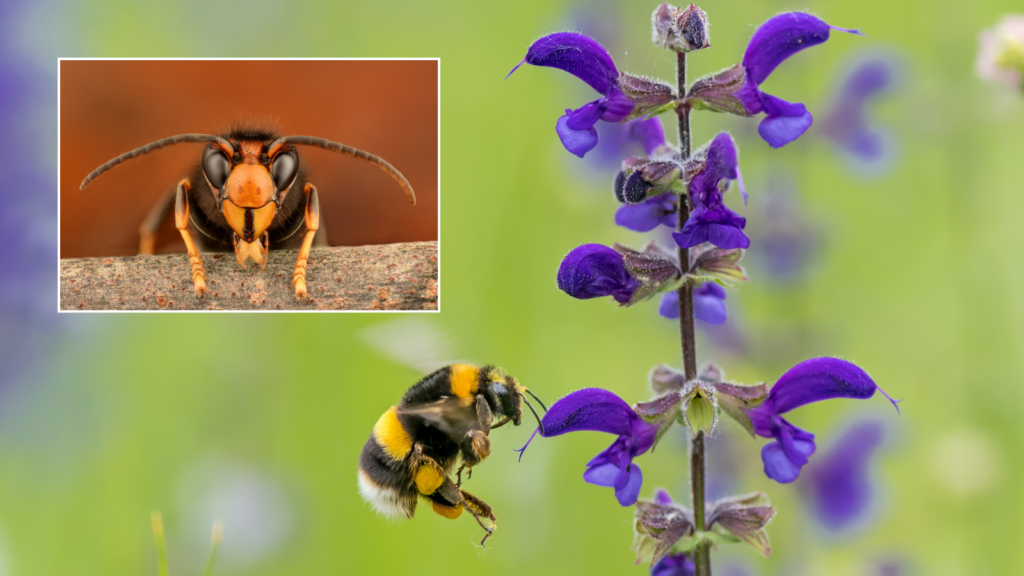

Britain’s battle against the invasive yellow-legged hornet has intensified as the species extends its reach into previously unaffected regions, including Somerset, Lincolnshire and Greater Manchester. The insect, which was discovered in the country for the first time a decade ago, typically appears in southern counties such as Kent, Sussex and Surrey.
However, this year has witnessed sightings as far west as Somerset for the first time, whilst the species has also been recorded in Immingham in northeast Lincolnshire and Oldham. Originally known as the Asian hornet, the creature was given a new name two years ago after widespread confusion with its less problematic European relative, which possesses darker legs.
The species is thought to have reached Europe in 2004 from its native south-east Asia, with warmer springs and summers likely contributing to its continued expansion.
The Government’s 60-strong National Bee Unit, operating under the Animal and Plant Health Agency, deploys an array of sophisticated techniques to locate and destroy hornet colonies. Teams establish bait stations containing liquids that attract hornets whilst leaving honeybees disinterested, then capture the insects with nets for marking with pens.
This “dotting” method allows inspectors to record flight directions and return times, with the hornets typically covering 100 metres per minute, enabling teams to calculate nest locations. For more challenging cases, five suitcases contain equipment Dr Kelvin Hughes, the unit’s principal inspector, likens to James Bond gadgetry.
These Dutch-manufactured kits feature tiny 300mg transponders attached to captured hornets, which communicate with handheld detectors through radio waves. The devices flash green when aimed towards the nest, although Hughes notes the hornets find the tags “unnatural” and occasionally pause in trees for up to half an hour.
Representatives from the beekeeping community have issued urgent appeals for a Government-led nationwide awareness initiative about the threat posed by the yellow-legged hornet. Lucie Chaumeton, a trustee of the British Beekeepers Association and vice-chair of its committee on the species, warned the insects leave a devastating environmental footprint.
“Asian hornets leave behind pollinator deserts, with a serious impact on food security and agricultural economy,” said Ms Chaumeton, who also keeps bees herself. She emphasised that the consequences extend beyond honeybee populations to encompass human safety, pollination systems and broader biodiversity.

Kate Wilson, who heads the National Bee Unit, stated: “Yellow-legged hornets cause significant damage to native pollinators, including our much-loved honeybees.”
Ms Chaumeton argued the hornets continue to be mischaracterised as primarily a concern for those who maintain hives. “Beekeepers cannot do this on their own. We urgently need more government-led national awareness campaigns so everyone in the country understands the threat,” she said.
This year’s recorded encounters with the hornets stand at 167 sightings with 53 confirmed nests, representing a marked decline from last year’s figures of 389 sightings and 93 nests. Andrew Durham, a Cambridgeshire beekeeper recognised as an expert on the yellow-legged hornet, suggested the reduction stems from weather conditions.
“When it’s very hot and dry you often get a reduction in insect numbers,” he said. Despite the lower overall numbers, Mr Durham expressed concern about the geographical distribution pattern emerging this year.
LATEST DEVELOPMENTS
- Eight-year Mercury mission prepares for critical moment after five billion-mile journey
- UN set to vote to scrap century-old world map and ‘shrink’ Britain to combat ‘Western biases’
- Mosquitoes capable of spreading deadly Zika virus found in Britain for first time

“They’re popping up in a wider range of places. It’s spreading,” said Mr Durham. The detection of hornets in locations as distant as Lincolnshire and Somerset has reinforced anxieties that the species is establishing itself across a broader territory, even if individual sighting numbers have temporarily declined.
The closing weeks of summer represent a particularly critical juncture in efforts to contain the species, as mature colonies reach their maximum size and produce fertile queens. These queens depart to mate and seek overwintering locations before establishing new colonies the following spring across an expanding geographical area.
Britain’s eradication strategy relies fundamentally on public participation, with members of the public encouraged to submit sightings althrough the Asian Hornet Watch app and online reporting systems. In 2024, approaching 30,000 reports were submitted by the public, leading to the identification of 24 nests.
Ms Chaumeton described the National Bee Unit’s work as “extremely effective” but stressed: “This relies entirely on members of the public reporting sightings.” Research into the invasion pattern indicates that public reporting represents an essential component of controlling the species, with successful eradication dependent upon rapid detection and response.
“We need a clear multi-year commitment from successive governments that eradication will continue,” said Ms Chaumeton.
Ms Wilson urged: “We encourage the public to remain vigilant and continue to report any potential sightings using the Asian Hornet Watch app and online.”
Our Standards: The GB News Editorial Charter