
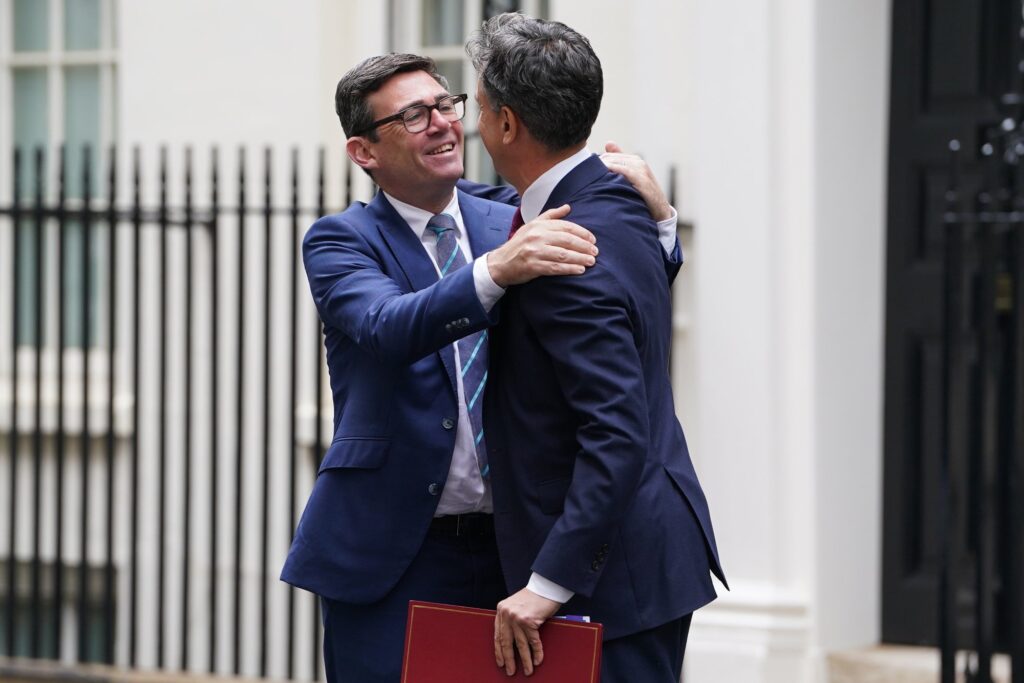

We Americans thought Britain’s standing could not fall further under Sir Keir Starmer. Then Andy Burnham handed the Foreign Office to Ed Miliband.
Viewed from Washington, the US-UK relationship rests on a simple principle: does London treat alliances as interests or as a stage on which to display its virtue? Starmer failed that test with the Chagos Islands. He pushed a handover. President Donald Trump called it a “great act of stupidity” and left Washington asking whether Britain still understood the strategic importance of Diego Garcia.
Read Also: Travellers win long-running planning row after pitching up on picturesque rural site
Burnham was supposed to be different. Instead, he persists in the mad Chagos deal and put Miliband in charge of Britain’s foreign policy. Those of us who predicted disaster in this appointment are being proved right in real time.
Miliband made his name lecturing Britain about climate change. Now he occupies the office that helps determine whether Britain is taken seriously in Washington and around the globe. And his first major foreign policy act has been to pick a fight with Israel.
That tells you rather a lot about this new government.
The fight was chosen. Burnham briefed Trump on Monday night. On Tuesday, Miliband went to the Commons and announced what he called a “comprehensive reset”. He did not stop at trade. He spoke of “settler terrorists”. He said ethnic cleansing is taking place in parts of the West Bank. He accused Israel of having “all too often… turned a blind eye”.
This is what passes for British diplomacy under Labour: another ministerial lecture, another display of moral superiority, another opportunity to distance from the US.
Israel has now responded. The British consulate in East Jerusalem is to close. British representatives assigned to the US-led Gaza coordination mission are to leave. Several British nationals, including MPs, have been barred from entering Israel.

As yet, Trump has not publicly objected to the measures.
The American reaction has come elsewhere. Ambassador to Israel Mike Huckabee has warned of “repercussions”. Florida Republican Congressman Randy Fine has pointed to the state’s anti-boycott law, under which companies that boycott Israel can be barred from certain state and local government contracts.
British businesses with Florida interests now have a reason to pay attention. Miliband will not be the one sitting in the boardroom explaining to them why Britain’s foreign policy has created an avoidable commercial problem.
The domestic timing is also striking. Ministers set a by-election in Starmer’s old Holborn and St Pancras seat, where Labour faces a Green challenge, and then brought the Israel measures forward. Whether the two events are politically connected is a matter of judgement. The sequence is not.
LATEST DEVELOPMENTS
- Israel closes UK consulate and bans 12 British officials amid Andy Burnham sanctions row
- Andy Burnham risks trade war with Donald Trump as US ambassador doubles down on Labour’s ‘Jew hate’
- Ed Miliband handed stark warning by Labour MP after announcing sanctions on Israel

Graham Stringer, a Labour MP, certainly saw the political danger. On GB News, he called the policy “student union politics”. He said it would “give license to people who want to attack Jews”. He said Jews in London, Leeds and Manchester would feel less safe. After visiting Heaton Park Synagogue, he asked whether the policy was a “cynical ploy to get back Muslim votes” and pointed to the Gorton and Denton by-election.
That was not a Conservative talking point. It was a Labour MP describing the government of which he is a member.
And there is a more serious issue than electoral arithmetic.
Iran and Russia are threats. Terrorism is a threat. Britain needs intelligence relationships with countries capable of helping protect British citizens. Israel has provided intelligence cooperation that British security officials have credited with helping prevent terrorist attacks. Tom Tugendhat, who saw that cooperation up close as security minister, has said so.
A trade restriction concerning settlements does nothing to strengthen that security relationship. It risks weakening it while giving Miliband another headline to take back to Westminster.
Burnham was sold as the blunt alternative to Starmer. The man who understood the North. The politician who supposedly had little time for Westminster’s metropolitan obsessions.
Yet when given power, he has kept the lecture and handed the microphone to Miliband.
Miliband’s first major foreign-policy intervention has been a confrontation with Israel at precisely the moment Britain’s relationship with Washington is already under strain.
Defence still looks hesitant. Chagos remains a running sore. Britain wants to be treated as a serious global power while repeatedly behaving as though foreign policy were an opportunity for ministers to advertise their moral credentials.
Burnham has not spoken to the Israeli Prime Minister since taking office but has found time to preview sanctions to the President of the United States.
Britain’s standing in America was earned in war, in sacrifice and in intelligence work that never makes the front pages.
Starmer began squandering it.
Burnham and Miliband are torching it.
For those of us Yanks who respect and love Britain, the situation is unbearable. In our hearts, Britain must remain a great power. The Labour government increasingly looks unwilling and incapable of behaving like one.
Our Standards: The GB News Editorial Charter