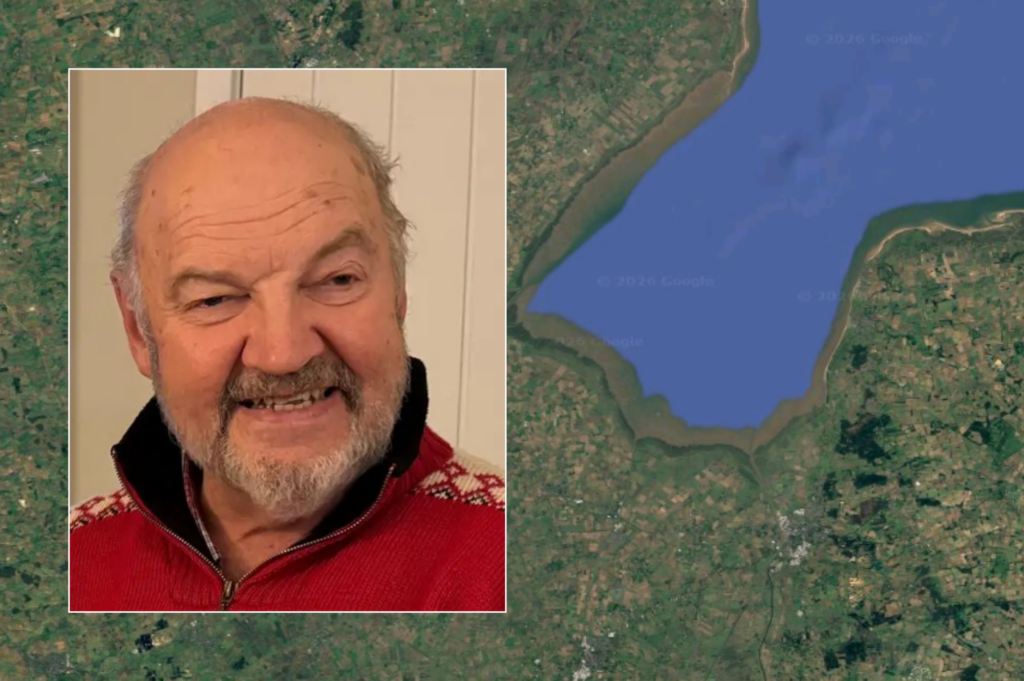

The remains of a colossal ancient supervolcano have been discovered off the coast of Norfolk.
The enormous volcanic structure spans at least 40 miles across and was found beneath The Wash, the shallow bay situated off the East Anglian coast.
Read Also: Travellers win long-running planning row after pitching up on picturesque rural site
It stretches into parts of modern-day Norfolk and Lincolnshire.
The volcano detonated approximately 454 million years ago with a force comparable to one million nuclear weapons.
According to scientists, an explosion of that magnitude would be capable of annihilating human civilisation if it occurred today.
Researchers at the British Geological Survey (BGS) believe this cataclysmic event may explain a previously mysterious disaster that blanketed vast swathes of northern Europe in volcanic ash.
Areas affected include Scandinavia, Poland and Belarus.
The find represents a dramatic shift in understanding of England’s deep geological history.

The identification was made possible by a fresh examination of rock samples originally extracted eight decades ago from deep boreholes at two sites, North Creake in Norfolk and Claxby in Lincolnshire.
These specimens had been preserved in the BGS archives at Keyworth in Nottinghamshire.
Within the samples, scientists found minuscule ash crystals, each tinier than a single human hair, which matched volcanic material previously analysed by the University of Oslo.
The groundwork for the discovery had been laid by academics at the University of East Anglia, whose earlier research had detected the unusual geophysical anomaly beneath The Wash.
LATEST DEVELOPMENTS
- Archaeologists may have discovered first-ever victim of trebuchet attack more than 700 years ago
- Blood Moon set to light up UK skies in just days as best spots to watch moment revealed
- Archaeologists discover 16,000-year-old turtle figurines at prehistoric ritual site

Together, these strands of evidence enabled BGS experts to confirm the presence of the vast supervolcano hidden deep below one of England’s most unassuming coastal landscapes.
Dr Tim Pharaoh of the BGS offered reassurance to the public.
He described the findings as a “fantastic result” that has transformed “our understanding of England’s geological past”.
Dr Pharaoh added: “Unlike faults, which can be seismically reactivated, a volcano can’t. Once it’s gone extinct, that’s it. Nobody needs to worry about the volcano erupting again.”

Globally, around 30 supervolcanoes are known to exist, with Italy’s Campi Flegrei being the closest to Britain.
The most recent truly apocalyptic super-eruption took place at Toba in Indonesia roughly 74,000 years ago.
The event was so devastating that genetic evidence indicates it reduced the entire human population to just a few thousand survivors.
New Zealand’s Taupo, which last erupted 25,500 years ago, is considered overdue for another major event.
Our Standards: The GB News Editorial Charter