
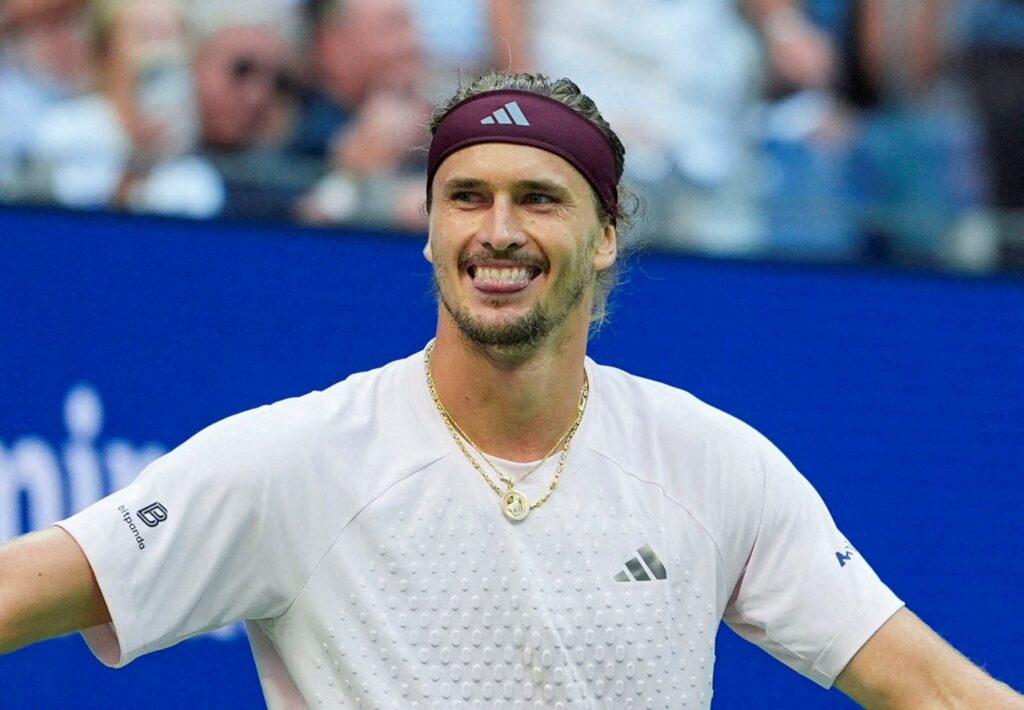

Alexander Zverev has admitted he does not know why his lengthy serving routine has become more extreme after it annoyed Karen Khachanov during their US Open semi-final.
The German booked his place in Sunday’s final against Ben Shelton by securing a 6-3, 7-6, 7-6 victory at Arthur Ashe Stadium.
Khachanov threatened to force his way back into the contest during the second and third sets but failed to capitalise on his opportunities.
His latest defeat marked the third time he has fallen short in a Grand Slam semi-final.
Read Also: Urgent probe launched after Southport attack victims' files accessed in major data breach
Read Also: Briton saves five bears from cages in South Korean camp in extraordinary rescue mission
However, it was Zverev’s habit of repeatedly bouncing the ball before serving that became a major talking point following the match.
Khachanov claimed the routine made it difficult to prepare for the incoming serve and insisted he was not the only player who found it frustrating.
“The way he bounces the ball, look, it annoys not only me, but, of course, a lot of players, because it takes so much time,” the Russian said.
“You don’t know how to prepare for the serve; you are ready, then it’s another 12 bounces.

“Every point is like that.”
Despite his irritation, Khachanov acknowledged that Zverev was entitled to continue with the routine provided he remained within the permitted time.
“If it’s within the rules regarding the time, I cannot say anything against that, because it’s in the rules,” he added.
“If he extends the time, he gets a time violation, simple as that.”
LATEST SPORTS NEWS:
- Aston Villa unhappy with new Premier League rules as referees face mounting pressure
- Former Sky Sports reporter claims broadcaster ‘didn’t really rate me’ and says football career is over
- Rory McIlroy makes two complaints after struggling at Irish Open

Chair umpire Damien Dumusois issued Zverev with one time violation towards the end of the opening set but did not punish him again.
Khachanov refused to demand greater intervention during the match, arguing that monitoring the clock was the official’s responsibility.
“It’s the job of the umpire to notice and be more aware, and actually take action,” he explained.
“It’s up to him, not to me.”
Zverev was subsequently asked why the number of bounces had increased so dramatically during the tournament and insisted it was not a deliberate tactic.
“I have no idea why,” the top seed admitted. “I’m not doing it on purpose!
“I saw the stat, I bounced it 12,000 times or something like that, it’s quite funny.
“I’m not counting in my head; I’m not getting a certain number or anything like that. I don’t know why it increased so much.”

Zverev revealed that seeing the statistic before facing Khachanov had briefly prompted him to shorten the routine.
“I think today it decreased because I saw it before the semi-final, so I was like, Ok, it’s got to go down,” he said.
“But then I forget about it every once in a while, and then it goes up.”
When pressed on what eventually tells him to stop bouncing the ball and begin his service motion, Zverev remained unable to offer an explanation.
“No clue, honestly, really honestly, no idea,” he replied.
Shelton will now be the next player required to contend with that unpredictable routine when he faces Zverev for the US Open title on Sunday.
Our Standards:
The GB News Editorial Charter