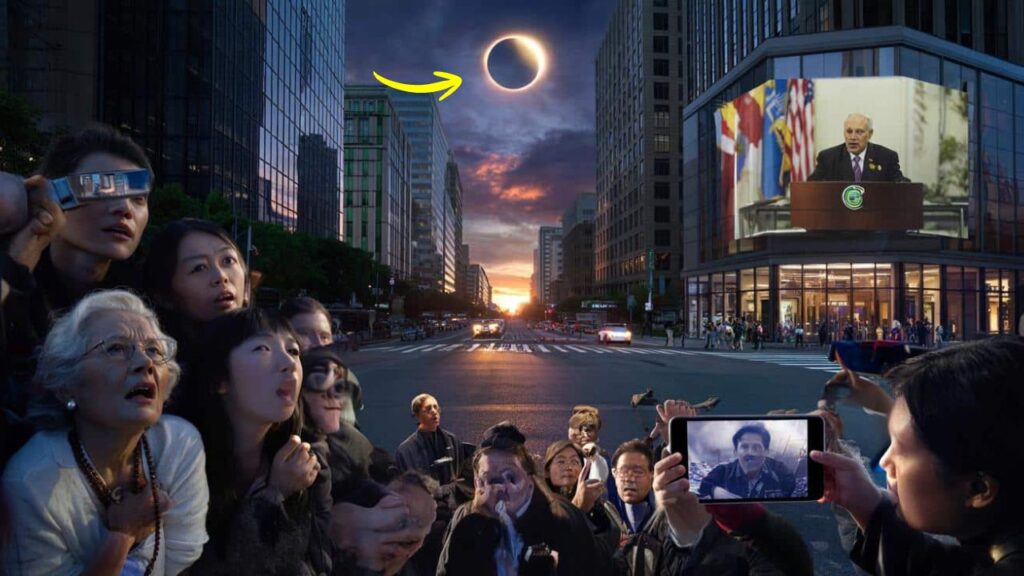
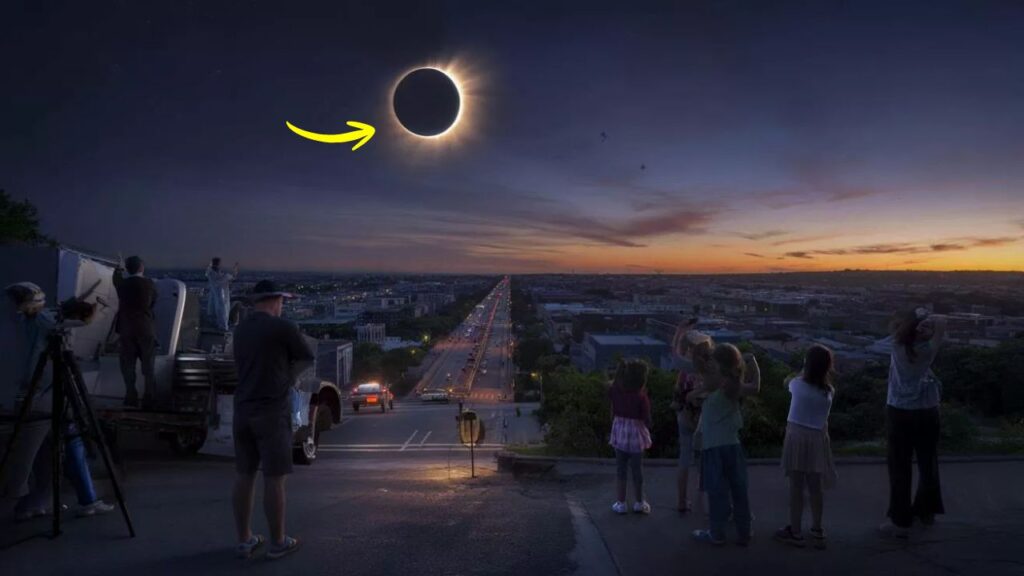
Around midday, the city felt wrong. Birds that usually screamed over the rooftops went strangely quiet. The traffic noise dropped to a kind of hush, as if someone had put a blanket over the world. People came out of offices and shops, phones already held up, eyes squinting behind cardboard eclipse glasses that made everyone look like characters from a low-budget sci-fi movie.
The light turned a weird, metallic silver. Shadows sharpened as if drawn with a marker.
Somewhere, a child asked, “Is the sun broken?” A man in a suit laughed nervously, as if he wasn’t sure of the answer himself.
Then, in one slow, impossible breath, the day folded into night. Street lamps flickered on mid-sentence. A dog started howling. And for a few long seconds, nobody thought about emails, or bills, or notifications.
Something old, and cosmic, and very real stepped into the room.
This is not a description of a movie. This is what happens when you stand in the path of a total solar eclipse—especially this one. Scientists call it the longest total solar eclipse of the century. For the rest of us, it’s the first time we’ll watch midday pretend to be midnight.
And it messes gently, but deeply, with the way we think about “normal.”
Table of Contents
The Light That Forgets How to Be Light
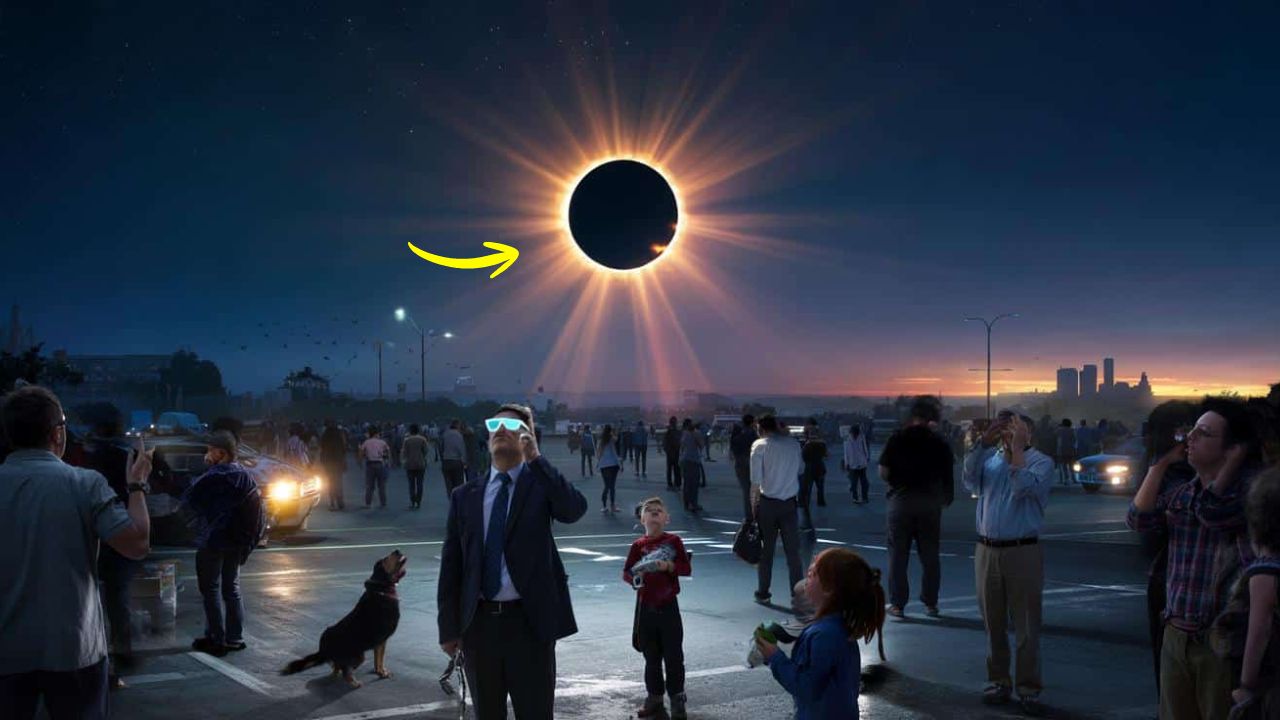
A total solar eclipse doesn’t just dim the sun. It rewrites the atmosphere. Colors drain from the landscape like someone has slid a filter over reality that no smartphone camera has quite nailed yet. You feel it in your chest as much as you see it with your eyes.
The temperature drops. Conversations slow. People who were scrolling TikTok ten minutes ago are suddenly whispering like they’ve stumbled into a cathedral.
During the 2024 eclipse in North America, residents in one Texas town described birds diving for their nests, cows heading toward barns, and neighborhood porch lights popping on like a nervous reflex. One woman told local reporters she burst into tears without really knowing why. She was standing in a supermarket parking lot, plastic eclipse glasses slipping down her nose, surrounded by strangers who had suddenly gone quiet.
“It felt like the world paused,” she said. “Like we got a trailer for the end of the movie.”
Multiply that by a longer, deeper darkness—stretching across countries, lasting minutes instead of seconds—and you start to grasp the emotional scale of what’s coming.
The Boring Precision Behind the Poetry
Behind the awe, the mechanics are almost boringly precise. The moon’s orbit lines up just right. The distances hit a narrow sweet spot. The tiny disk of rock that usually looks so small in the night sky perfectly hides the blazing face of the sun.
During this particular event, that alignment will hold longer than any living person is likely to see again.
Astronomers are giddy. A stretched-out window of totality means a rare chance to study the solar corona—the sun’s outer atmosphere—in clean detail. Weather nerds will track the temperature drop minute by minute. City planners will nervously eye power grids and traffic flows.
Everyone else? They’ll be standing somewhere with their mouths slightly open, quietly negotiating their place in the universe.
How to Actually Experience It, Not Just Film It
The biggest difference between watching a viral eclipse video and living through this one is simple: preparation. Not the Pinterest kind. The “where will my body be when the sky goes dark?” kind.
The path of totality will be a narrow ribbon. Step outside it, and you’ll miss the full shock of day turning to night. That means maps, timing, and probably at least one slightly chaotic car trip.
Start by picking a spot directly under that path, even if it’s a boring field or a dusty parking lot. Then build the rest of the day around that point like it’s a friend’s wedding. Travel early. Leave buffer time. Choose comfort over drama.
You don’t need the perfect Instagram background when the sky is the main character.
The Gear You Actually Need (And What to Leave Home)
Let’s be honest: nobody really rehearses looking up at the sky. Most people will grab whatever they have, stand outside a mall, and hope their phone’s “eclipse mode” will somehow capture the moment. That’s one way to do it. It’s also how you end up watching the whole event through a 6-inch screen while your actual eyeballs miss the show.
Experts repeat this like a mantra for a reason: you need certified eclipse glasses or indirect viewing gear for everything except the brief, total blackout. No sunglasses. No stacking three pairs. No “I’ll just glance up quickly.” Eyes don’t grow back.
At the same time, try not to go full prepper with a suitcase of gear you barely understand. You want just enough protection and planning that you can relax into the weirdness when the light finally breaks.
Pack lightly, but smartly:
Certified eclipse glassesSimple pinhole projectorWater and snacksA light layerBlanket or chairOne recording device
ItemWhy You Need It One pair per person, plus a spare. Non-negotiable. A backup viewing method, easy to make from cardboard. You’ll be outside longer than you expect. Temperatures can drop noticeably during totality. Comfort matters when you’re looking up for minutes. Use it sparingly. Put it down when totality hits.
You’ll remember the goosebumps more than the footage anyway.
The Thing That No Photo Captures
During totality, something subtle happens that no camera can reproduce: people stop acting like strangers.
The shared gasp. The collective “whoa.” The way conversations dissolve into pure reaction. One astronomer I spoke to after a previous eclipse put it like this:
“It’s one of the last things that makes grown adults point at the sky and forget how they look doing it. For a few minutes, we’re all just animals under a changing sun.”

To give that feeling room, think less about content and more about presence. You don’t need to capture every second. You need to be there for every second.
What the Animals Know
The natural world does not understand eclipses. It only understands that day suddenly became night, and that has never meant anything good.
Birds will quiet or head for roosts. Insects will change their patterns. Pets may act unsettled, as if a storm is coming that they can’t quite hear. The temperature can drop several degrees. The wind may shift.
The whole scene takes on a strangely late-evening feel in the middle of the day.
For a few minutes, the world operates on a different set of rules. And we get to witness it.
When the Sky Goes Dark, What Do We Do With That Feeling?
There’s a particular kind of silence that falls during a total solar eclipse. It isn’t empty. It’s charged. Like the pause before an answer you’re not sure you want to hear.
That silence has spooked kings, launched myths, and nudged whole cultures into new stories about who’s in charge of the heavens. In the century we’re living through, it arrives in a world of push notifications, satellite internet, and climate anxiety. That changes the texture, but not the core.
Some will treat this longest eclipse as a science festival. Others will call it a sign, good or bad. Most will experience it as an interruption of routine so pure that it feels almost illicit—as if time itself has stepped outside for a cigarette.
The day will turn to night. And then, almost rudely, snap back to business hours.
What lingers are the questions you don’t ask out loud. Where was I when the sun disappeared? Who was I standing next to? What did my own small life feel like under a sky that suddenly remembered how to surprise me?

Those questions don’t have answers. They just have echoes. And if you’re lucky, they’ll follow you for a long, long time.
In-Depth FAQs: Your Questions Answered
How long will total darkness actually last?Depending on where you stand along the path of totality, the sun will be fully covered for several minutes—longer than any other eclipse this century. Outside that narrow band, you’ll only see a partial eclipse and never get true night.
Is it safe to look at the eclipse with the naked eye at any point?It’s only safe during the brief phase of totality, when the sun is completely blocked and you see the corona as a glowing ring. The second even a sliver of sun reappears, you need your eclipse glasses or indirect viewing again. No exceptions.
Do I really need to travel to the path of totality?You’ll still see the sun get bitten away in a partial eclipse outside the path. But you won’t experience that full “day to night” transformation. If you can travel without major stress, being under totality is a very different, deeper event.
Can my phone camera capture the eclipse properly?Most phones can record something, especially in wide shots that include the changing light and people’s reactions. For close-ups of the sun itself, you’d need filters and specialized gear. Without them, your results will be small, blown-out blobs. Focus on filming the atmosphere, not just the disk.
What will animals and nature do during the eclipse?Expect birds to quiet or head for roosts. Insects will change their patterns. Some pets may act unsettled, as if night has arrived early. The temperature can drop several degrees, and the wind may shift. The whole scene takes on a strangely late-evening feel in the middle of the day.