
NASA Issues Solar Flare : NASA has issued urgent warnings about a barrage of powerful solar flares erupting from the Sun in early February 2026, with potential disruptions looming for the United States.
These events, captured live by NASA’s Solar Dynamics Observatory, mark some of the strongest solar activity in years, raising concerns for power grids, communications, and everyday tech across America.
Table of Contents
The Sun Unleashes Fury
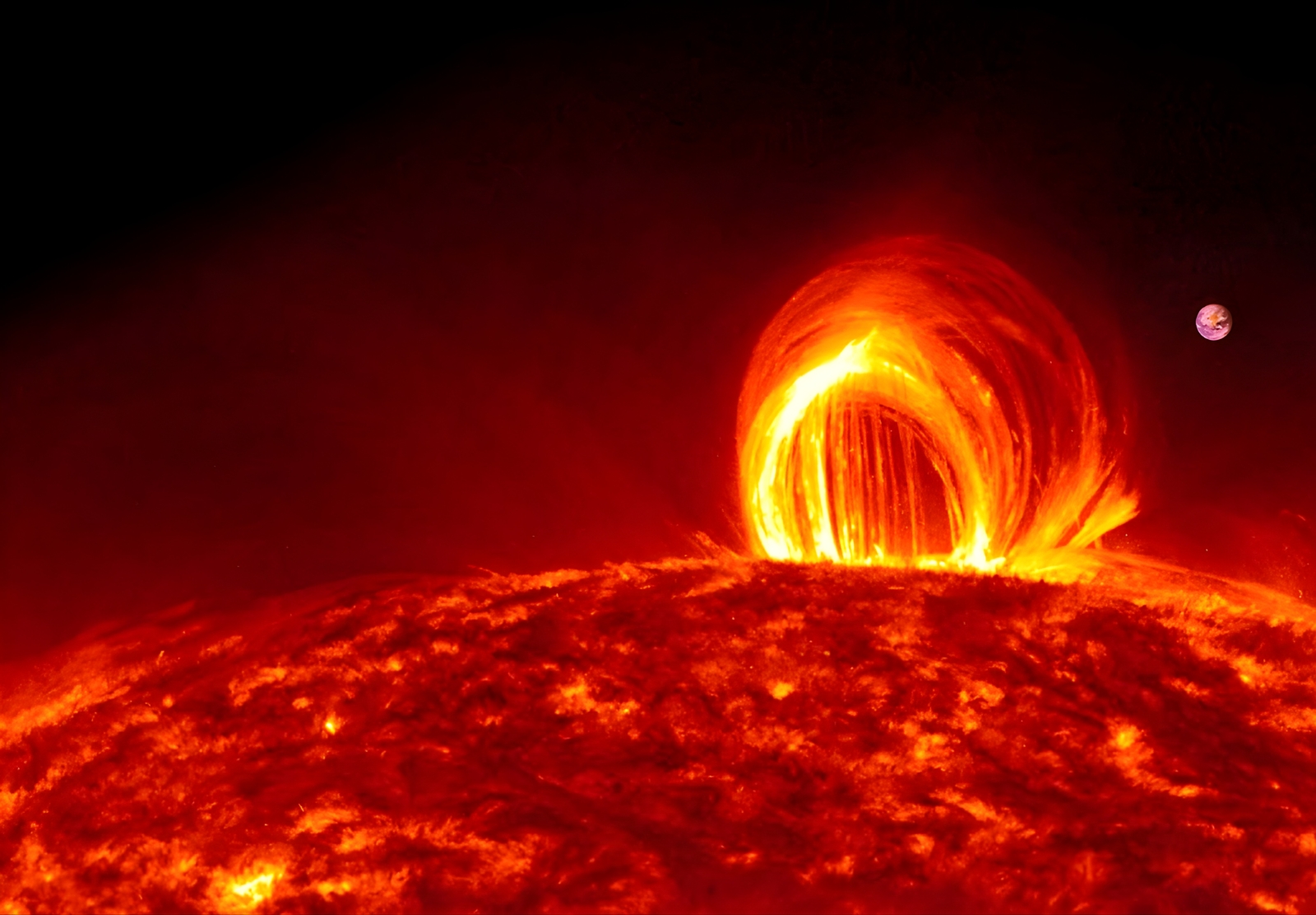
Just days ago, on February 4, the Sun blasted out an X4.2-class solar flare, peaking at 7:13 a.m. ET, one of six X-class monsters in the first four days of the month.
X-class flares are the heavyweight champions of solar eruptions, packing energy equivalent to millions of hydrogen bombs exploding at once.
NASA’s constant vigil with spacecraft like SDO revealed these blasts originating from unstable sunspots, where twisted magnetic fields snap like over-stretched rubber bands.
This isn’t a one-off; the Sun has been on a rampage. An X8.1 flare lit up February 1, followed by X2.8 and others, all during the tail end of solar maximum from 2024. Scientists at NASA’s Goddard Space Flight Center describe it as the Sun flexing its muscles in an 11-year cycle, but this intensity has everyone on edge.
How Solar Flares Work – A Fiery Explosion Explained
Picture the Sun’s surface as a boiling pot of plasma, heated to 10,000 degrees Fahrenheit, where magnetic loops build up and then violently reconnect.
When they do, they release a torrent of radiation – X-rays, ultraviolet light, and energetic particles – hurtling toward Earth at light speed. Unlike coronal mass ejections (CMEs), which are slower plasma clouds that can trigger auroras and storms, flares hit fast and hit hard.
These bursts don’t just dazzle; they superheat the ionosphere, the upper layer of Earth’s atmosphere that bounces radio waves.
For Americans, that means potential blackouts in high-frequency radio signals, affecting aviation, maritime ops, and even amateur ham radio enthusiasts tuning in from backyards.
NASA emphasizes that while the flares themselves don’t carry particles far, accompanying CMEs could amplify the chaos if aimed right at us.
Direct Hits on America: Power Grids at Risk
In the U.S., the real worry is cascading effects on our wired world. Flares like the recent X4.2 can induce geomagnetic currents in long power lines, from California’s sprawling grids to New York’s urban networks.
Think back to the 1989 Quebec blackout, when a milder storm knocked out power for six million people – today’s infrastructure is bigger, but so are the vulnerabilities.
NOAA, partnering with NASA, warns of radio blackouts across the sunlit U.S. side, disrupting air traffic control and emergency services.
GPS signals could glitch too, throwing off everything from Uber rides to precision farming in the Midwest. Satellites in orbit face radiation pummeling, with older ones potentially frying electronics, as seen in past events where spacecraft went into safe mode.
Everyday Life Disrupted – From Flights to Phones
Imagine boarding a flight from LAX to JFK only for pilots to lose HF comms mid-air; that’s the scenario playing out in simulations right now.
Polar routes, popular for transatlantic hops, see heightened radiation risks, prompting airlines to reroute. On the ground, AT&T or Verizon users might notice spotty service if ionospheric scintillation scrambles signals.
Aurora chasers are thrilled – northern lights could dance as far south as Alabama if a G3 storm hits – but utilities brace for voltage spikes that trip transformers.
Even your smart fridge or EV charger could hiccup if the grid fluctuates. NASA reports no major outages yet from these flares, but the February 4 event’s CME is under close watch for a glancing blow by February 6.
NASA’s Vigil and Tech Defenses
NASA’s fleet – SDO, SOHO, and Parker Solar Probe – provides real-time eyes on the Sun, feeding data to NOAA’s Space Weather Prediction Center.
They’ve issued R3-strong radio blackout alerts, urging satellite operators to power down non-essentials. In the U.S., FEMA and DHS are looped in, with grid operators like PJM Interconnection testing hardening measures post-2025 storms.
Experts like NASA’s solar physicist Dr. Alex Young (paraphrased from blogs) note we’re in a hyperactive phase, but predictions are tricky – models forecast arrivals within 24-48 hours, but speeds vary. Advances like AI-driven forecasting are helping, but human oversight remains key.
Historical Echoes: Lessons from Past Storms
The 1859 Carrington Event dwarfed these, igniting telegraph wires and visible auroras in Hawaii. Fast-forward to 2003: an X45 flare (estimated) caused Swedish blackouts and satellite drag.
Recent U.S. scares, like the 2024 G5 storm, lit up skies but spared major damage thanks to warnings. Today’s flares echo that, with six X-classers stacking up risks.
America’s grid has improved with transformers shielded against geomagnetically induced currents (GICs), but experts warn a perfect storm could still cost billions.
NASA Issues Solar Flare Looking Ahead: What Comes Next for Solar Max
Solar Cycle 25 peaks behind us, but activity lingers into 2026, promising more fireworks. NASA urges preparedness: backup power for critical ops, radiation monitors on flights, and public apps like NOAA’s Space Weather Live.
Upcoming missions like ESCAPADE will probe Mars’ magnetosphere for better Earth analogs. As President Trump’s administration eyes space leadership, these events underscore U.S. reliance on solar sentinels.

SCIENCE MARVELS – READ MORE : Hidden Secrets of 350-Year-Old Shipwreck Revealed After Archaeologist’s 14-Year Dive Uncovers Remarkable Historical Artifacts
FAQ
What causes solar flares? Magnetic reconnection on the Sun’s surface releases pent-up energy in seconds.
Can this flare cause blackouts in the U.S.? Possible if CME hits directly; grids are monitored, minor risks now.
Are solar flares dangerous to humans? No direct harm on ground; astronauts and high-altitude flights face radiation.
How does NASA track them? SDO watches 24/7 in multiple wavelengths.
When might effects peak? CME from Feb 4 flare: possible Feb 6; check NOAA.
Will I see northern lights? Yes, potentially in northern U.S. states if G2+ storm.





Latest Comments