
Face of Vampire : A startling scientific breakthrough has brought the face of a suspected 18th-century “vampire” back to life, captivating Americans with a blend of history, horror, and cutting-edge forensics.
Discovered in a Connecticut graveyard, this man’s gruesome burial hints at the dark superstitions that gripped early settlers amid tuberculosis outbreaks.
Table of Contents
Unearthing the Vampire Panic
Back in the late 1700s, rural New England was plagued by a mysterious illness we now know as tuberculosis, but locals called it “consumption.” Families watched loved ones waste away, coughing blood, convinced the dead were rising to drain the living of life force.
This led to the “Great New England Vampire Panic,” where graves were disturbed to “kill” the undead suspects. In Griswold, Connecticut, archaeologists in 1990 stumbled upon one such grave during a routine dig.
The skeleton, dubbed JB55 from brass tacks on his coffin spelling his initials and age (55), lay with femurs crossed over his chest like a skull-and-crossbones warning. This mutilation was meant to pin him down, preventing any nocturnal prowls.
No serial killer was at work, as police first feared; instead, it was folklore in action. Poor John Barber, a farmer likely felled by TB, became a scapegoat for community terror. His grave’s position on a hillside farm cemetery sealed the vampire theory.
A Violent Life, A Feared Death
Bioarchaeological clues paint JB55 as no stranger to brutality. Forensic analysis revealed healed fractures from at least one severe beating, suggesting a rough existence on the frontier.

Tuberculosis probably finished him, but his disfigurement and combative history fueled fears he’d return as something monstrous.
Experts note that “vampire” accusations often targeted outsiders—those with strange behaviors, diseases, or social deviance.
In JB55’s case, his marginal lifestyle and visible scars made him a prime suspect. Communities exhumed bodies, staking hearts or rearranging bones to stop the curse.
This panic peaked around 1830 but echoed earlier European traditions brought by colonists. Stones on chests, decapitations, or face-down burials were common “protections.” JB55’s crossed legs were a classic Yankee twist on the ritual.
Forensics Meets Folklore
Fast-forward to modern times: In 2019, scientists extracted DNA from JB55’s skull, running it through genealogical databases.

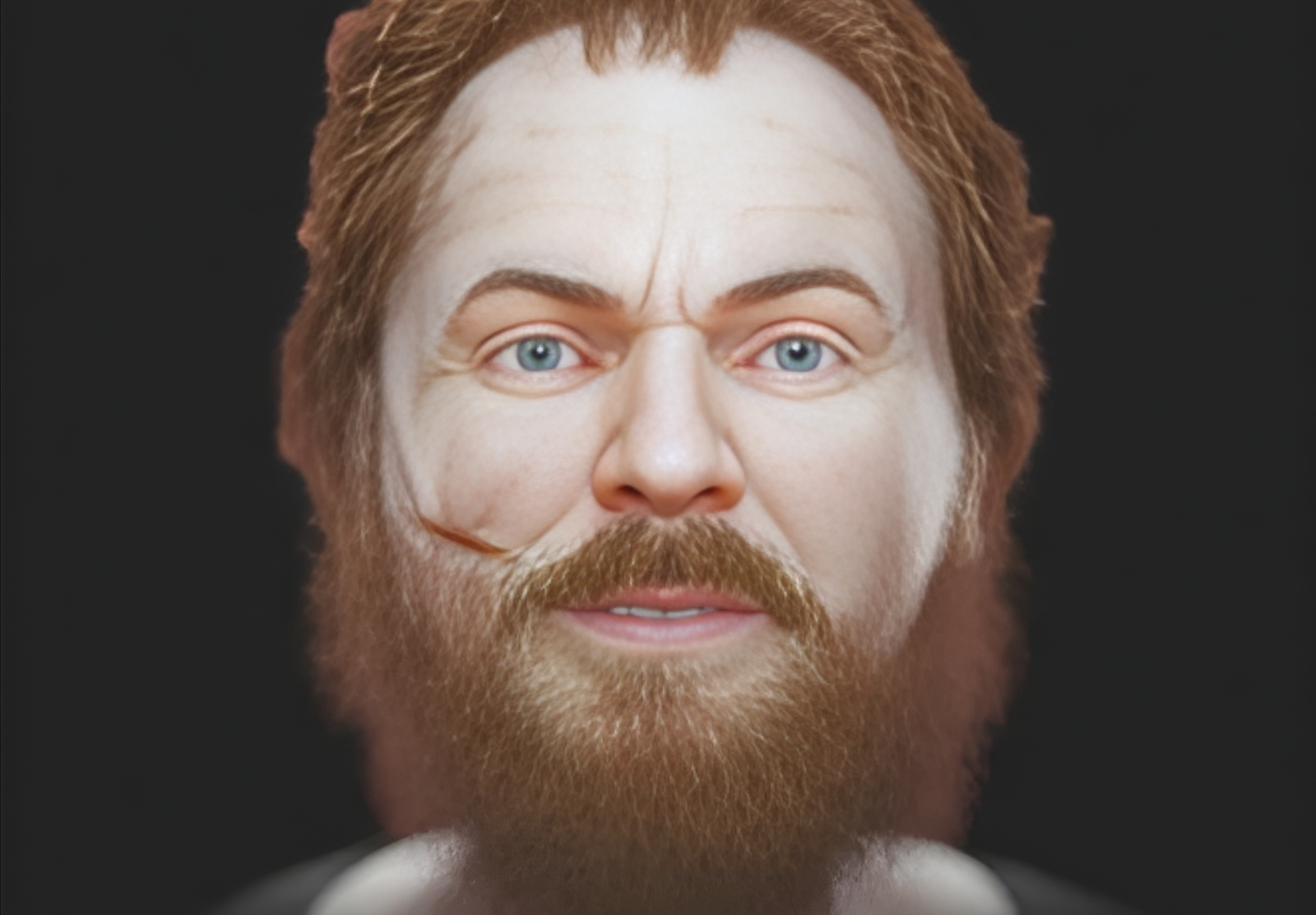
They identified him as John Barber, a humble farmer with English roots. No supernatural fangs—just a human victim of panic and plague. Then came the facial reconstruction by Virginia Commonwealth University (VCU) researchers.
Using CT scans, 3D modeling, and tissue-depth data, forensic artist Katie Cunningham layered muscle, skin, and features onto the digital skull.
The result? A stern, middle-aged man with a square jaw, prominent brow, and piercing eyes that stare out from history.
Parabon NanoLabs handled the DNA phenotyping, predicting traits like brown hair, fair skin, and a medium build. Released in early 2023, the image went viral, bridging 200-year-old horror with today’s true-crime obsession.
Echoes in Modern America
JB55’s story resonates today amid ongoing vampire myths in pop culture—from Twilight to The Vampire Diaries.
But it also spotlights real health scares mistaken for the supernatural, like TB’s bloody cough mimicking blood-drinking.
Connecticut’s vampire graves aren’t unique; over 80 cases surfaced across New England. Dedham, Massachusetts, saw hearts burned in 1810. Each tale underscores immigrant folklore clashing with harsh colonial life.

Recent recreations, like a 400-year-old Croatian “vampire” face from 2026 digs, show global parallels—beheadings and stones to thwart the undead. Yet JB55’s American face humanizes the legend, reminding us fear turns neighbors into monsters.
Cultural Impact and Legacy
Hollywood loves this lore: Films like 30 Days of Night draw from panic tales, while books like Deborah Blom’s The Vampire in New England detail graves. Museums now display JB55’s replicas, drawing history buffs.
Public reaction? Social media exploded with “He looks like my uncle!” memes, blending awe and chills. It sparks debates on how disease shapes society—from AIDS stigma to COVID conspiracies.
Experts urge context: These weren’t psychopaths but terrified folks using rituals for control. JB55’s face forces us to empathize with the past’s paranoia.
Vampire Burials Across the U.S.
SiteYear DiscoveredKey FeaturesLikely CauseGriswold, CT (JB55)1990Femurs crossed on chestTuberculosis panic Dedham, MA1810 (exhumed)Heart removed and burnedConsumption outbreak North Smithfield, RI1790sSkull in torso, bones arrangedFamily TB deaths Jewett City, CT1990sStakes through coffinFolklore ritual
This table highlights patterns in New England sites, all tied to 18th-19th century fears.
SCIENCE MARVELS – READ MORE : Haunting 3D Scans Reveal Chilling Faces from the Past — Scientists Use Cutting-Edge Imaging to Recreate Long-Lost People and Mysterious Artifacts in Stunning Detail
Face of Vampire
John Barber’s recreated face shatters vampire myths, revealing a man caught in superstition’s grip. As forensics revives the past, it warns against letting fear rewrite history—today’s panics could bury tomorrow’s truths just as deeply. His story endures as a poignant American footnote, where science finally gives the “undead” peace.

FAQ
Who was the “Face of a Vampire”? John Barber (JB55), an 18th-century Connecticut farmer buried as a vampire due to TB suspicions and anti-rituals.
Why was he called a vampire? Crossed leg bones pinned his chest, a common 19th-century method to prevent undead rising during TB epidemics.
How was his face recreated? Using DNA analysis, CT scans, and 3D forensic modeling by VCU experts for accurate tissue reconstruction.
Are there other U.S. vampire burials? Yes, dozens in New England, like Rhode Island and Massachusetts, all linked to consumption folklore.
What does this mean today? It shows how diseases fuel myths, urging better understanding of historical panics and modern health fears.







Latest Comments