
China’s Space Robot Dogs : Deep in the shadowy caves mimicking the moon’s hidden tunnels, China’s latest innovation—robotic dogs built for space—has ignited a fresh wave of concern across American defense circles.
These four-legged machines, straight out of a sci-fi thriller, are training to scout lunar lava tubes ahead of Beijing’s ambitious astronaut landings.
As President Trump’s administration ramps up its own space push, whispers in Washington suggest these bots could tip the balance in the new space race.
Table of Contents
The Birth of Lunar Scouts
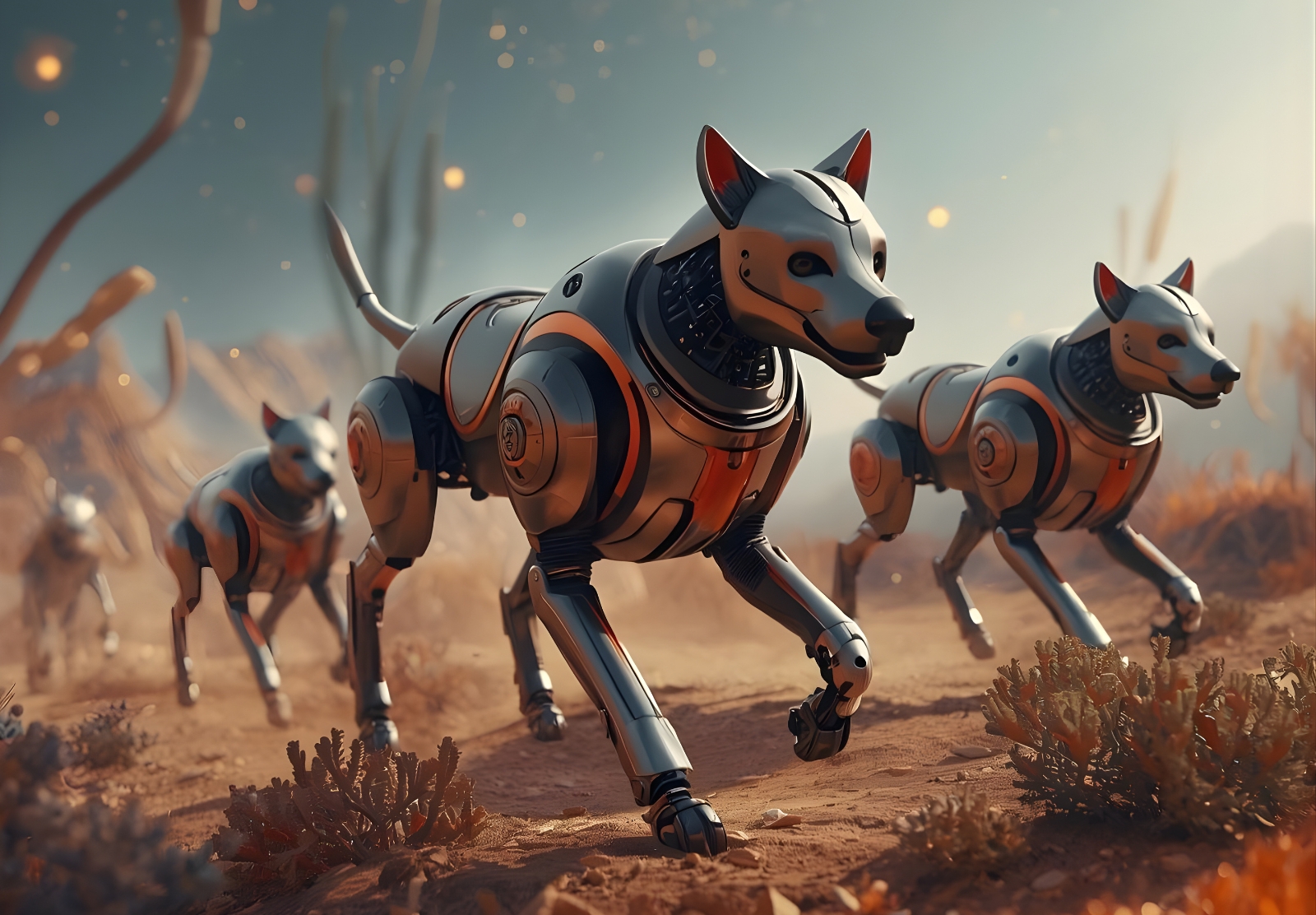
Robot dog with red flag and blue orb navigating rocky moon simulation terrainResearchers at Peking University unveiled two custom robotic dogs designed specifically for deep-space probing.
These aren’t your average Unitree knockoffs; they’re engineered with advanced “embodied intelligence” to handle the moon’s unforgiving underground voids.
Tested in a frigid lava cave near Jingpo Lake in northeastern China, the bots proved their mettle by dodging jagged rocks, mapping out 3D structures, and snapping high-res scans—all on their own.
Lead developer Zhang Shanghang called the site a dead ringer for lunar lava tubes, those natural bunkers perfect for shielding future bases from radiation and micrometeorites.
Picture this: a pair of metallic hounds slinking through pitch-black passages, planting tiny Chinese flags as they go, just like in the viral test footage.

It’s all part of China’s blueprint to crack open the moon’s south pole by 2030, where water ice lurks as fuel for long-haul missions.
Why Lava Tubes Matter So Much
Lunar lava tubes aren’t just cool geology—they’re humanity’s best bet for surviving on the moon. These collapsed tunnels from ancient eruptions offer stable temps, protection from solar flares, and potential ice deposits for drinking water or rocket propellant.
China sees them as prime real estate for the International Lunar Research Station, a joint venture with Russia eyed for 2035. Sending robot dogs first makes sense: humans can’t risk cave-ins or getting lost in the dark.
US Watches with Growing Worry
Red quadruped robot dog next to large gray boulder on sandy terrain with black backdropFrom the Pentagon to NASA headquarters, America’s space hawks are buzzing.
China’s bot pack arrives as NASA’s Artemis program stumbles—Artemis II now slips toward late 2026 amid technical glitches and budget overruns.
President Trump, fresh off his 2024 reelection, has vowed to reclaim US lunar dominance with beefed-up funding for Space Force and private partners like SpaceX.
But Beijing’s steady clip—Chang’e-6 sample grabs last year, now these dogs—feels like a sprint while the US jogs.

Defense analysts fret over dual-use tech: those same navigation smarts could scout military outposts or even orbital assets. With China flexing rifle-packing robot dogs on Earth, lunar versions raise eyebrows about hidden agendas.
Tech That Powers the Pack
At their core, these quadrupeds pack LiDAR for 3D mapping, AI brains for split-second obstacle dodges, and grippy legs tuned for low-gravity slips.
Peking’s team juiced “embodied intelligence,” letting dogs learn from trial runs like real pups chasing sticks.
No humans pulling strings—these roam solo, building maps precise enough to guide landers. Battery life? Tuned for hours in vacuum chill, with modular payloads for drills or spectrometers.
It’s evolutionary: from Boston Dynamics’ Spot inspiring early models, to China’s tweaks for space extremes. Videos show them hauling flags over rubble, hinting at payload capacities for science gear.
Beijing’s Bigger Lunar Ambitions
This isn’t a one-off stunt. China’s space sprint includes the Long March 10 mega-rocket, tested in 2025 sims, and taikonauts aiming for moonwalks before decade’s end. Robot dogs slot into a swarm strategy—drones overhead, crawlers below.
The south pole prize? Shadows hiding ice for hydrogen-oxygen fuel, key to hopping to Mars. Partners like Russia bring nuclear tech; others may join to counter US-led Artemis Accords.
Critics call it aggressive expansionism, but Beijing frames it as peaceful science. Still, with Shijian satellites shadowing US assets, trust runs thin.

America’s Counter-Moves
NASA isn’t sleeping—its own dog-like rovers sniff Martian dunes, and VIPER buggy eyes lunar ice. But delays plague crewed returns, fueling calls for urgency.
Trump’s Golden Dome missile shield eyes space threats, while SpaceX Starships promise cheap lunar hops. Expect more US robot scouts soon, perhaps armed with better AI from xAI ties.
Bipartisan lawmakers push bills to bar Chinese lunar leases, fearing resource grabs. The race? It’s on, with bots as the vanguard.
Global Ripples and Rival Plays
Russia eyes joint moon bases; India, Japan test their landers. Private firms like Intuitive Machines crash-land successes, blurring lines between nations and corps.
Yet tensions simmer—China gripes US satellites too close; Washington calls out “dogfighting” maneuvers. No new space treaty in sight as New START expires.These robot dogs? A wake-up that space is contested turf, where four legs beat two for first dibs.
Strategic Edge in the Shadows
Deploying bots underground gives China intel gold: stable tube spots for habitats, ice veins for sustainability. US sims lag; NASA’s clunky rovers prioritize surface treks.
China’s Space Robot Dogs
China’s robot dogs herald a robotic vanguard reshaping lunar quests, forcing the US to accelerate or cede ground.
As these mechanical explorers delve into moon shadows, the stars-aligned rivalry promises breakthroughs—and brinkmanship—for generations. Victory goes to the swiftest swarm.
SCIENCE MARVELS – READ MORE : Groundbreaking Pig Lung Transplant Gives New Hope: Scientists Achieve First Successful Pig‑to‑Human Organ Procedure in Medical History
FAQ
What sparked China’s robot dog lunar tests? Peking University researchers sought to mimic moon lava tubes in a Chinese cave for base scouting.
When does China plan moonwalks? Target: before 2030, with station by 2035.
How do US efforts stack up? NASA’s Artemis faces slips; robots focus surface over subsurfaces.
Could these dogs have military uses? Dual-use AI raises flags, echoing armed Earth variants.
What’s next for the bots?







Latest Comments