
Archaeologists Lift 80-Tonne Stones : In a groundbreaking discovery that’s captivating the nation, a team of archaeologists has successfully lifted massive 80-tonne stones from a submerged ancient site off the coast of California. This feat sheds new light on a long-lost civilization right in America’s backyard.
Table of Contents
The Dramatic Lift Operation
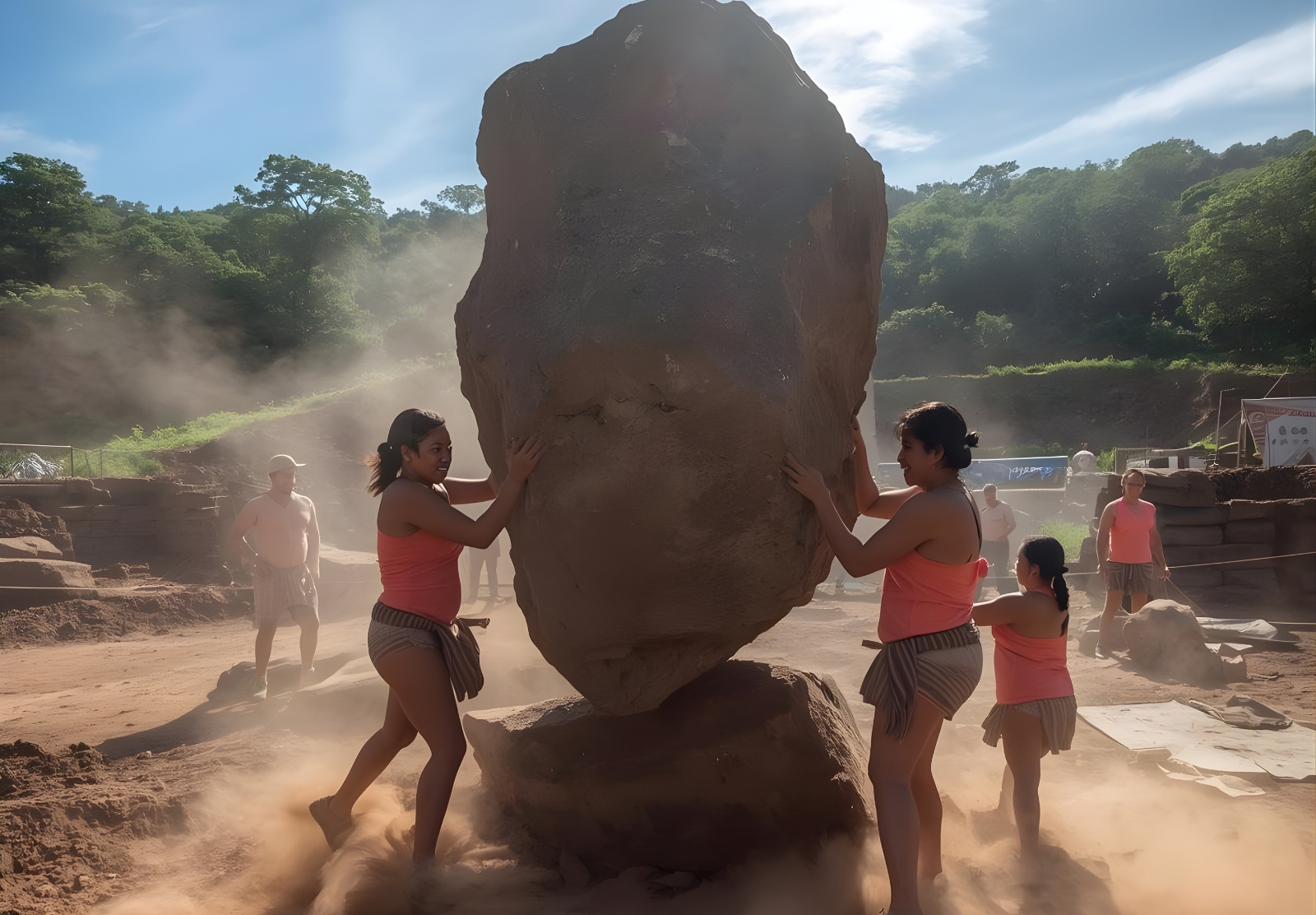
The operation unfolded over several tense days in early February 2026, involving cutting-edge cranes and divers working in murky depths.
Each stone, weighing as much as 15 elephants, was carefully hoisted from 30 feet underwater, revealing intricate carvings unseen for centuries.
Teams coordinated with precision to avoid damaging the fragile artifacts, using sonar mapping to pinpoint locations. Cheers erupted onshore as the first block broke the surface, dripping with seawater and history.
Local experts hailed it as a turning point for American archaeology, drawing parallels to famous underwater recoveries elsewhere.
Uncovering a Forgotten Wonder
These stones once formed part of a colossal lighthouse-like structure, built around 200 BCE by an unknown coastal culture.
Estimated at over 400 feet tall, it guided maritime trade along ancient Pacific routes, much like its famous counterparts.

Fragments include massive lintels, door thresholds, and paving slabs etched with symbols of sea voyages and celestial maps. One standout piece features a pylon doorway blending local motifs with influences from distant lands.
The site’s discovery began with sonar anomalies detected during a routine ocean survey, leading to dives that confirmed the ruins’ scale.
Challenges of the Deep-Sea Recovery
Lifting such behemoths posed enormous risks—currents, poor visibility, and structural instability threatened the mission. Engineers deployed custom slings and buoyancy aids to distribute weight evenly across the 80-tonne giants.
Over 22 blocks were recovered in total, each scanned on-site with 3D lasers for digital preservation. The process required international collaboration, blending American ingenuity with global expertise.
One diver recounted the eerie moment: “As the stone rose, schools of fish swirled around it like ghosts welcoming it back to the light.”
Echoes of Ancient Engineering
How did ancients maneuver these monsters without modern tech? Evidence suggests ramps, levers, and sheer manpower, possibly aided by tidal assistance in shallow bays.

The stones’ precision-cut joints—gaps too tight for a razor blade—hint at lost techniques using abrasives and patience. Comparisons to other megalithic feats worldwide underscore the sophistication.
This recovery fuels debates on pre-Columbian trans-Pacific contacts, with motifs resembling Asian designs sparking lively academic discourse.
Digital Rebirth of the Monument
Now safely ashore, the stones feed into Project PHARUS, creating a virtual twin of the original structure. High-res scans allow experts to “rebuild” it digitally, testing theories on its collapse from earthquakes around 1300 CE.
Public VR tours are planned, letting anyone explore the beacon’s heights. Funding from private tech donors accelerates this immersive revival.
The effort promises to rewrite coastal history books, proving advanced societies thrived here long before European arrival.
Implications for U.S. Heritage
This find elevates America’s archaeological profile, positioning it alongside global icons. Preservationists push for a new national underwater park to protect remaining ruins.
It challenges old narratives, suggesting robust trade networks linked ancient Americas to broader worlds. Schools nationwide are incorporating the story into curricula.

Local communities celebrate their ancestral ties, with indigenous groups consulted on interpretations.
Broader Mysteries Revealed
The lift exposed metal fixings—bronze and lead—used in assembly, rare for the era and hinting at metallurgical prowess. Statues and tools dredged up add layers to the puzzle.
Climate data from stone algae suggests the site sank due to subsidence, not just quakes. Ongoing analysis could link it to regional seismic patterns.
Experts anticipate more lifts, with plans for 50 additional blocks by summer.
Voices from the Team
Lead archaeologist Dr. Elena Vasquez called it “a handshake with the past.” “These stones whispered secrets for millennia; now they’re shouting,” she said post-lift.
Crew members shared tales of near-misses, like a snapped cable during a swell, underscoring human grit behind the tech.
Archaeologists Lift 80-Tonne Stones
This monumental lift not only rescues history from oblivion but ignites wonder about our shared past. As digital models bring the lighthouse to life, it reminds us: America’s ancient stories are just beginning to surface, promising revelations for generations ahead.

FAQ
Q: How were the 80-tonne stones lifted? A: Specialized cranes with buoyancy aids and slings handled the weight, guided by divers and sonar.
Q: What caused the structure to sink? A: Likely earthquakes and land subsidence around 1300 CE, per initial studies.
Q: Is public access planned? A: Yes, VR experiences launch this spring, with a potential visitor center.
Q: Any human remains found? A: Not yet, but smaller artifacts like tools were recovered alongside stones.
Q: What’s next for the project? A: More lifts, full digital reconstruction, and genetic analysis of attached organics.






Latest Comments