In the quiet, fertile plains of West Nawalparasi, Nepal, where the whisper of history mingles with the rustle of modern crops, a monumental discovery is rewriting a foundational chapter of South Asian heritage. For centuries, the Koliya republic was a name in ancient Pali texts—a powerful, autonomous state known as the maternal homeland of Queen Mayadevi, the mother of Gautama Buddha. But its physical heart, its capital, remained lost to time.
Now, archaeologists have pierced the veil. At Panditpur, believed to be the ancient capital Koliya Nagara, a second phase of excavation has revealed nothing less than a grand, 2,600-year-old square palace complex. This isn’t just a collection of old walls. It is a breathtaking snapshot of sophisticated urban life from an era that predates the Buddha himself, complete with running water, bathing chambers, and evidence of a city designed with profound cosmological intent. This is the material proof of a civilization that shaped the very world into which the Buddha was born.
Table of Contents
The Astonishing Find: A Palace of Water and Wisdom
The scale and sophistication of the discovery at Panditpur (Kolnagar) have stunned researchers. This is not a rudimentary fortress; it is an architectural testament to a refined and powerful republic.
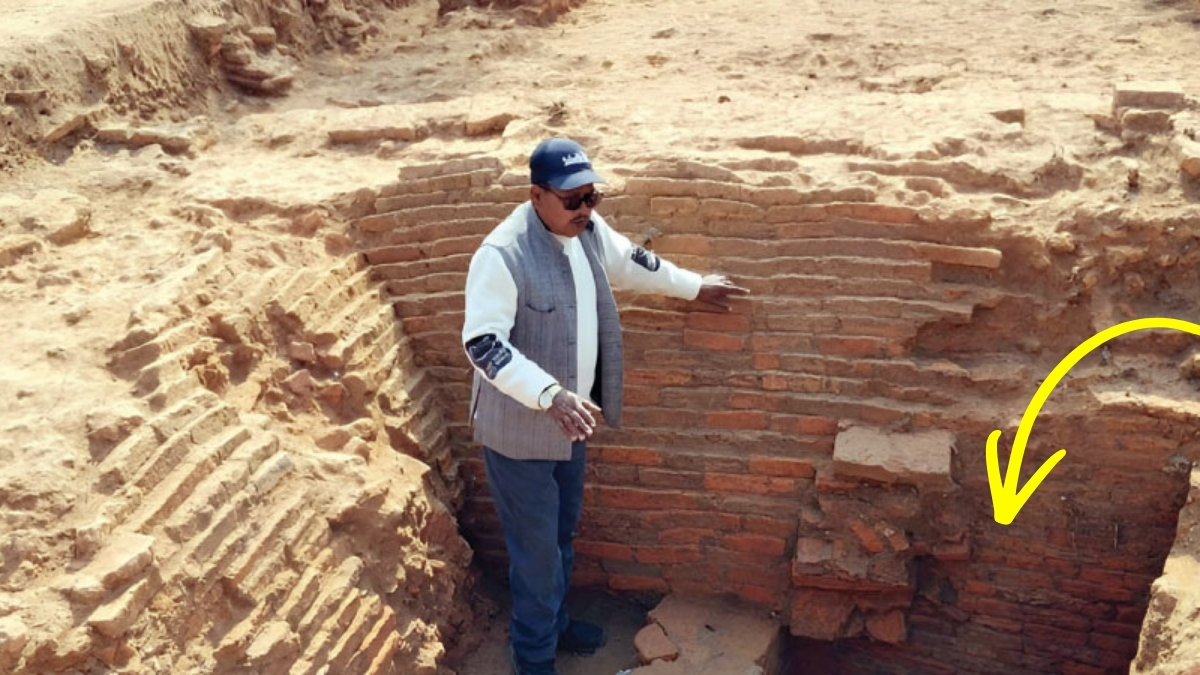
The Grand Palace Complex Led by archaeologist Bhaskar Gyawali, the team has uncovered the remains of a square palace covering approximately five katthas. Within this complex, they have identified well-defined walls, a network of organized rooms, and intricate alleyways. This layout speaks to a high degree of administrative planning and social hierarchy.
A Hydraulic Marvel The most electrifying finds relate to water management, a key indicator of advanced civilization. Archaeologists have revealed:
- A natural water spring located inside the palace walls, providing an independent, secure water source.
- An advanced water channeling system.
- Structures identified as modern-style bathing chambers, suggesting rituals of purity and luxury.This intricate hydraulic engineering paints a picture of a society that mastered its environment for both practical need and refined living.
Deep Dive: The Koliya Republic in the Time of Buddha
The historical context makes this discovery globally significant. The Koliya and their neighboring rivals, the Shakyas of Kapilavastu, were two of the most important republican states (gana-sanghas) in the eastern Gangetic plain during the first millennium BCE.
A Pre-Imperial World Order These republics were not monarchies. They were governed by assemblies of elite families, making them fascinating early experiments in collective governance. The discovery of this palace complex offers the first major architectural insight into the power and material culture of one of these states. It allows us to move from textual mentions to tangible reality.
The “Chakra System” City Plan Perhaps the most philosophically profound revelation is the geophysical survey data indicating the ancient city was developed based on a “chakra system.” This suggests the urban plan was consciously aligned with sacred geometric and cosmological principles, mirroring the spiritual worldview of the era. The estimated 100-bigha area, with inner and outer settlements, confirms this was a major, planned urban center.
The Archaeological Evidence: A Tapestry of Daily Life
The artifacts unearthed are the intimate fingerprints of the Koliyas’ daily existence and their connections to broader historical currents.
Dating to a Pivotal Era Preliminary carbon dating points to an origin around 600 BCE. This firmly places the site’s foundation in the pre-Buddhist period, a time of immense philosophical and social ferment across Northern India and Nepal.

Cultural Markers The recovery of Kushan-era bricks (1st-3rd centuries CE) shows the site remained important and was renovated centuries later, linking it to a vast pan-Asian empire. Distinctive earthenware and everyday household items complete the picture, allowing us to envision the lived experience within these walls.
Global Implications: A New Pilgrimage for History
The unearthing of Koliya Nagara does more than fill a historical gap; it reconfigures the sacred geography of Buddhism and early South Asian history.
Completing the Buddha’s Landscape For Buddhist pilgrims and scholars, the circuit of sacred sites has long included Lumbini (birthplace), Kapilavastu (childhood home), and Kushinagar (death). The confirmed capital of the Koliya republic—the kingdom of his mother—adds a crucial, deeply personal dimension to this map. It illuminates the political and familial world that surrounded the young Siddhartha Gautama.
A Catalyst for Cultural TourismLocal authorities, like Tourism Focal Person Tulsiram Lamichhane, are already planning to integrate Panditpur into the Lumbini-Ramgram tourist circuit. This discovery promises to transform the region into a holistic heritage destination, drawing not only pilgrims but also global historians and archaeologists eager to witness this newfound chapter of ancient urbanism.
What This Means for History: Stone and Story Converge
The Panditpur excavation is a powerful reminder that history is not only written in texts but is also etched into the earth, waiting to be read. The grand palace with its private spring confirms the power and prosperity hinted at in ancient chronicles.
It challenges us to rethink the pre-Buddhist era in the Himalayan foothills, revealing it as a period of remarkable urban sophistication and philosophical innovation. As Mayor Dhanpat Yadav stated, this discovery is a source of deep pride—a reconnection with a majestic past that physically anchors a people’s identity.
The excavation may be paused, but the revelation has just begun. Each uncovered stone at Panditpur is a syllable in the long-lost story of the Koliya, finally speaking again after 2,600 years of silence.
5 In-Depth FAQs
1. Who were the Koliya people, and why are they important?The Koliyas were a clan-based republican state (gana-sangha) in the eastern Gangetic plain, contemporaneous with the Shakya clan (the Buddha’s paternal clan). They are best known as the maternal lineage of Gautama Buddha; his mother, Queen Mayadevi, was a Koliya princess. Their capital was a major political and cultural center in the region during the 1st millennium BCE.
2. What is the “chakra system” of city planning mentioned?While details are still emerging, a “chakra system” in ancient Indian urban design typically refers to a radial or concentric circular plan, often symbolizing cosmic order, the wheel of law (dharma-chakra), or mandala geometry. Its mention suggests Panditpur was laid out according to sophisticated Vedic or early Hindu/Buddhist cosmological principles, aligning human habitation with cosmic patterns.
3. How does carbon dating work on a site like this, and how reliable is the 600 BCE date?Carbon dating measures the decay of radioactive Carbon-14 in organic materials like charcoal, seeds, or bone. Archaeologists would have sampled such materials from the earliest foundational layers of the palace. The “around 600 BCE” date is a preliminary result; final, more precise dating will come from multiple samples analyzed in specialized labs. It provides a robust scientific anchor for the site’s origins in the pre-Buddhist Iron Age.
4. What are the next steps for the Panditpur site?Immediate next steps involve: Consolidation and Protection of exposed structures to prevent damage. Detailed Publication of findings for peer review. Securing funding and planning for future excavation phases to uncover more of the palace and the wider city. Simultaneously, authorities are developing plans for controlled tourism infrastructure, such as walkways and a visitor center, to make the site accessible while preserving it.
5. How does this discovery connect to Lumbini and other Buddhist sites?This discovery creates a tangible historical corridor. Pilgrims can now trace a more complete journey: from Lumbini (the Buddha’s birth), to Koliya Nagara/Panditpur (his mother’s kingdom and a major political center of his time), to Kapilavastu (his father’s Shakya republic), and beyond to his places of enlightenment and passing. It enriches the pilgrimage from a purely spiritual journey into a deeply historical and cultural one.