Time is relentless. It wears away mountains, silts up harbors, and erases the marks we leave behind. But sometimes, for a brief, precious moment, time steps back. It reveals a fragment of the past, exposed and fragile, before swallowing it again forever.
That is exactly what happened on a storm-battered beach in eastern Scotland. And only the sharp eyes of local dog walkers and the desperate race of archaeologists preserved a 2,000-year-old moment that would otherwise have been lost to the waves.
This is the story of the Angus Beach footprints—and the storm that nearly stole them.
Table of Contents
The Astonishing Find: A Surface from the Past
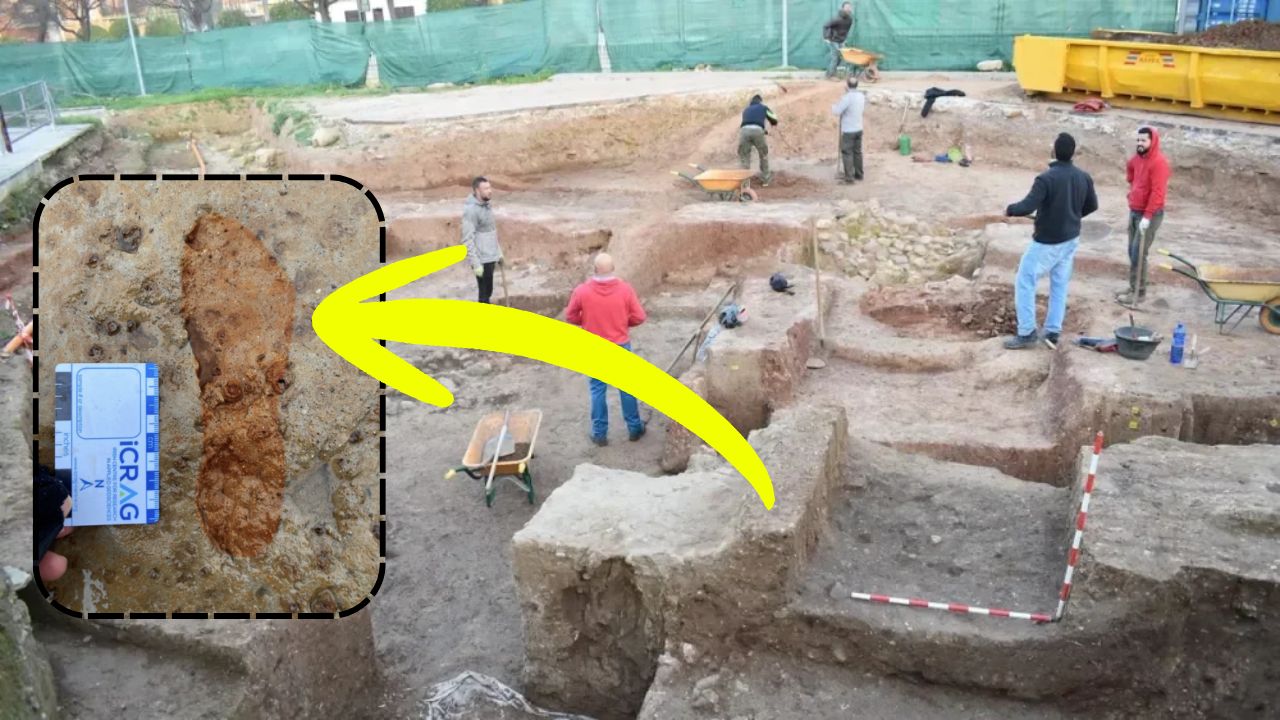
The discovery began with erosion. Powerful storms battered the coast of eastern Scotland, eating away at the sands of Angus Beach. When the tides receded, they left behind something extraordinary.
An ancient clay surface lay exposed.
And on that surface were marks that stopped people in their tracks: footprints. Human footprints. Animal footprints. Preserved in the clay for two millennia, now revealed under grey Scottish skies.
Local dog walkers spotted the markings. They did exactly what needed to be done. They alerted Bruce Mann, the council archaeologist. Mann recognized the significance immediately. He called in a team from the University of Aberdeen.
Kate Britton, the team leader, described the urgency:
“We knew we were dealing with a really rare site and that this discovery offered a unique snapshot in time—but it was also clear that the sea would soon take back what had so recently been revealed.”

The clock was ticking.
What the Footprints Reveal: A Moment Frozen in Mud
The team raced against the elements. They mapped the site. They took physical casts of the prints. They captured 3D models using advanced scanning technology. Every second counted.
The prints told a story.
Barefoot humans walked here. Animals moved alongside them. The clay had been soft enough to capture every detail—toes, heels, the subtle pressures of living beings going about their day. Then the surface dried or was covered, sealing the moment for 2,000 years.
Who were these people? What were they doing? The footprints alone cannot say. But they offer something almost more intimate: direct evidence of presence. A man or woman walked here. A child may have run alongside. Animals grazed or were herded nearby.
This was not a battlefield or a royal tomb. It was a day in the life of Iron Age Scotland.
Dating the Moment: Plant Remains and Radiocarbon
To understand when this moment occurred, the team needed more than footprints. They needed datable material.
Beneath the layer of clay that held the prints, they found plant remains. These were carefully collected and sent for radiocarbon dating. The results confirmed the age: approximately 2,000 years old.
That places the footprints in the Iron Age, a period of significant change in Scotland. Iron tools were replacing bronze. Communities were building hillforts and brochs. The Romans were pressing northward, though they never conquered Caledonia.
The people who left these prints lived in that world. They knew nothing of the empire to the south. They knew their land, their animals, their coastline. And they walked here, leaving marks that would outlast them by two millennia.
The Race Against Destruction: 50-Mile-per-Hour Winds
The archaeologists worked under impossible conditions. The same storms that had revealed the site were now trying to destroy it.
Britton described the challenge:
“The sea would soon take back what had so recently been revealed.”
Tides washed in and out. Winds reached 50 miles per hour. The fragile clay surface crumbled. Each wave erased more of the prints. Each gust dried and cracked the ancient ground.
The team did not stop. They documented everything they could, as fast as they could. When the site finally vanished beneath the returning sand and sea, they had preserved it. The footprints were gone, but the data remained.
Global Implications: Community as First Responders
This discovery carries a powerful lesson. It was not an archaeologist who found the prints. It was not a university research project. It was local dog walkers who spotted something unusual and reported it.
Elinor Graham of the University of Aberdeen emphasized this point:
“With sea levels rising and coastal erosion accelerating around Scotland it’s more important than ever that local community members keep an eye on their local coasts and report potential new discoveries.”

Scotland’s coastline is eroding rapidly. Climate change accelerates the process. Ancient sites that have been buried for millennia are being exposed—and destroyed—at an unprecedented rate.
The people who walk these beaches every day are the first line of defense. Their eyes can spot what professionals might miss. Their reports can trigger the kind of rapid response that saved the Angus footprints.
This is citizen science in action. And it is saving history.
What This Means for History: Every Print Tells a Story
The Angus Beach footprints are now preserved digitally and in casts. They will be studied for years to come. But their true significance goes beyond the data they contain.
They are a reminder that history is not just in books and museums. It is in the ground beneath our feet. It is in the cliffs and beaches we walk every day. It is fragile, fleeting, and irreplaceable.
Two thousand years ago, someone walked here. Their feet pressed into wet clay. The sun dried it. Sediment covered it. Storms revealed it. And for a few precious days, before the sea reclaimed it, we saw their prints.
We saw them because dog walkers paid attention. Because archaeologists raced against the tide. Because technology captured what nature would soon erase.
The footprints are gone now. But their story remains.
And it is a story that belongs to everyone.
In-Depth FAQs: Your Questions Answered
1. How did footprints survive for 2,000 years on a beach?The footprints were made in wet clay that then dried or was quickly covered by sediment. This sealed the surface, protecting it from erosion and disturbance. Over millennia, additional layers built up on top, preserving the prints until recent storms stripped away the overburden and re-exposed the ancient ground surface.
2. How do we know the footprints are 2,000 years old?Archaeologists collected plant remains from directly beneath the footprint layer. These were analyzed using radiocarbon dating, which measures the decay of radioactive carbon in organic material. The results placed the plant remains, and therefore the overlying footprints, at approximately 2,000 years before present.
3. Who were the people who made the prints?The footprints themselves do not reveal identity, but the dating places them in the Iron Age in Scotland. This was a period when the local population lived in farming communities, built hillforts, and had limited contact with the Roman Empire to the south. They were likely part of the ancestral Celtic cultures of the region.
4. Why was it so urgent to document the site quickly?The site was exposed by storm erosion and remained vulnerable to tidal action and wind. The same forces that revealed it would soon destroy it. The team had a narrow window—measured in days—to record as much information as possible before the fragile clay surface was completely eroded.
5. What can we learn from footprints that we cannot learn from other artifacts?Footprints offer a direct, intimate connection to individual humans and animals. They show us movement, gait, group composition, and behavior. Unlike tools or pottery, which may be traded or moved, footprints are in situ—they record exactly where and how living beings passed through a landscape. They are moments frozen in time.