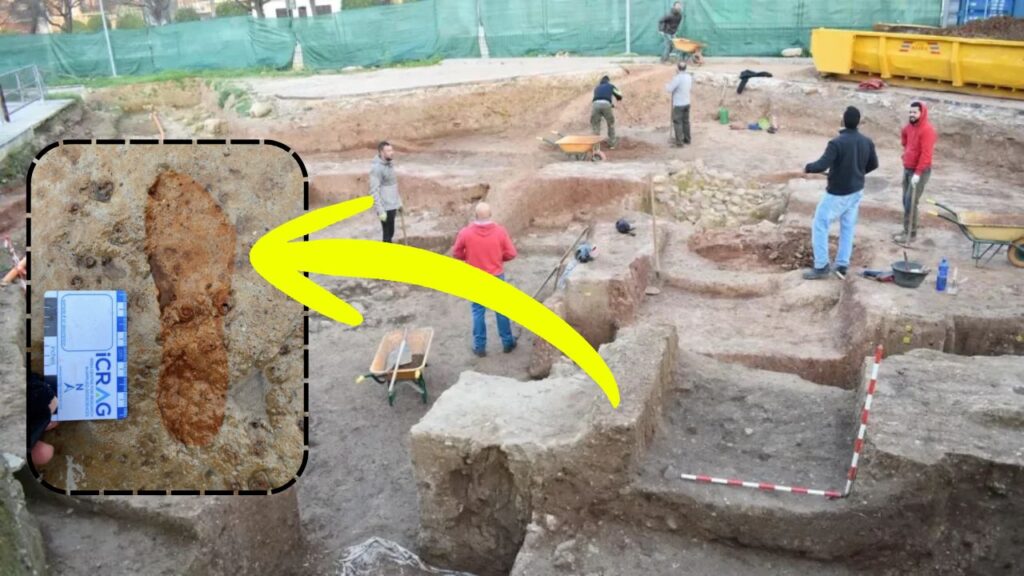
Archaeologists have uncovered groundbreaking evidence that early humans were crafting wooden tools far earlier than scientists once believed. New research reveals that humans were shaping and using wooden tools around 430,000 years ago, pushing back the timeline of advanced toolmaking by nearly 40,000 years. The discovery, made in Greece, includes the oldest known hand-held wooden tools ever found.
The findings are being hailed as a major breakthrough in understanding early human behavior, intelligence, and technological skill during the Middle Pleistocene era.
Table of Contents
Ancient Wooden Tools Unearthed in Greece

The discovery comes from the Marathousa 1 archaeological site in Greece’s central Peloponnese, a location long known for its exceptional preservation conditions. Researchers uncovered two carefully worked wooden artifacts—one made from alder wood and another from either willow or poplar—both dating back approximately 430,000 years.
These tools were identified and analyzed by an international research team from the University of Tübingen and the University of Reading, with the study published in the prestigious journal PNAS.

Microscopic Proof of Human Craftsmanship
Unlike stone tools, wooden objects rarely survive for hundreds of thousands of years due to natural decay. According to Annemieke Milks, an expert in early wooden technologies at the University of Reading, the survival of these tools is extraordinary.
Using microscopic analysis, researchers examined the surface of the wooden remains and identified clear marks from chopping and carving. These marks provide unmistakable evidence that early humans deliberately shaped the wood rather than using it in a natural or accidental form.
The analysis confirmed that two of the wooden pieces were intentionally modified by humans, while a third piece initially examined was later determined to have been marked by animal claws rather than human hands.
A Window Into Middle Pleistocene Life
Marathousa 1 was once located along the shore of a prehistoric lake and appears to have been a crucial hub for human activity during the Middle Pleistocene period, which lasted from around 774,000 to 129,000 years ago. Alongside the wooden tools, archaeologists discovered stone tools, bone artifacts, and the remains of an elephant and other animals.
These findings suggest that the site served as a butchering and processing area where early humans exploited both animal and plant resources. The presence of large animal remains alongside tools highlights a sophisticated understanding of survival strategies.
Expanding the Known Limits of Early Technology
One of the alderwood tools showed signs of heavy use, suggesting it played an important role in daily activities. Researchers believe it may have been used for digging near the lakeshore, extracting roots, or stripping bark from trees. The second tool, a much smaller piece of willow or poplar, appears to have been shaped for fine tasks and may have been used in the production or maintenance of stone tools.
This smaller artifact is especially significant, as it represents a uniquely compact, likely finger-held wooden tool—something rarely seen in the archaeological record from this period. Together, the tools demonstrate that early humans were not only using large, simple implements but were also capable of producing specialized wooden tools for different purposes.
Competition With Carnivores and Complex Behavior
According to paleoanthropologist Katerina Harvati, who leads the long-term research program at the site, the Middle Pleistocene was a critical phase in human evolution. It was during this time that more complex behaviors and advanced technological practices began to emerge.

The site also shows evidence of intense competition between humans and large carnivores. Marks left by predators were found near the butchered elephant remains, indicating that humans and carnivores were vying for the same food resources—a powerful insight into survival pressures faced by early humans.
Why This Discovery Changes Everything
Previous discoveries of ancient wooden objects—such as a 476,000-year-old wooden structure found at Kalambo Falls in Zambia—were not tools but structural elements. While wooden weapons and digging sticks have been found in places like the UK, Germany, China, and Zambia, all of those examples are significantly younger than the Marathousa 1 tools.
This makes the Greek discovery the earliest confirmed evidence of deliberate wooden toolmaking in human history and the first of its kind from southeastern Europe.
As researchers continue excavations, the Marathousa 1 site is expected to yield even more insights into how early humans adapted, innovated, and survived in challenging environments—reshaping what we know about the origins of human technology.