Imagine the scene. A misty battlefield in ancient Britain. Roman legionaries, disciplined and armed with the finest weaponry in the world, stand in formation. Then they hear it. A sound unlike anything they’ve encountered. A harsh, resonant, terrifying blast that cuts through the air like a physical force. It is the sound of the carnyx, the war trumpet of the Celtic tribes. And it means death is coming.
For centuries, we have known of this instrument only through Roman accounts and faded carvings on ancient metalwork. But now, the carnyx itself has spoken. Archaeologists in Norfolk, England, have uncovered a hoard of Iron Age military objects that includes one of the most complete carnyces ever found in Europe. It is a discovery that reshapes our understanding of ancient warfare, Celtic culture, and the terrifying sounds that once echoed across battlefields.
This is the sound of resistance. And it has been silent for 2,000 years.
Table of Contents
The Astonishing Find: A Hoard Fit for a Warrior Queen
The discovery occurred during a routine archaeological excavation in West Norfolk, a region once inhabited by the Iceni tribe. The team from Pre-Construct Archaeology was working on a site earmarked for residential development when they found something extraordinary .
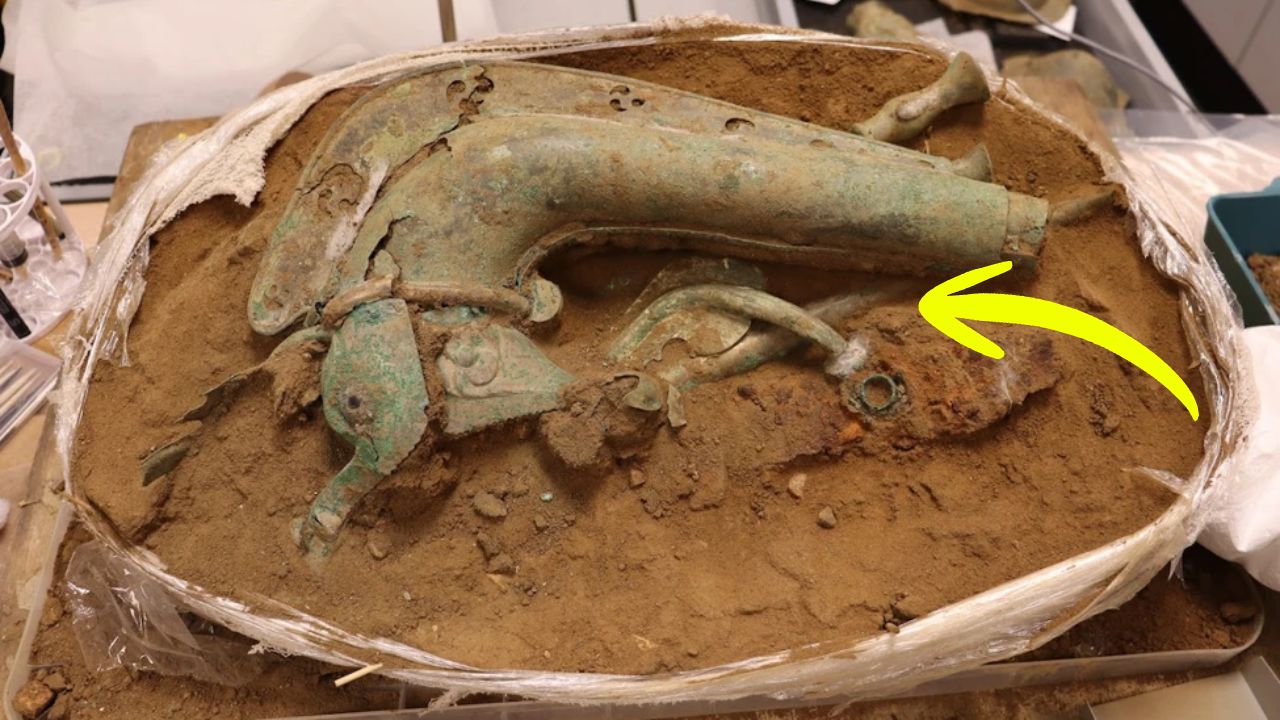
Buried in the soil was a cache of Iron Age metal objects. At its heart lay the near-complete bronze war trumpet, or carnyx. Alongside it were pieces of what could be a second carnyx, five shield bosses, an unknown iron object, and a sheet of bronze featuring the image of a boar’s head that was once part of a military standard—the first of its kind ever found in Britain .
Mark Hinman, chief executive of Pre-Construct Archaeology, was unequivocal: “This is a once-in-a-lifetime, once-in-a-career find. I’ve been doing archaeology for over 40 years and I’ve never seen anything like this” .
The team carefully lifted the entire block of soil containing the hoard to preserve its context. Using non-invasive X-ray and CT scanning, they peered inside before beginning the painstaking conservation process . The items are extremely fragile, made from thin sheets of bronze that have become brittle over two millennia . But what they revealed is rewriting history.
The Carnyx: A Weapon of Psychological Warfare
The carnyx was not merely an instrument. It was a weapon of psychological warfare. Standing up to two meters (6.5 feet) tall, these S-shaped bronze horns were held vertically so the sound would project over the heads of warriors . The bell at the top was fashioned into the shape of an open-mouthed animal—most often a boar, but sometimes a serpent or wolf .
When the warrior blew into the mouthpiece, the sound that emerged was described by ancient writers as harsh and suitable for the tumult of war. The Greek historian Diodorus Siculus wrote in the first century BC: “Their trumpets are of a peculiar barbarian kind; they blow into them and produce a harsh sound which suits the tumult of war” .
The Romans were both terrified and fascinated. They frequently depicted carnyces on their victory monuments as trophies of war, symbols of the wild peoples they had conquered . But the carnyx also haunted them. It was the sound of the “other,” of the untamed barbarian who refused to submit to civilization.
John Kenny, a music archaeologist at London’s Guildhall School of Music and Drama, has studied and played reconstructed carnyces. He describes the instrument’s power: “Immensely powerful when played at full volume, it is also possible to play whisperingly quietly, and to combine it with delicate instruments like flute, harp, string quartet and the human voice” .
The newly discovered carnyx is exceptional. Conservator Jonathan Carr noted that it is “the most complete carnyx ever found, with the pipe, mouthpiece and bell all uniquely intact” . Even the ears, often broken off in other finds, remain in place. Gary Trimble, senior project officer, marveled: “It’s got these great big flappy ears which are wonderful, and they’re still in place” .
The Boar Standard: A Symbol of Fierce Power
Alongside the carnyx, the hoard contained a sheet-bronze boar’s head that once adorned a military standard . This is the first object of its kind ever discovered in Britain .
The boar was a powerful symbol for Celtic peoples. Fierce, dangerous, and unpredictable, it represented the ideal warrior. Dr. Fraser Hunter, Iron Age and Roman curator at National Museums Scotland, explained: “They were very fierce animals to face in the hunt, so the symbolism of the boar is a lot about the strength of it—a very appropriate adversary in battle” .
The standard would have been held aloft like a modern flag, serving as a rallying point for troops and a visible manifestation of the tribe’s identity and power . To find both a carnyx and a boar standard together is extraordinary. Trimble stated simply: “Carnyxes are extraordinarily rare… a boar standard, that’s even rarer” .
The Iceni and Boudica: A Haunting Connection
The location of the find adds another layer of significance. West Norfolk was the heartland of the Iceni tribe, the Celtic people who, under their queen Boudica, rose in bloody rebellion against Roman rule in AD 60-61 .
The hoard has been dated to approximately 50 BC to AD 50, placing it squarely in the period leading up to and including the rebellion . While it cannot be proven that these specific objects were used by Boudica’s warriors, the connection is tantalizing.
Mark Hinman told The Guardian: “We are absolutely within the heartland of the Iceni—whether it was they who buried the hoard or not, we just don’t know. [But] almost certainly the items were buried in the first century AD, and that brings us closer to the Iceni and to Boudicca. They are of such quality that … any important people from the Iceni and other groups would have known these objects” .
One can imagine these very instruments sounding across the battlefield as Boudica’s forces clashed with the Roman legions. The carnyx would have blared its defiance. The boar standard would have marked the position of the war leader. The shield bosses would have turned aside Roman blades.
The rebellion ultimately failed. Boudica was defeated, and she died shortly after—by poison, according to tradition, to avoid capture. But the objects used by her people were buried, perhaps as a ritual offering or to hide them from the victorious Romans. They remained in the earth for nearly two millennia, waiting to tell their story.
Global Implications: Reshaping Our View of the Iron Age
The Norfolk Carnyx Hoard, as it is being called, is internationally significant . It is only the third carnyx ever found in Britain and one of the most complete in Europe . The boar standard is unique .
Dr. Fraser Hunter, a leading authority on carnyces, stated: “I’ve looked at carnyces from around Europe, and the full research and conservation of these incredibly fragile remains will reshape our view of sound and music in the Iron Age” .
The hoard also reveals the connections between Britain and the wider European Iron Age world. Hunter noted: “The carnyces and the boar-headed standard are styles well known on the continent and remind us that communities in Britain were well-connected to a wider European world at this time” .
Dr. Tim Pestell, Senior Curator of Archaeology for Norfolk Museums Service, emphasized the find’s power to capture the public imagination: “This find is a powerful reminder of Norfolk’s Iron Age past which, through the story of Boudica and the Iceni people, still retains its capacity to fascinate the British public” .
What This Means for History: The Sound Returns
The conservation and research process is just beginning. The objects are extremely fragile and require extensive stabilization before detailed study can occur . Their long-term home has yet to be determined, and a coroner’s inquest will decide their legal status under the Treasure Act .
But one thing is already clear. The sound of the carnyx, silenced for 2,000 years, will be heard again. Through reconstruction and study, we will come closer to understanding what the Romans heard and what the Celts felt when that harsh, resonant blast cut through the air.
Mark Hinman, reflecting on the find, captured its almost mystical quality: “It’s hard to describe, but you kind of feel like it’s looking back at you. It’s quite a thing” .
The Norfolk Carnyx Hoard is more than an archaeological discovery. It is a bridge across millennia, connecting us to the people who fought, died, and buried their most precious objects in the soil of their homeland. Their weapons are now in our hands. Their sound is returning.

And history will never be the same.
In-Depth FAQs: Your Questions Answered
1. What is a carnyx?A carnyx is an ancient Iron Age war trumpet used by Celtic tribes across Europe . It was a vertical, S-shaped bronze wind instrument, typically around two meters (6.5 feet) tall, with a bell shaped like an open-mouthed animal, such as a boar . It was used to inspire warriors and intimidate enemies on the battlefield .
2. How rare is this discovery?This find is extraordinarily rare. The carnyx from Norfolk is only the third known in Britain and is one of the most complete ever found in Europe. The boar’s head standard found alongside it is the first of its kind ever discovered in Britain.
3. What else was found in the hoard?The hoard includes the near-complete carnyx, parts of a second carnyx, five shield bosses (the metal domes at the center of shields), a sheet-bronze boar’s head from a military standard, and an iron object of unknown origin .
4. What is the connection to Boudica and the Iceni?The hoard was discovered in West Norfolk, the heartland of the Iceni tribe, which was led by Queen Boudica during her rebellion against the Romans in AD 60-61 . The artifacts date to the first century AD, placing them in the same period and location as the Iceni, making a connection possible, though not definitive .
5. What happens to the artifacts now?The objects are currently undergoing specialist conservation at the Norfolk Museums Service to stabilize them . A coroner’s inquest will determine their legal status under the Treasure Act of 1996. Their long-term home has not yet been decided. The discovery was featured on the BBC program Digging for Britain.