In the rolling hills of northern Greece, a lost school has finally spoken. For centuries, historians knew the stories: Aristotle, the greatest philosopher of the ancient world, summoned to tutor a young prince who would become Alexander the Great. The place was Mieza, a quiet Macedonian city. The time was 343 to 340 BCE. The lessons shaped history.
But where exactly did this happen? What did the school look like? How did the future conqueror spend his days?
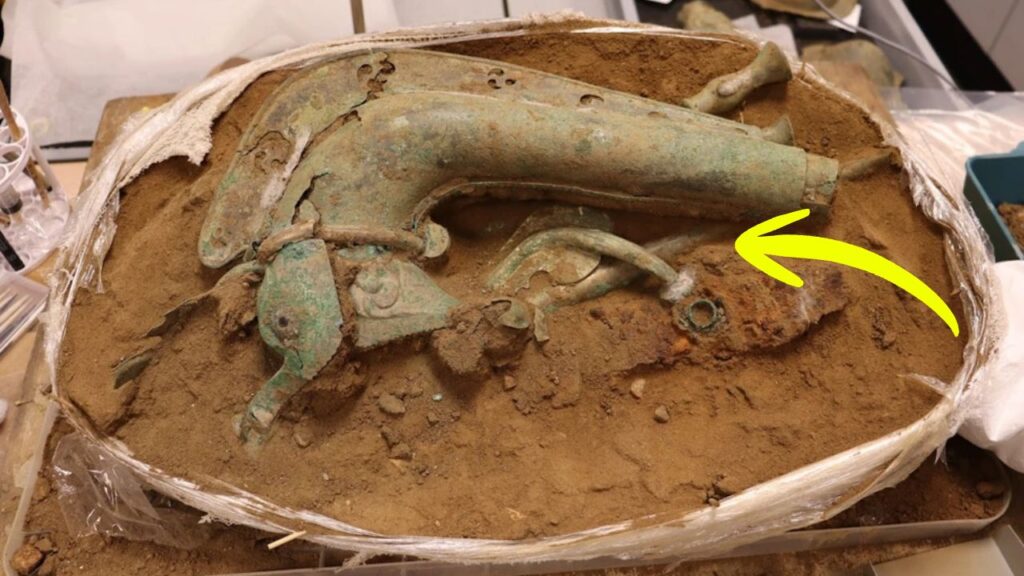
Archaeologists now have answers. Renewed excavations at Mieza have uncovered the monumental gymnasium where Aristotle taught. The discoveries include a sprawling complex of rock-cut terraces, a 650-foot-long portico, prized Athenian olive oil jars, and something almost miraculous: four writing styluses that may have once been held by Aristotle’s students themselves.
This is the school of legends. And it is real.
Table of Contents
The Astonishing Find: A Gymnasium Fit for a Prince
Mieza lies in northern Greece, in the region of ancient Macedonia. It was here that King Philip II sent his son Alexander to study under Aristotle. The choice was deliberate. Philip wanted the best education for his heir. Aristotle, fresh from his own studies with Plato in Athens, was the best.
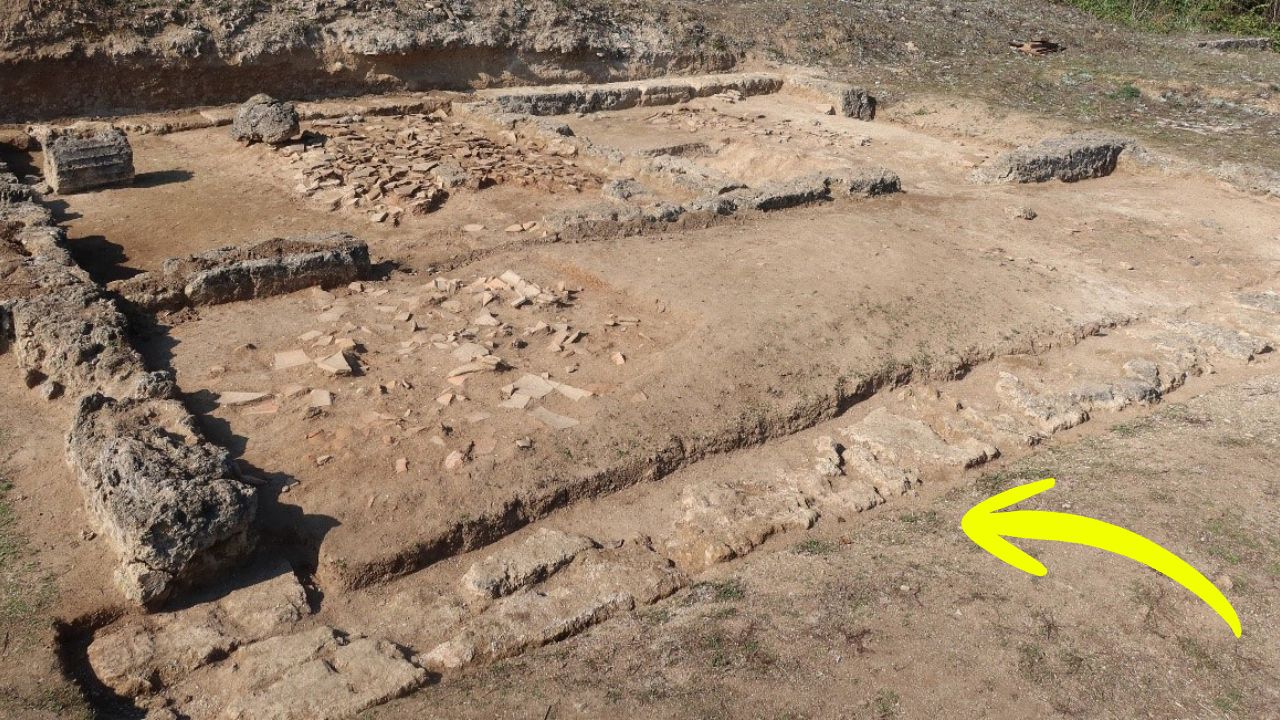
The recent excavations, reported by Greek City Times, focused on the site’s gymnasium. In the Greek world, gymnasiums were not just for physical exercise. They were centers of intellectual life. Young men trained their bodies and their minds in these spaces.
What the archaeologists found is breathtaking.
The gymnasium at Mieza was built on an enormous scale. It covers 14 acres and is carved into three rock-cut terraces. This was not a simple building. It was a monumental complex, designed to impress and to educate.
New dating confirms that construction occurred around the middle of the fourth century BCE—precisely the period when Aristotle taught there. The timeline fits perfectly.
The Xystos: A 650-Foot Walkway for Warriors
The centerpiece of the complex is the xystos, a covered portico used for exercise. It stretches an astonishing 650 feet in length and rises to two stories. Columns in the Doric order line its facade.
Imagine young Alexander running here. Imagine him wrestling, practicing spear throws, building the body that would carry him across Asia. The xystos was where physical training happened, rain or shine. Its scale reflects the ambitions of Philip II, who was building not just an army but a dynasty.
The portico was more than a gym. It was a statement. Macedonia was no longer a backwater. It was a power, and its youth would be trained accordingly.
The Olive Oil Jars: Athenian Luxury in Macedonia
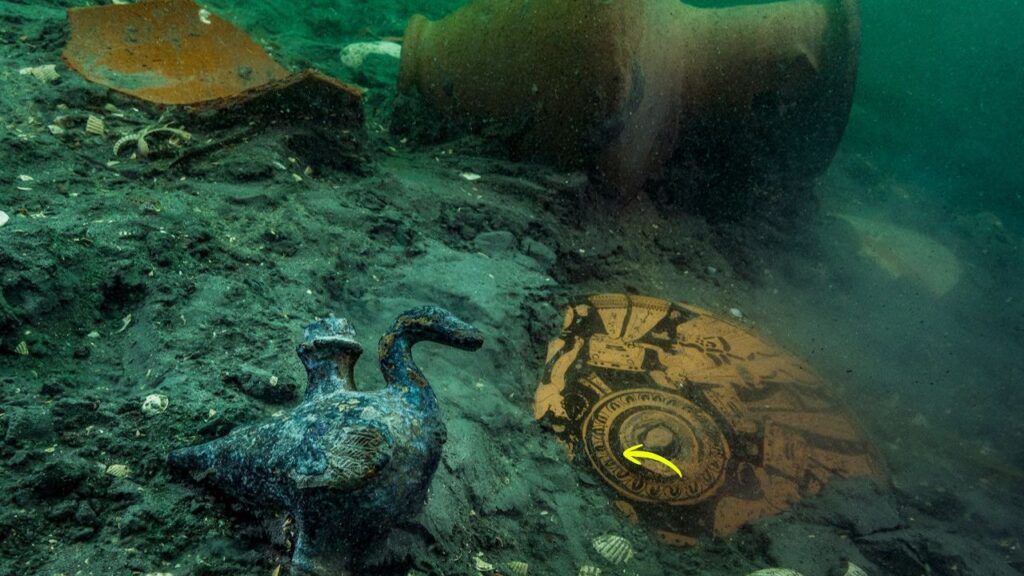
Surrounding the central courtyard, or palaestra, archaeologists found rooms filled with broken jars. These were not ordinary containers. They were Panathenaic amphoras—prized vessels awarded to victors in the Panathenaic Games of Athens.
What were they doing in a Macedonian gymnasium?
Greek athletes customarily covered themselves in olive oil before exercise. The oil was then scraped off, taking dirt and sweat with it. High-quality oil was essential. And the finest oil came from Athens, packaged in these distinctive amphoras.
Their presence at Mieza speaks volumes. Macedonian youths were not rough country boys. They were connoisseurs. They imported the best, even for something as basic as exercise oil. Philip II was building an elite, and no expense was spared.
The Styluses: Tools of Learning
The most electrifying discovery came in the form of four small objects. They are styluses—writing implements used by ancient Greeks to inscribe wax tablets. Students would scratch letters onto the wax, erase them, and write again.
These styluses were found in the gymnasium. They date to the right period. And they may have been used by the most famous students in history.
Imagine Alexander himself, scratching out Greek letters under Aristotle’s watchful eye. Imagine his companions—the friends who would become his generals, the men who would conquer the known world—learning philosophy, ethics, and science in this very room.
The styluses are small. They are unassuming. But they are direct evidence of education happening here. They connect us, across 2,400 years, to the moment when a philosopher shaped a conqueror.
What Aristotle Taught: The Lessons That Changed the World
What did Aristotle teach the young Alexander? The sources are fragmentary, but they suggest a broad curriculum. Philosophy, of course. Ethics and politics. But also medicine, biology, geography, and literature. Aristotle gave Alexander a copy of Homer’s Iliad, annotated with his own notes. Alexander carried it throughout his campaigns.
The philosopher instilled in the prince a love of Greek culture, a respect for knowledge, and perhaps a vision of a united world. Alexander’s later actions—founding cities, encouraging cultural exchange, seeking the edges of the earth—reflect Aristotelian influence.
The gymnasium at Mieza was where that influence took root.
Global Implications: Connecting Philosophy to Power
This discovery matters far beyond Greece. It illuminates the relationship between ideas and action, between education and empire.

Alexander conquered the known world. But he did so with a mind shaped by Aristotle. The philosophy he learned at Mieza informed his policies, his treatment of conquered peoples, his vision of a cosmopolitan empire. Without Aristotle, Alexander might still have conquered. But he would not have been the same conqueror.
The gymnasium also reveals the ambitions of Philip II. He was not just building a military machine. He was building a civilization. He brought the greatest thinker of the age to teach his son. He built facilities that rivaled those of Athens. He wanted Macedonia to be not just powerful but cultured.
Mieza was the crucible where these ambitions were forged.
What This Means for History: The School Lives Again
The excavations at Mieza are ongoing. The gymnasium is being conserved. The styluses are being studied. More discoveries surely await.
But already, the picture is clear. We now have a physical place where one of history’s greatest teachers taught one of history’s greatest students. We can walk the terraces where Alexander trained. We can see the jars that held his olive oil. We can touch the styluses he may have held.
History is often abstract. Dates, names, events. But sometimes, it becomes tangible. Sometimes, we can reach across millennia and almost feel the presence of those who came before.
Mieza is such a place. Aristotle taught here. Alexander learned here. And now, we can stand where they stood.
The school of legends is open again.
In-Depth FAQs: Your Questions Answered
1. How do we know Aristotle actually taught at this specific gymnasium?Ancient historians, including Plutarch, explicitly state that Aristotle tutored Alexander at Mieza. The new excavations have confirmed that the gymnasium was built around 343–340 BCE, exactly the period of the tutelage. The monumental scale, the presence of luxury goods like Panathenaic amphoras, and the discovery of writing styluses all align with the historical accounts of an elite educational facility.
2. What was the xystos, and why was it 650 feet long?The xystos was a covered portico or walkway used for athletic training in bad weather. Its extraordinary length—650 feet—reflects the importance placed on physical education in Greek culture. Young men trained here in wrestling, running, and other sports. At Mieza, the scale also reflects the ambitions of Philip II, who was building a facility worthy of a future king and his companions.
3. What are Panathenaic amphoras, and why are they significant?Panathenaic amphoras were prize jars filled with olive oil, awarded to victors in the Panathenaic Games of Athens. They featured distinctive black-figure decoration and were highly prized throughout the Greek world. Their presence at Mieza indicates that Macedonian youths used high-quality imported Athenian oil for their athletic training, revealing their elite status and luxurious tastes.
4. Could the styluses really have been used by Alexander?It is impossible to prove that Alexander personally used these specific styluses. However, they were found in the gymnasium, date to the correct period, and are the type of implement used by students for writing on wax tablets. Given that Alexander and his companions were the students at this facility, it is highly plausible that they or their classmates used these very tools.
5. What happened to the gymnasium after Alexander left?The gymnasium likely continued in use after Alexander’s departure. Greek gymnasiums were enduring institutions in Hellenistic cities. However, the site was eventually abandoned and buried over time. The current excavations are revealing multiple phases of use, and further study will clarify the building’s later history before its final abandonment.