
Voyager Spacecraft Nears Historic Milestone : NASA’s Voyager 1 probe, humanity’s farthest-flung emissary, hurtles toward a groundbreaking achievement set for November 2026.
As it approaches a distance of one light-day from Earth—about 16.1 billion miles—scientists brace for the moment when signals will take a full day each way.
Table of Contents
The Dawn of a Grand Adventure
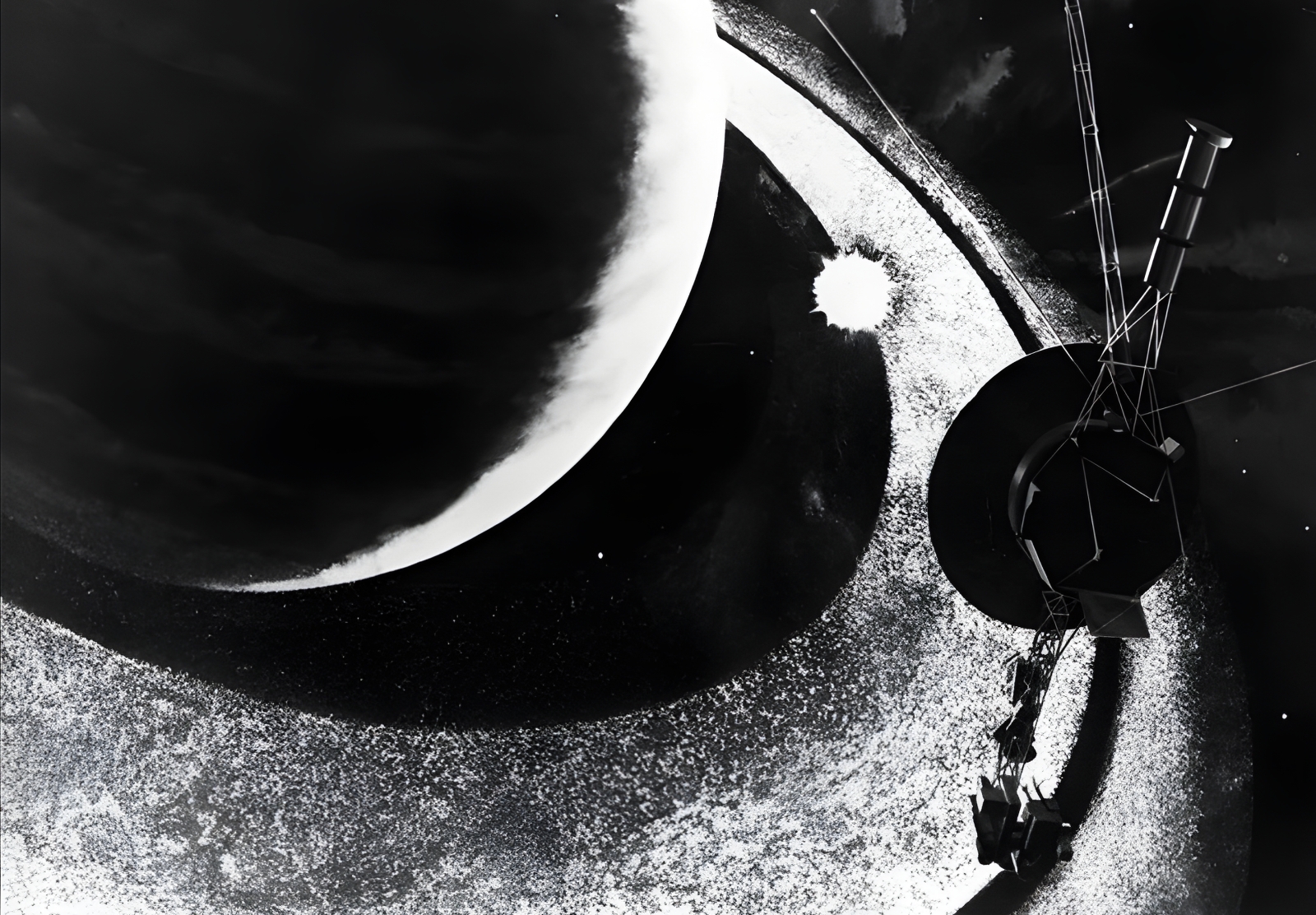
Back in the sweltering summer of 1977, engineers at NASA’s Jet Propulsion Laboratory watched with bated breath as Voyager 1 rocketed skyward on September 5 aboard a Titan IIIE-Centaur launch vehicle.
Launched just 16 days after its twin, Voyager 2, the probe was designed to snatch close-up views of Jupiter and Saturn during a rare planetary alignment that offered gravity-assist slingshots to the outer solar system.
What started as a two-planet flyby evolved into an epic interstellar odyssey. Voyager 1’s path veered northward out of the ecliptic plane after Saturn, dooming any Pluto visit but prioritizing a tantalizing peek at Titan, Saturn’s hazy moon.
Today, nearly 49 years later, it reigns as the most distant human-made object, clocking 171 AU—or 25.7 billion kilometers—from home as of early 2026.
Jaw-Dropping Encounters with Giants
Voyager 1’s first blockbuster came in March 1979, whipping past Jupiter at 349,000 kilometers from its roiling clouds.

The probe’s cameras unveiled Io’s explosive volcanoes—the first active ones spotted beyond Earth—while revealing Europa’s cracked ice shell hinting at subsurface oceans and Ganymede’s grooved terrain.
Saturn dazzled next in November 1980. Skimming 124,000 kilometers above the ringed world’s atmosphere, Voyager captured intricate ring structures like spokes and braids, plus Titan’s thick orange haze that veiled its surface in mystery. These flybys rewrote textbooks, spotting new moons and measuring ferocious 1,100 mph winds.
Voyager 2, meanwhile, shouldered the grand tour, zipping to Uranus in 1986 and Neptune in 1989—discoveries like Neptune’s Great Dark Spot that Voyager 1 could only dream of. Together, they’ve beamed back over 67,000 images, transforming fuzzy dots into vibrant worlds.
Breaking Free into the Void
The real drama unfolded post-planets. In 1990, Voyager 1 pivoted for its “Family Portrait,” snapping the iconic Pale Blue Dot—Earth as a fragile speck in cosmic rays. Cameras powered down to save juice, shifting focus to the heliosphere’s edge.
December 2004 marked the termination shock at 94 AU, where solar wind brakes to subsonic speeds. Then, on August 25, 2012, at 121 AU, it pierced the heliopause into interstellar space—the first craft to escape the sun’s bubble. Plasma waves confirmed the leap, with cosmic rays surging and solar particles vanishing.
Voyager 2 followed in 2018. Now both probes sample the very local interstellar medium (VLISM), detecting magnetic bubbles and unexpected density jumps that challenge models of our galactic neighborhood.

Battling Age in the Cosmic Wilderness
These 1970s relics run on decaying plutonium RTGs, churning out just 240 watts today—half launch power. Engineers play power whack-a-mole: cosmic ray detectors offline on Voyager 1 in February 2025, low-energy particles next in 2026.
Glitches test grit. In 2023-2024, a corrupted flight data subsystem memory chip spewed gibberish; JPL wizards relocated code in the 68KB brain, restoring science by June 2024.
Thruster swaps in 2024-2025 keep antennas Earthward despite clogs. Signals now lag 23.5 hours one-way, demanding poker-faced patience.
Yet data flows: magnetometers chart interstellar fields, plasma waves hum with electron densities. Voyager 1 cruises at 17 km/s toward Ophiuchus, outpacing rivals like Pioneer 10.
The Light-Day Leap Looms Large
By November 2026, Voyager 1 hits one light-day: 25.9 billion km, where light—and radio—takes 24 hours to traverse.
A Monday command won’t echo back till Wednesday, amplifying the mission’s one-way vibe.This isn’t just mileage; it’s a gauge of light-speed limits.
At 38,000 mph, it’d take humans 49 years to match. Voyager 2 trails at 12.6 billion miles, but both embody endurance, with contact possible till 2036.

Voices from the Team
Suzanne Dodd, Voyager project manager, marvels at the probes’ tenacity. “We’ve had anomalies getting harder, but younger engineers keep it going,” she said post-2024 fix.
Ed Stone, former chief scientist, called the heliopause crossing “a new region we hadn’t realized was there.” Their whispers from afar fuel dreams of future probes like interstellar Arks.
Legacy Carried on Golden Records
Each Voyager totes a gold-plated record: Earth’s sounds—from whale songs to Chuck Berry—plus 115 images and greetings in 55 languages.
Carl Sagan’s brainchild aims at ET, etched with pulsar maps and hydrogen atom art. Will aliens groove to “Johnny B. Goode” eons hence?As power fades, Voyagers become silent ambassadors, drifting for billions of years.
Voyager Spacecraft Nears Historic Milestone
Voyager 1’s light-day milestone cements its status as a testament to bold exploration, pushing boundaries where no human has—or soon will.
These plucky probes remind us: curiosity outlives hardware, whispering secrets from the stars long after silence falls. As President Trump’s administration eyes new space frontiers, Voyager’s saga inspires the next leap.
SCIENCE MARVELS – READ MORE : Scientists analyze deep volcano ‘pulse’ under tourist area, calming fears while confirming no eruption danger or travel impact currently
Frequently Asked Questions
Q: How far is Voyager 1 right now? A: As of February 2026, about 171 AU or 25.7 billion km—nearing the light-day mark.

Q: Will we lose contact soon? A: Not yet; RTGs support data till 2036, then eternal silence beyond DSN range.
Q: What’s the Golden Record for? A: A time capsule of Earth—music, images, greetings—for any extraterrestrials it encounters.
Q: Can we still fix Voyager issues? A: Yes, via Deep Space Network commands, though lags and limited memory challenge engineers.
Q: What’s next after Voyager? A: Concepts like interstellar probes with lasers or sails build on its interstellar data.


Latest Comments