
Astronomers Spot Long‑Lost Lunar : Astronomers have pinpointed what they believe is the long-lost site of Luna 9, the Soviet spacecraft that made history as the first to soft-land on the Moon back in 1966.
Using cutting-edge AI tools on NASA’s lunar images, researchers announced the breakthrough this week, reigniting excitement over a pivotal moment in space exploration.
Table of Contents
The Historic Luna 9 Mission
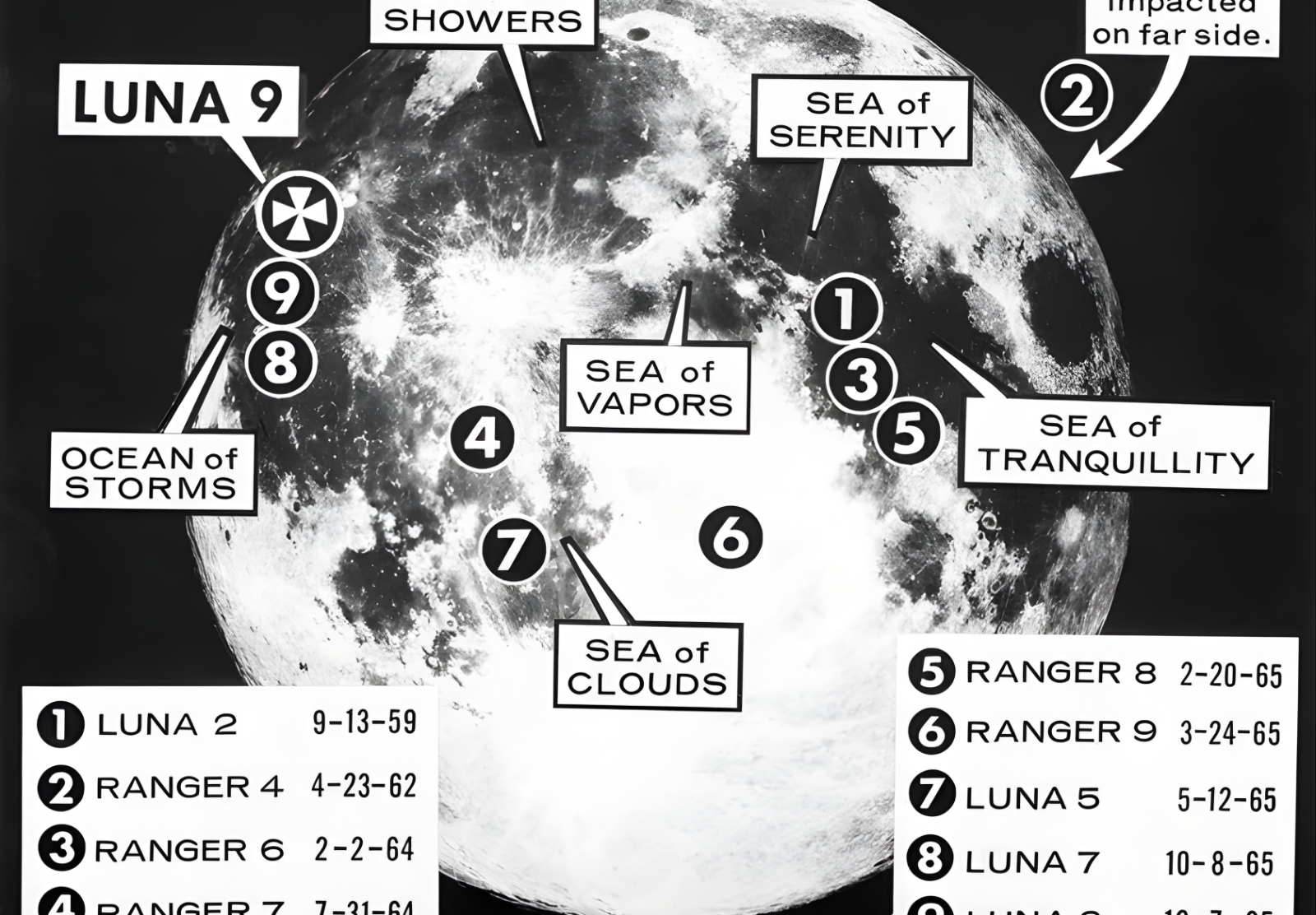
Luna 9 blasted off from Earth’s Baikonur Cosmodrome on January 31, 1966, aboard a Molniya rocket, kicking off a high-stakes race in the Cold War space showdown between the Soviet Union and the United States.
Ground teams nailed a critical mid-course correction on February 1, shifting the probe from a flyby to a direct lunar collision path just 233,000 kilometers from the Moon.
Three days after launch, on February 3 at 18:45 UT, the spherical lander capsule—about 1 meter wide and weighing 99 kilograms—detached at five meters altitude, rolled upright after touchdown, and unfurled four petals for stability in the Oceanus Procellarum region.
Groundbreaking Achievements on the Lunar Surface
Engineers designed Luna 9 with retro-rockets, an inflatable bag for cushioning the impact, and batteries backed by small solar panels to power its instruments.

Within hours of landing near 7.08°N, 64.37°E, it beamed back the world’s first close-up photos from the Moon’s surface, captured by a television camera that scanned panoramas revealing a firm, dusty terrain—not the feared quicksand pits some scientists had dreaded.
The probe transmitted data on radiation, temperature, and soil density for nearly three days until its batteries died, proving the lunar surface could bear heavy landers and paving the way for manned missions.
Decades of Mystery Surround the Landing Site
Soviet reports pinned the site loosely in Oceanus Procellarum, but fuzzy telemetry and no precise coordinates left it lost amid the Moon’s vast plains.
Over the years, NASA radars rediscovered other relics like India’s Chandrayaan-1 orbiter and Soviet Lunokhod rovers, but Luna 9’s small size—amid shifting shadows and regolith dust—kept it elusive despite LRO’s high-res scans since 2009.
Earlier manual hunts yielded zilch, turning the probe into a holy grail for “space archaeologists” chasing Cold War ghosts on the lunar floor.

AI-Powered Rediscovery in 2026
Enter the YOLO-ETA algorithm, a machine-learning whiz from University College London researchers Lewis Pinault and team, trained to spot spacecraft debris in LRO’s Narrow Angle Camera images at 0.25 meters per pixel.
Scanning a 5×5 km zone around the old coordinates, it flagged a cluster at 7.03°N, 64.33°E—about 5 km off—showing a bright pixel for the lander, dark smudges for the deflated airbag, and craters from discarded hardware impacts.
Confidence scores hit 60-77% across eight images under varying light, matching Luna 9’s flat-horizon panoramas and component scatter patterns.
Confirming the Clues with Science
The team cross-checked topography against the probe’s 1966 horizon shots, finding a strong fit, while nearby features aligned with the mission’s retrorocket block crash filmed by Pulkovo Observatory.
A rival group pegged a different spot, but both highlight LRO data’s power, with calls now for targeted re-imaging or radar pings to clinch it.
Published in npj Space Exploration, the paper urges orbiters to revisit under matched lighting, potentially ending the 60-year hunt.

Why This Matters Today
Spotting Luna 9 isn’t just nostalgia—it’s a win for preserving humanity’s off-world heritage amid rising lunar traffic from Artemis, China’s probes, and private landers.
It sharpens maps for safe future landings, avoiding crash debris, and demos AI’s role in sifting petabytes of space data for hidden gems.
As NASA gears up for crewed returns by late 2026, this find reminds us how fragile early triumphs were, etched forever in regolith.
Astronomers Spot Long‑Lost Lunar Technical Snapshot of Luna 9
FeatureDetailsMass99 kg (lander capsule) Dimensions1 m diameter sphere PowerBatteries + solar cells InstrumentsTV camera, radiation/temp sensors Landing TechRetro-rockets, airbag, 4 petals
SCIENCE MARVELS – READ MORE : Astronomers Spot Long‑Lost Lunar Object, Reviving Decades‑Old Space Mystery and Offering New Clues About Moon’s Forgotten History
FAQs
What was Luna 9’s biggest accomplishment? It achieved the first soft landing on the Moon and sent back the initial surface photos, debunking dust trap fears.
Why was the exact site unknown for 60 years? Imprecise Soviet tracking and the probe’s tiny footprint blended into lunar regolith under varying shadows.
How did astronomers find it now? YOLO-ETA AI scanned NASA’s LRO images, spotting a matching debris cluster with high confidence.
Is the discovery confirmed?It’s a strong candidate needing orbital re-imaging or radar for proof, but evidence aligns closely.
How does this impact modern space efforts? It aids heritage preservation, debris mapping, and AI tools for lunar navigation as returns ramp up.







Latest Comments